- Recently XRP dropped about 15% while Bitcoin fell only around 1%, highlighting increased volatility.
- Liquidation events and delays to spot XRP ETF approvals contributed to a larger monthly decline.
- Some analysts argue that if ETF-driven demand removes circulating supply, XRP could rebound to $5–$12.
XRP’s price has become a focal point of debate after the token fell roughly 15% over the past month while Bitcoin’s price remained nearly unchanged.
Market observers and analysts are asking why XRP experienced such a sharp pullback when the broader market looked relatively stable.
The answer, they say, lies in a mix of liquidation dynamics, regulatory delays, and growing institutional activity.
Stark contrast with Bitcoin
In October both Bitcoin and XRP surged—Bitcoin pushing above six figures while XRP climbed toward $3.
Profit-taking quickly followed, and many altcoins absorbed the bulk of the selling pressure.
Retail and leveraged positions in XRP were hit particularly hard: a single liquidation wiped out roughly $8.13 million in leveraged XRP positions within a four-hour window.
That sequence amplified losses and pushed XRP below a failed support level at $2.50 after the earlier spike.
Prominent market reporter Charles Gasparino emphasized the disparity: Bitcoin fell only about 1% over the month while XRP plunged about 15%.
Why is BTC down 1 percent over the past month but XRP is down 15 percent?
— Charles Gasparino (@CGasparino) October 24, 2025
This divergence highlights a structural reality: XRP has historically tracked Bitcoin’s moves but with greater intensity. When BTC stalls or consolidates, that sensitivity can become a significant headwind for XRP.
XRP price and the ETF supply shock
Beyond short-term mechanics, longer-term narratives are reshaping investor expectations.
Analyst Zach Rector has argued that the launch of multiple spot XRP ETFs and similar institutional vehicles could effectively remove a large portion of circulating supply from the market.
Rector calls this an “supply shock” that could set the stage for substantial repricing. His conservative models point to targets between $5 and double-digit levels—potentially as high as $12 by December 2025—if inflows materialize and tokens get locked within ETF structures.
🧵Final 2025 XRP Timeline 🧵
XRP November Pump Coming ✅
$5-$12 XRP by first part of December 🚨— Zach Rector (@ZachRector7) October 22, 2025
Regulatory context also matters. Bitcoin and Ethereum benefited from clearer pathways to spot ETF approvals, which attracted fresh capital into those markets.
XRP, by contrast, still faces unresolved approval prospects for spot ETFs in several jurisdictions. Those delays tend to weigh on demand from risk-averse institutional buyers and make the token more sensitive to retail flows and shifts in sentiment.
At the same time, on-exchange derivatives data points to growing institutional interest: XRP futures and micro XRP contracts listed on exchanges such as CME have recorded sizable volumes in recent months, signaling that professional trading desks are increasingly engaging with the token.
XRP price analysis
From a technical perspective, the $2.30 area acted as tangible support during the mid-month liquidations, and the bounce toward roughly $2.50 suggests buyers remain interested at those levels.
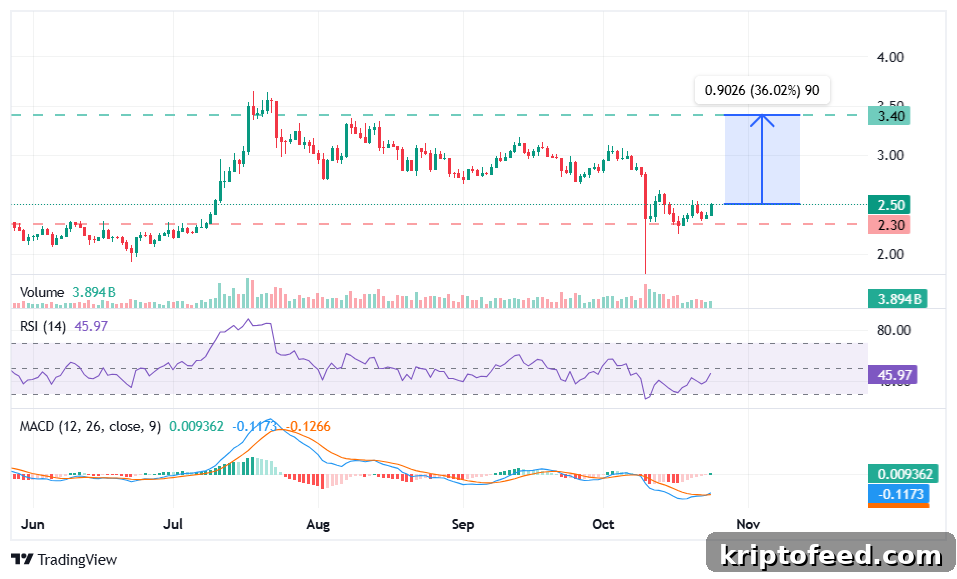
A sustained move above $3.40 would, according to many analysts, open the path toward $5.50, and if ETF-driven supply locks occur, significantly higher levels become plausible.
On-chain signals add nuance to the picture.
The XRP Ledger is approaching a milestone of nearly 100 million transfers recorded, indicating continued utility and adoption for payments and DeFi rails where XRP plays a role.
That on-chain activity can provide a durability argument even as price action remains volatile.
Weighing the road ahead requires balancing several forces: correlation-driven volatility, liquidation dynamics, regulatory clarity, and institutional adoption through derivatives and potential ETFs.
Short-term traders must manage heightened risk associated with larger XRP swings. Long-term investors should watch ETF developments and on-chain adoption closely, as those factors could act as primary levers for the next leg of momentum.