
- XRP is eyeing a breakout as regulatory clarity and bullish momentum converge near its 2021 cycle highs.
- Ripple’s stablecoin initiatives and expansion across the European Union pave the way for cross-border compliance and leadership in digital finance.
- The long-running lawsuit has concluded, removing years-long regulatory overhang and triggering renewed institutional interest.
XRP’s price action is approaching a potential major breakout. After lingering below the 2021 cycle highs for months, the token is showing renewed strength.
XRP is currently trading at $3.29, up 11.6% over the past 24 hours.
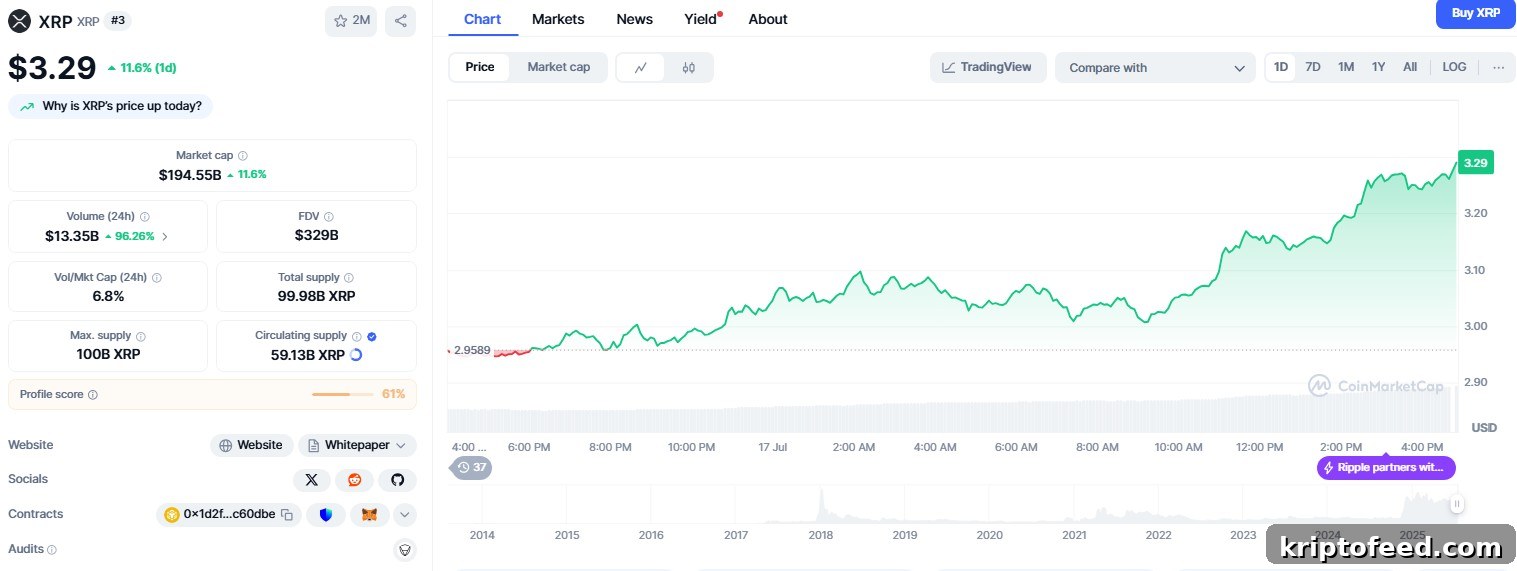
Trading volume has surpassed $13 billion, and technical momentum is building across major exchanges.
This price movement reflects more than market speculation. The current rally is supported by a mix of regulatory, institutional, and technological developments that could reposition Ripple’s token at the center of digital asset adoption across the United States and Europe.
Stablecoin laws, Ripple’s charter, and MiCA sharpen regulatory clarity
The Guiding and Establishing National Innovation for US Stablecoins Act (GENIUS) passed the House this week after Senate approval in June.
Backed by President Donald Trump and House Majority Leader Steve Scalise, the bill arrived alongside related measures such as CLARITY and Anti-CBDC legislation.
Ripple, which launched the USD-backed stablecoin RLUSD in December, filed for a US national bank charter and a Federal Reserve master account on July 2.
These steps would allow Ripple to hold RLUSD reserves directly with the Fed, improving transparency and regulatory compliance.
At the same time, Ripple is preparing to expand operations in Europe. The company confirmed plans to seek an EU electronic money institution license under the Markets in Crypto-Assets (MiCA) framework.
Ripple’s objective is to achieve MiCA compliance and broaden its footprint in the European stablecoin market.
Taken together, these developments provide a clearer path to regulatory legitimacy across major jurisdictions and significantly strengthen XRP’s long-term positioning.
Lawsuit nearly resolved as penalty remains $125 million
A separate catalyst for XRP’s momentum is the winding down of Ripple’s long-running court battle with the US Securities and Exchange Commission.
On June 26, Judge Analisa Torres denied a joint motion by Ripple and the SEC seeking to reduce the civil penalty from $125 million to $50 million and to remove a permanent injunction.
She ruled the parties did not demonstrate the “extraordinary circumstances” required to revise her assessment.
The following day, Ripple CEO Brad Garlinghouse announced on X that the company would withdraw its cross-appeal, expressing optimism the SEC would follow suit.
Although the $125 million fine remains in place, the move has been interpreted as the beginning of the end of prolonged litigation.
The regulatory overhang that constrained XRP for years may now be lifting.
ETFs and acquisitions signal renewed institutional push
With legal uncertainty easing, asset managers have acted quickly. On July 15, ProShares launched leveraged futures funds for Solana and XRP, while spot ETF approvals remain pending with the SEC.
A week earlier, the SEC issued new disclosure guidance intended to speed crypto ETF approvals.
Trump Media & Technology Group further stepped into the space, filing for a “blue-chip” basket ETF that would include Bitcoin, Ether, Solana, and XRP—an example of growing bipartisan pressure to accelerate ETF listings.
Concurrently, Ripple has been expanding its infrastructure.
The company acquired major broker Hidden Road for $1.25 billion and is developing a ledger-based lending protocol scheduled for a Q3 launch.
Chief Technology Officer David Schwartz told DL News in late June that several acquisitions are underway.
These efforts aim to deepen XRP liquidity, broaden use cases, and increase investor confidence.
Price trajectory and technical signals
According to crypto strategist Pentoshi, XRP has traded in a “very clean” structure over the past seven months, with limited overhead resistance.
“It arguably has little resistance from here because it never spent time trading here on the verge of price discovery,” he wrote on X. Relative Strength Index (RSI) readings across major trading platforms have moved back into “buy” territory, reinforcing bullish sentiment.
At the time of writing, XRP trades at $3.29. While it has not yet surpassed its all-time high of $3.84 set in January 2018, the convergence of regulatory clarity, ETF interest, and Ripple’s strategic positioning marks a meaningful phase.
The coming weeks may determine whether XRP can reclaim its previous peak and establish new price territory in this cycle.