
- XRP Ledger TVL fell 12.5% to $54.2 million.
- Open interest dropped 36%, and funding rates turned negative.
- A death cross and a falling triangle suggest further downside.
XRP faces renewed downward pressure as a mix of geopolitical uncertainty, regulatory delays, and weakening on-chain metrics push the token closer to a critical breakdown.
The cryptocurrency that once benefited from optimism around a potential XRP ETF and Ripple’s courtroom victories is now testing major support near $2. After a modest rebound, XRP is up 3.34% and trading at $2.02.
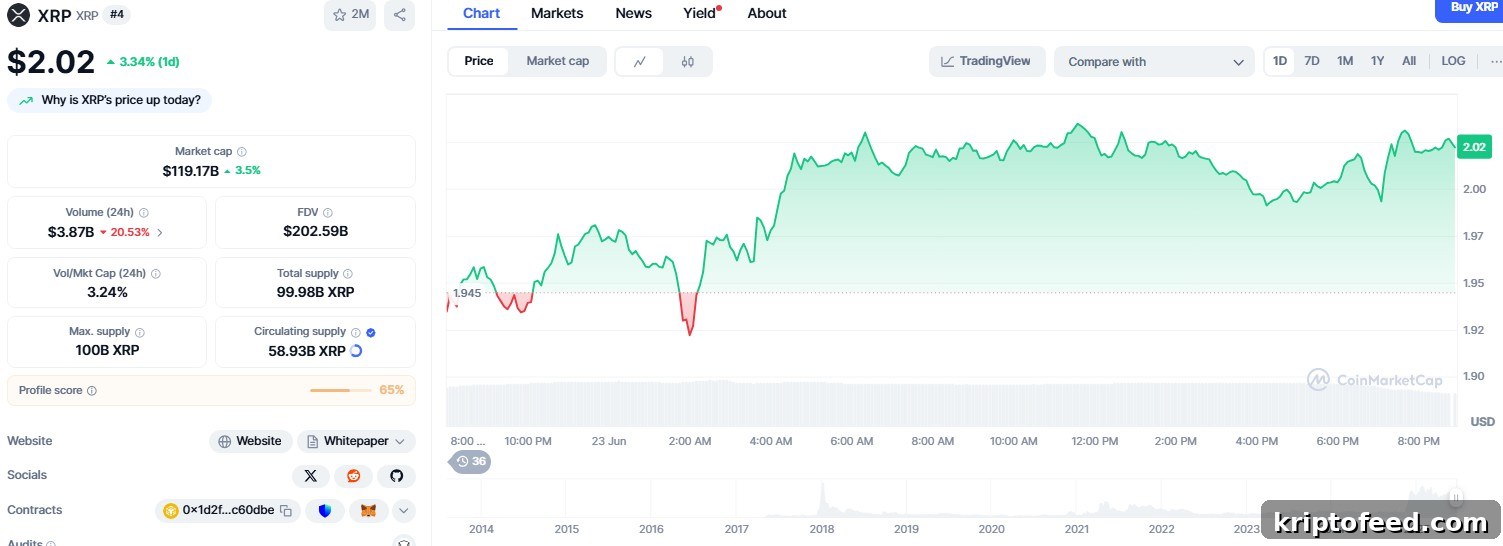
With bearish technical setups in place and key indicators flashing red, analysts warn the next move could push XRP toward $1.47—or worse.
ETF delay and macro risks sour sentiment
Investor confidence took a hit after the U.S. Securities and Exchange Commission postponed its decision on Franklin Templeton’s XRP ETF.
That delay is the latest in a string of regulatory setbacks for crypto assets in the United States, fueling speculation that institutional adoption of XRP could take longer than expected.
The announcement last week coincided with rising geopolitical tensions in the Middle East. As fears of a broader conflict rose, Bitcoin and many major altcoins entered a broad risk-off phase.
XRP was hit particularly hard and entered one of its longest losing streaks in over a month.
This double blow—the ETF delay and the wider crypto sell-off—triggered a rapid loss of momentum. XRP now trades just above the critical $2 level. Today’s move above $2.00, however, signals a short-term bounce that traders are watching closely.
On-chain metrics show weakness
Network data points to deterioration.
Total value locked (TVL) on the XRP Ledger has declined roughly 12.5% to $54.2 million, signaling reduced participation and weaker decentralized finance activity.
That drop has cast doubt on XRP’s strength of use cases, especially as competing networks display more resilient metrics under similar market conditions.
Open interest in XRP derivatives has also fallen by nearly 36%, while funding rates have turned negative. These figures indicate traders are shifting to a more bearish stance and are positioning for lower prices ahead.
Technically, XRP is forming a falling triangle—a pattern often seen as bearish—while a “death cross” has emerged as the 50-day moving average falls below the 200-day moving average.
Support zones and potential downside targets
According to technical analyst EGRAG Crypto, the $2.10–$2.09 range has served as significant support that aligns with the 200-day moving average.
Repeated tests have weakened this zone, increasing the likelihood of a decisive break.
If XRP fails to hold above $2, the next demand zone sits between $1.90 and $1.77.
A further breakdown could see XRP test support at $1.47, and in a worst-case scenario analysts warn of a drop below $1 if panic selling intensifies.
However, today’s recovery to $2.02 suggests $2 could hold for now, at least temporarily slowing the downside trajectory.
ETF hopes and bounce arguments remain
Despite the bearish backdrop, some market participants remain optimistic. XRP produced a sharp V-shaped recovery from roughly $1.91 to reclaim the $2 level, supported by about $4 billion in futures trading volume.
That bounce, though brief, indicated there is still demand at lower levels.
Well-followed trader CasiTrades suggested a successful defense of $2 could open a path to $3, especially if volume holds and macro headlines improve.
Event-driven prediction platform Polymarket currently shows better than 80% odds of an XRP ETF approval later this year, offering bulls a potential catalyst to watch.
With XRP trading at $2.02, attention now turns to whether this rebound has enough volume and momentum to push higher—or whether sellers re-emerge around this level.
Outlook hinges on technicals and regulation
XRP sits at a pivotal juncture. If the $2 support fails, downside risks could accelerate and push the price toward $1.47 or lower.
Conversely, holding above $2 amid improved ETF sentiment and easing geopolitical tensions could set the stage for a recovery toward $2.30–$2.33 and beyond.
Market observers are advised to monitor ETF developments—particularly from the SEC—while keeping a close eye on network metrics and price action around key support levels.