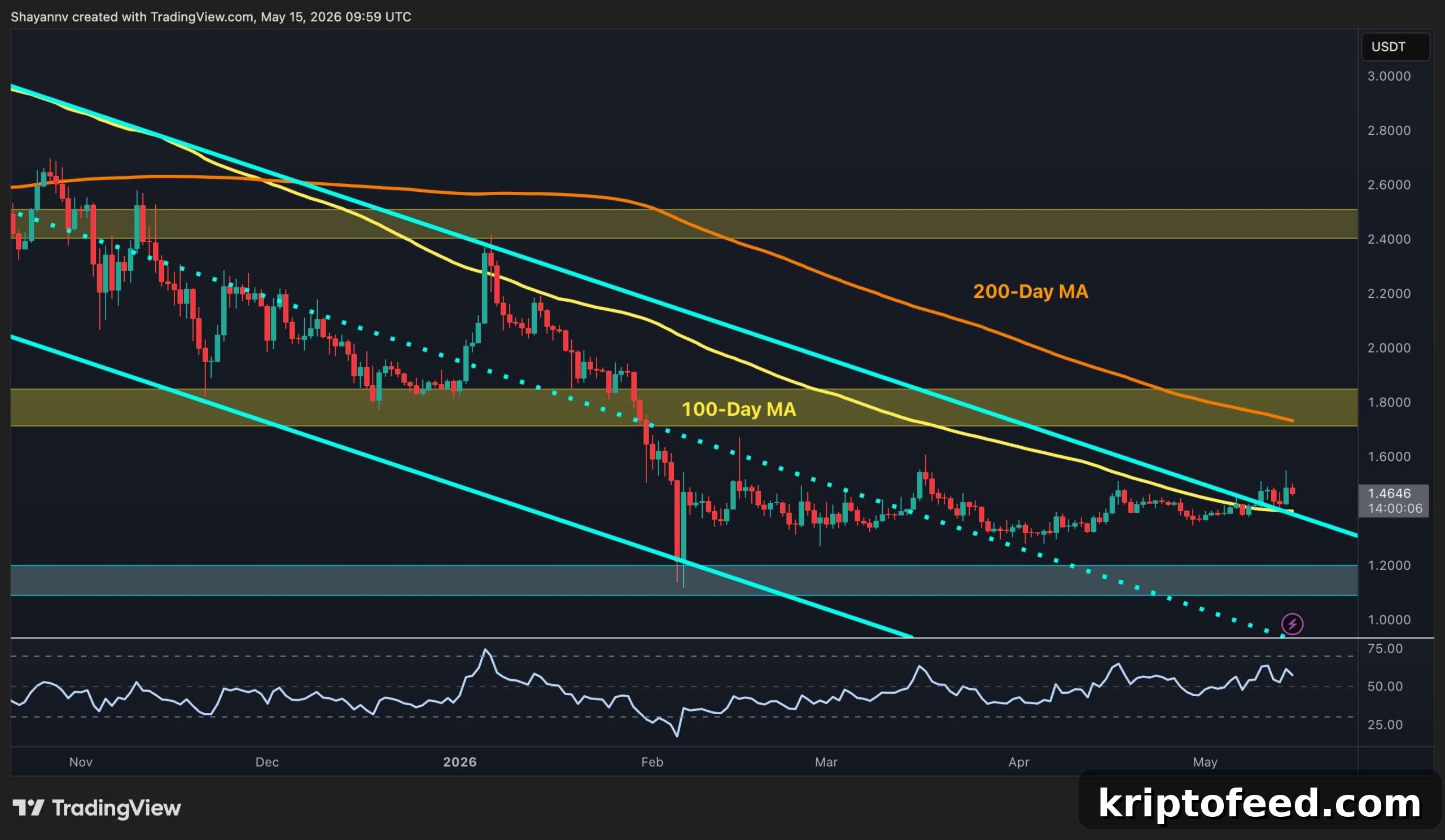
XRP is trading at $1.43, having cleared a key resistance cluster it has struggled with for months. The USDT pair has pushed above the 100-day moving average and the upper boundary of a descending channel, while the BTC pair has broken a short-term resistance level. For the first time this cycle, both pairs are displaying coordinated strength, supported by rising RSI readings on each chart.
Ripple Price Analysis: The USDT Pair
On the USDT pair, XRP is consolidating above the convergence of the declining 100-day moving average, near $1.40, and the upper boundary of a descending channel. The RSI has moved into the 55–60 range and is holding there rather than rolling over, which indicates that buying pressure behind the move may be more lasting than previous attempts.
A sustained daily close above the psychological $1.50 level would confirm the breakout and open the path toward the $1.80 supply zone. The 200-day moving average sits around the same area and could be reclaimed if momentum persists. Reclaiming that average would likely attract sidelined investors who have been waiting for a clear sign to re-enter the market and take long positions in XRP for the coming months.
The BTC Pair
The BTC pair also shows a meaningful development. XRP has recovered from about 1,700 sats and is testing the recent low near 1,800 sats. That recovery has been accompanied by a bullish RSI divergence and a rebound from oversold levels — a reversal pattern many traders look for after a liquidity sweep below a key level.
If XRP reclaims the 1,800 sats level, the next significant resistance lies around the 2,000 sats zone, where the 100-day moving average is currently sloping down. Beyond that, the 200-day moving average sits near roughly 2,100 sats.
Regaining the 2,000 sats area would serve as an early indication that XRP’s extended underperformance versus Bitcoin may be starting to reverse. Consolidation above 1,800 sats would be a positive step, but stronger structural improvement would be required to confirm a sustained shift in relative strength.