- XRP trades around $1.86 as ETF inflows clash with weak price momentum.
- Technical setups point to a potential recovery, but the $1.77 support remains critical.
- Outlook for 2026 depends on adoption, growing usage and valuation debates.
XRP enters 2026 caught between ambitious long-term forecasts and growing short-term skepticism.
Despite strong institutional signals, price performance has lagged, intensifying debate about XRP’s next move, especially after the altcoin slipped below $2.
XRP drifts sideways as conviction remains divided
XRP is currently trading around $1.86, implying a market capitalization near $113 billion and ranking it among the largest digital assets globally.
However, that valuation stands in sharp contrast to recent price action.
Over the past three months XRP has fallen nearly 37%, and it remains about 49% below its mid-2025 peak.
The price has traded in a tight range between $1.83 and $1.91, reflecting a market that appears hesitant rather than convinced.
Nonetheless, institutional interest has not waned despite price stagnation.
XRP-linked exchange-traded funds (ETFs) have recorded seven consecutive weeks of net inflows, with total assets approaching $1.24 billion.
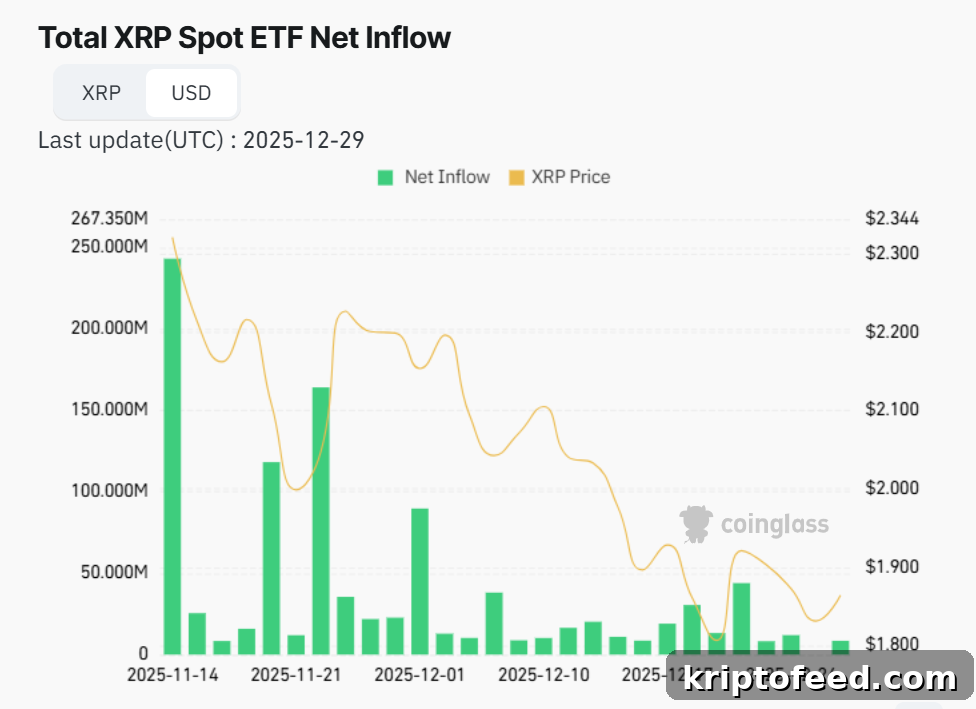
These steady inflows suggest larger investors are building exposure during weakness rather than exiting positions.
Such accumulation can quietly absorb selling pressure and help stabilize XRP during prolonged consolidation phases.
Bullish chart patterns clash with valuation concerns
From a technical standpoint, several analysts see early signs of a possible reversal.
Chart formations like a triple bottom near the $1.76 area and a developing inverse head-and-shoulders pattern indicate a market attempting to build a floor.
Momentum indicators such as the MACD have begun to rise, reinforcing the view that downward pressure may be easing.
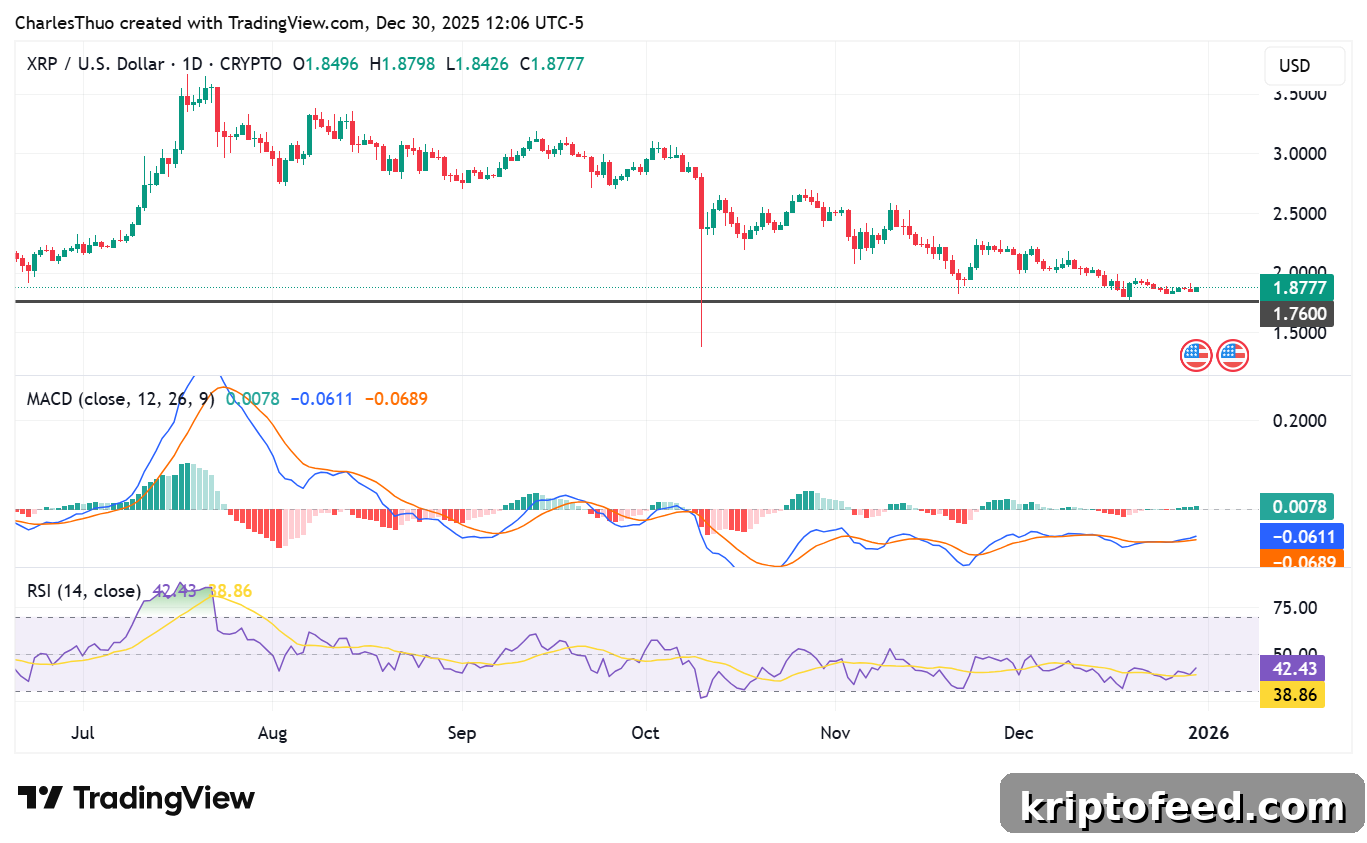
Yet these bullish signals are conditional. If the $1.77–$1.80 support zone fails to hold, XRP could suffer a much deeper decline.
Some analysts warn that a decisive break below this area could open the door to a fall toward $0.80, a level that would represent a dramatic reset of market structure.
This risk persists as long as price action remains below key moving averages.
Beyond charts, criticism has emerged over XRP’s underlying network activity.
Galaxy Digital CEO Mike Novogratz recently questioned whether XRP’s valuation is justified given reports of roughly 16,000 daily active addresses.
He noted those figures pale in comparison with other major networks that show substantially higher on-chain engagement.
The argument highlights a broader concern that XRP’s valuation may be driven more by narrative and institutional positioning than by visible growth in real-world usage.
Supporters argue that XRP’s role in cross-border payments and its expanding ecosystem are not fully captured by simple address counts.
They also point to regulatory clarity following Ripple’s legal progress as a structural advantage that could underpin longer-term adoption.
What XRP’s price outlook says about 2026
The most optimistic forecasts come from Standard Chartered, where Geoffrey Kendrick, head of digital asset research, predicted that XRP could reach $8 in 2026.
That projection implies a gain of more than 300% from current levels and assumes a potent combination of sustained ETF inflows, tighter supply dynamics and broader institutional adoption.
In such a scenario XRP’s market capitalization would exceed $450 billion, placing it among the most valuable financial assets in the digital economy.
Even advocates concede this represents a best-case outcome rather than a base expectation.
Reaching those levels would require not only favorable market conditions but enduring confidence in XRP’s long-term utility.
Without stronger evidence of expanding network use, critics argue the path to those valuations will remain challenging.
For now, XRP sits at a crossroads: steady institutional accumulation sits alongside technical signals of recovery, while concerns over on-chain usage and valuation create a divided outlook for 2026.