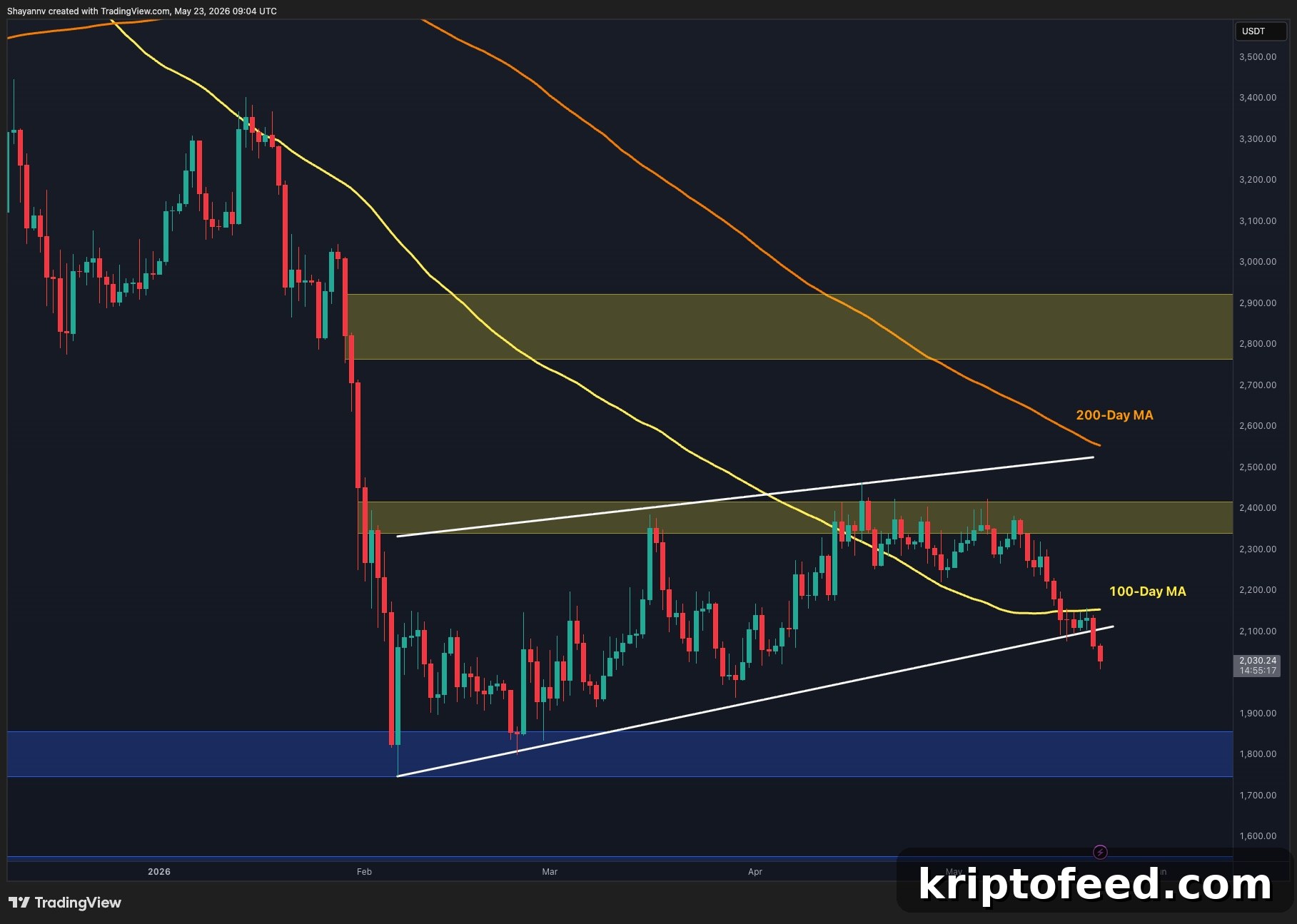
Ethereum faces renewed selling pressure after failing to reclaim a key dynamic resistance cluster around the 100-day moving average and the lower boundary of the previous consolidation range. The broader market remains strained, and ETH is approaching a critical support region where short-term reactions may appear. Unless buyers quickly retake lost ground, the path of least resistance favors further downside.
Ethereum Price Analysis: The Daily Chart
On the daily chart, Ethereum encountered a firm rejection at the confluence of the 100-day moving average and the broken wedge support near the $2,100–$2,150 area. That wedge had acted as dynamic support for several months, and the decisive break beneath it marks a notable bearish structural shift.
The breakdown confirms weakening bullish momentum and growing seller control. ETH now trades near the $2,000 psychological support zone after losing the crucial $2,100 level. The price action looks consistent with a breakdown-and-pullback pattern: a temporary retest of the broken wedge boundary and the $2,100–$2,150 resistance area could occur before the downtrend resumes.
If bearish momentum continues, the next primary downside target is around the substantial $1,800 support region, which previously served as a major demand zone during February’s capitulation. A break beneath $1,800 could expose Ethereum to deeper corrections toward lower macro support around $1,550–$1,600.
On the upside, reclaiming the 100-day moving average near $2,150 would be the first sign that buyers are attempting to reverse the recent breakdown. Until that level is reclaimed and validated, sellers retain the short-term advantage.
ETH/USDT 4-Hour Chart
On the 4-hour timeframe, Ethereum’s structure is clearly bearish, reflecting heightened fear and uncertainty after the sharp impulse move down from the $2,400 area. Price has consistently printed lower highs and lower lows, and selling accelerated after ETH broke the ascending support trendline near $2,200–$2,250.
That breakdown sparked liquidation-driven selling, pushing price into a key 4-hour order block around the $1,950–$2,000 support zone. This area is significant because it has acted as a reaction zone for an extended period and likely contains substantial resting liquidity. As a result, Ethereum could see a short-term corrective retracement from here before any further downside continuation.
In the event of a rebound, the primary pullback target is the $2,100–$2,150 region, now a nearby supply zone and potential resistance. This level also coincides with the previously broken market structure, increasing the likelihood of renewed selling if price revisits it.
However, unless ETH reclaims and holds above $2,200, the short-term trend remains bearish, and any recovery is more likely to be a corrective bounce inside a larger downtrend.
Sentiment Analysis
The latest Ethereum liquidation heatmap shows a concentrated pool of liquidity below the current price, with the most notable cluster around the $1,800 region. That zone has become a liquidity magnet, containing a dense accumulation of leveraged positions that could attract price action in the near term.
Historically, Ethereum often moves toward high-liquidity regions before staging meaningful reversals. The recent drop and weak recovery suggest the market may need a final liquidity sweep to reset positioning and flush out remaining leveraged participants. The $1,800 area is therefore a critical level to watch: it could absorb selling pressure and remove a large portion of resting liquidity.
From a market mechanics perspective, liquidity grabs often precede stronger impulsive moves. If Ethereum reaches this zone, panic selling and forced liquidations could intensify, creating opportunities for larger players to accumulate at lower prices. Consequently, while short-term rebounds remain possible, the overall liquidity structure implies Ethereum could be vulnerable to a deeper corrective move toward the $1,800 cluster before a sustainable bullish phase begins.