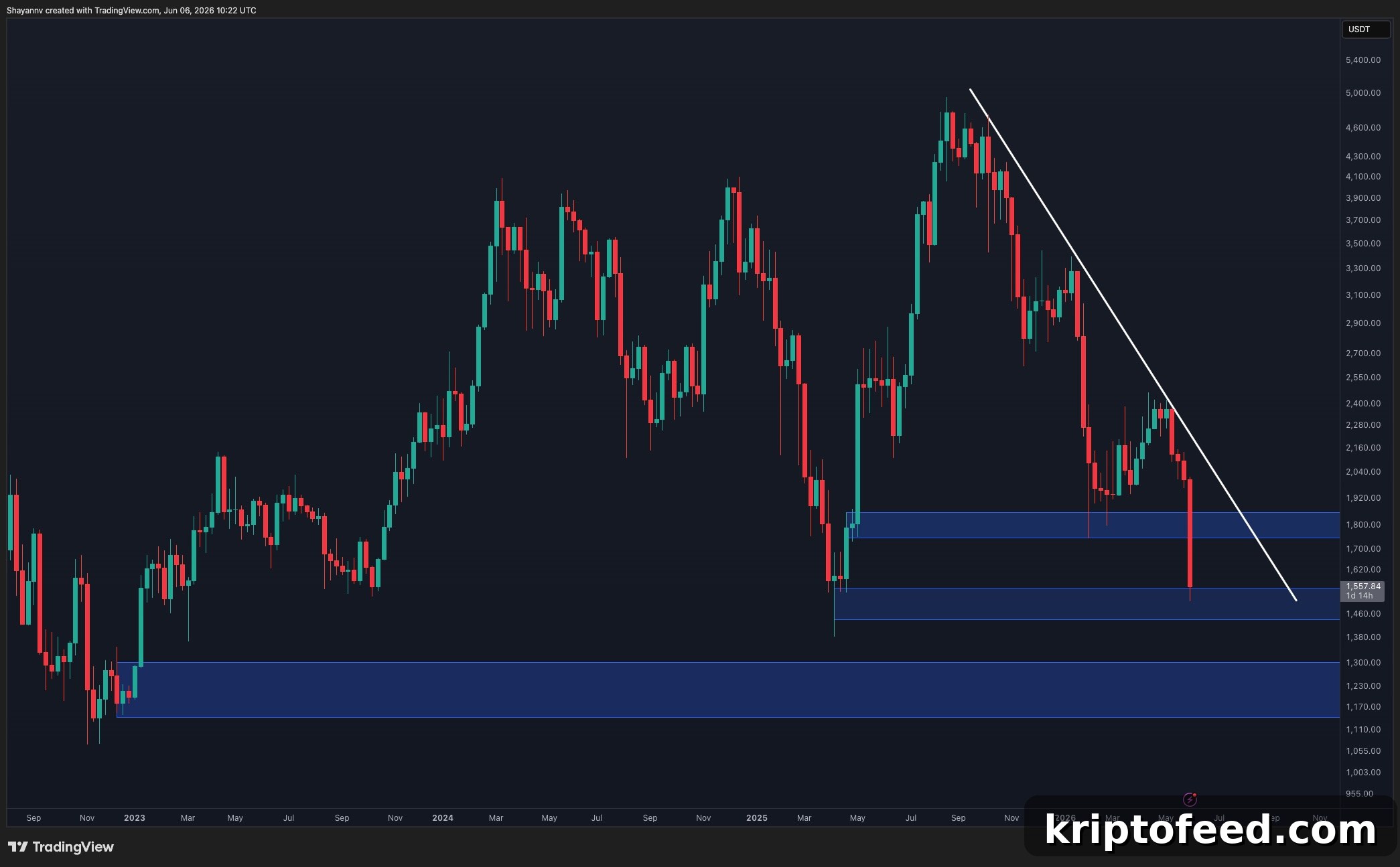
Ethereum has entered a decisive bearish phase after losing several high-timeframe support levels within days. The latest sell-off pushed ETH through a major confluence zone that had served as support during the first half of the year, leaving the market at a critical crossroads. Buyers must defend lower demand areas to prevent a deeper correction.
Ethereum Price Analysis: The Weekly Chart
The weekly chart reveals a clear deterioration in market structure. After peaking near $5,000, ETH formed a series of lower highs beneath a descending trendline that has capped every major recovery attempt since late 2025. The recent rejection from that trendline reinforced bearish control and accelerated the downside move.
More notably, ETH has broken below the key support area around $1,750–$1,850, a zone that previously acted as a pivotal level during the March rebound. This breakdown confirms a bearish continuation pattern and shifts attention to the next demand region around $1,450–$1,550.
The current weekly candle is testing the upper boundary of that support zone, with price trading near $1,560. A weekly close below this region would substantially increase the likelihood of an extension toward the broader demand area around $1,150–$1,300, which represents the next significant historical support visible on the chart.
For bulls to regain momentum, ETH would first need to reclaim the broken $1,750–$1,850 region and then break above the descending trendline resistance. Until those conditions are met, the broader structure remains bearish.
ETH/USDT 4-Hour Chart
The 4-hour chart highlights the intensity of the recent sell-off. ETH broke down from a prolonged descending structure without forming substantial support. The blue support zone between roughly $1,740 and $1,850, which had previously aligned with the 0.5–0.618 Fibonacci levels, failed to contain selling pressure and has turned into resistance.
ETH is now testing the lower demand zone around $1,500–$1,570, where some reactive buying has emerged. However, the rebound is limited and does not yet indicate a sustainable trend reversal. If this support area fails to hold, the next downside target could emerge below $1,500. Conversely, any relief rally would likely encounter resistance around $1,740–$1,850, followed by the Fibonacci cluster between $1,880 and $1,920.
Sentiment Analysis
The three-month liquidation heatmap indicates that a sizeable amount of downside liquidity was cleared during the recent cascade. As ETH fell from above $2,000 toward $1,500, most of the prominent liquidation clusters beneath the market were swept, reducing the immediate magnetic effect from lower levels.
At the same time, the most significant remaining liquidity concentrations are now positioned above the current price, particularly in the $1,700–$1,900 region and extending toward $2,400–$2,500. This creates a dynamic where the market lacks major nearby liquidity targets below spot while sizeable overhead liquidation pools remain in place.
However, the absence of significant liquidity beneath price does not automatically signal an imminent reversal. Instead, it suggests ETH may enter a period of consolidation or a corrective rebound before establishing its next directional move. If buyers fail to reclaim broken support levels, the market could still experience a deeper retracement driven by spot selling rather than liquidation hunting.
For now, Ethereum remains under strong bearish pressure, but with most nearby downside liquidity already swept, traders should watch whether the $1,450–$1,550 support zone stabilizes price and triggers a relief rally toward the newly formed resistance overhead.