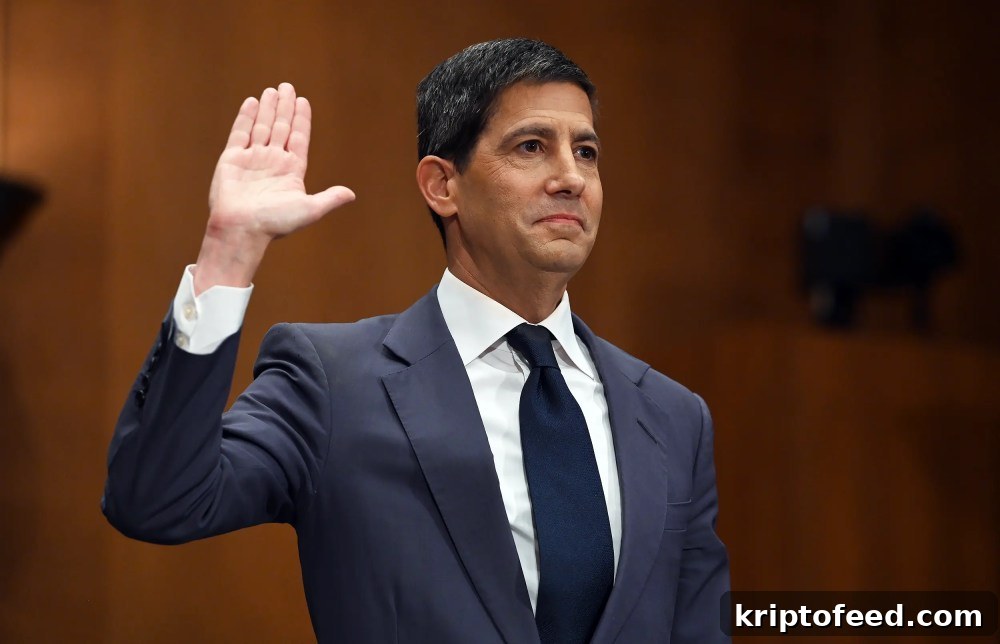
Kevin Warsh is scheduled to be sworn in as the seventeenth Federal Reserve Chair at the White House on Friday, May 22, with President Trump administering the oath.
Analysis from XWIN Research Japan highlights the specific on-chain signals most likely to react first as markets begin to price what a Warsh-led Fed could mean for Bitcoin.
Coinbase Premium and Exchange Netflows Are the Ones to Watch
XWIN’s analysis, published on May 22, focuses on a particular risk that many crypto commentators have overlooked: the question is not simply whether Warsh will cut rates or hold them steady, but what he plans to do with the Fed’s balance sheet.
During his Senate Banking Committee testimony, Warsh stated the Fed’s balance sheet is too large, should be reduced, and argued the central bank should not hold long-term Treasuries.
That approach amounts to quantitative tightening, which XWIN says operates differently from interest-rate policy. Instead of changing the price of money, quantitative tightening reduces the quantity of liquidity in the financial system directly.
XWIN highlighted a potentially uncomfortable scenario in which short-term rates fall while long-term yields rise simultaneously. Historically, that combination has exerted strong downward pressure on risk assets.
This dynamic matters for Bitcoin because the asset is increasingly sensitive to global liquidity conditions. ETF adoption, institutional participation, and a growing derivatives market have altered Bitcoin’s behavior compared with earlier cycles, making it more responsive to macro liquidity shifts.
For Bitcoin, XWIN expects early signs of stress to show up first in the Coinbase Premium, a metric that reflects US institutional spot demand.
The analysts argue that if markets begin to expect sustained quantitative tightening, institutional buying appetite could soften before prices fully adjust. A negative Coinbase Premium would be the earliest clear indicator that institutional demand is waning.
The second indicator XWIN recommends monitoring is Bitcoin exchange netflows. Rising inflows to exchanges typically signal defensive repositioning as holders move coins onto platforms where they are easier to sell. Under a risk-off environment driven by a new Fed regime, short-term holders could trigger that exact pattern.
What If Bitcoin Still Attracts Capital Under Tighter Conditions?
XWIN notes that many recent price moves in BTC have been driven primarily by leveraged positions rather than fresh buying. When rallies are led by short-covering instead of new capital, they can be fragile—another important risk for investors to monitor.
However, the research firm also allows for an alternative outcome. If ETF inflows recover, exchange reserves continue to decline, and the Coinbase Premium turns positive again, that would indicate Bitcoin is still able to attract capital even as overall liquidity tightens. Such a development would suggest that Bitcoin is drawing demand from outside the traditional fiat system.
At the time of the analysis, Bitcoin was trading just above $77,000 after earlier dipping to a three-week low near $76,000, with recovery attempts encountering resistance at roughly $78,000.