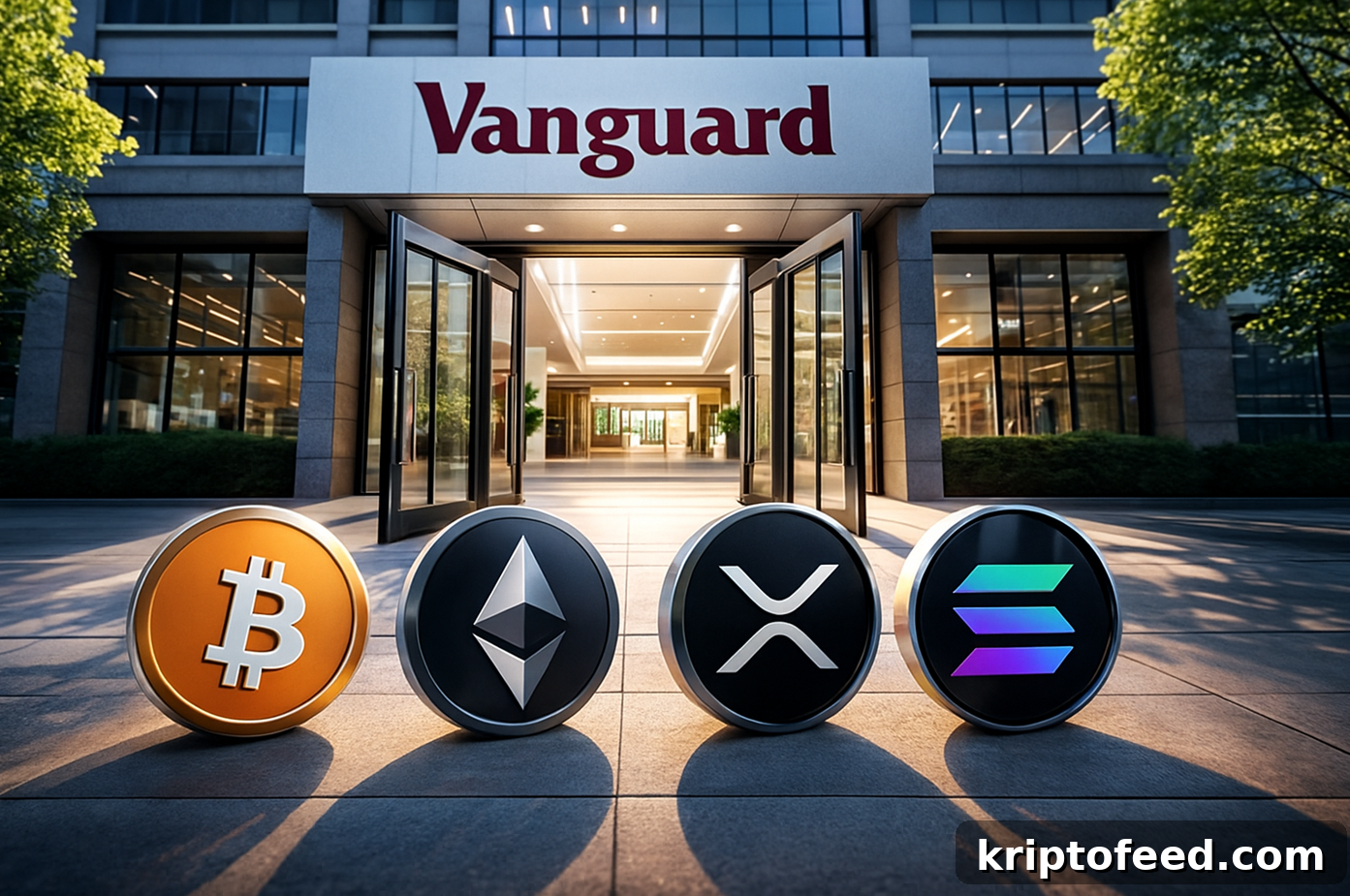
- Vanguard now allows clients to trade Bitcoin, Ethereum, XRP and Solana ETFs.
- XRP ETFs recorded $756 million in inflows over 11 days, with no outflows reported.
- Goldman Sachs and other firms are increasing their cryptocurrency exposure alongside Vanguard.
In a significant shift that signals growing mainstream acceptance of digital assets, Vanguard has opened its brokerage platform to regulated crypto ETFs.
Starting this week, U.S. investors can access exchange-traded funds tied to Bitcoin, Ethereum, XRP and Solana, marking a major turnaround from the company’s long-standing resistance to cryptocurrencies.
🚨 Just found this on Vanguard’s official website 👀
Multiple XRP ETFs (Franklin, Canary, REX-Osprey, ProShares…) are now showing under “Non-Vanguard Funds” in the Digital Assets category.
Looks like access is finally opening up for crypto ETFs pic.twitter.com/Y08IgtAybg
— Arthur (@XrpArthur) December 2, 2025
Notably, this decision comes amid rising client demand and growing institutional interest in digital assets, prompting Vanguard to rethink its traditional investment philosophy.
Vanguard finally embraces crypto
For years, Vanguard maintained a cautious stance toward cryptocurrencies. Former CEO Tim Buckley publicly dismissed BTC and other digital assets as too speculative and unsuitable for long-term retirement portfolios.
The firm consistently declined to offer crypto ETFs, emphasizing stability and low-risk investments for retirement-focused clients.
However, changes in leadership paved the way for a new approach.
Salim Ramji, formerly global head of ETFs at BlackRock, took the CEO role and has gradually steered Vanguard toward supporting regulated crypto offerings.
Although Vanguard still does not launch its own cryptocurrency ETFs or mutual funds, it now supports third-party products that meet regulatory standards, giving clients access to digital assets while maintaining compliance.
The platform expansion enables Vanguard’s more than 50 million U.S. brokerage clients to trade crypto ETFs alongside other non-traditional assets like gold.
This could significantly increase market participation, with some analysts forecasting short-term price upside for Bitcoin (BTC) and Ethereum (ETH).
Vanguard adds XRP ETFs
Among the new offerings, XRP-based ETFs have drawn special attention.
In just 11 trading days, spot XRP ETFs posted net inflows exceeding $756 million, with total assets under management reaching $723 million.
Remarkably, there were no outflows. Key inflow events included $243 million at the launch of Canary Capital’s product, $164 million tied to Grayscale and Franklin Templeton ETFs, and $89.65 million in the most recent session.
This rapid accumulation reduces liquid XRP available on exchanges, potentially creating a supply shock that could influence prices.
Traditional finance accelerates crypto adoption
Vanguard’s pivot reflects a broader trend of traditional financial institutions embracing crypto.
Goldman Sachs, for example, has deepened its exposure through a $2 billion acquisition of Innovator Capital Management, a provider of ETFs with defined criteria including structured funds linked to Bitcoin.
The bank has quickly increased its holdings in Bitcoin and Ethereum ETFs, amassing billions in assets while also developing infrastructure for tokenized financial products.
Industry observers view these moves as part of a gradual but meaningful integration of digital assets into mainstream portfolios, signaling that regulated, institutionally backed cryptocurrency investments are moving from niche to mainstream.
The implications of Vanguard’s decision reach beyond immediate market activity.
By enabling access to regulated crypto ETFs, the firm provides a familiar, compliant channel for retail and institutional investors to participate in digital asset markets.
That access could attract additional flows, reshaping liquidity dynamics and market sentiment for Bitcoin, Ethereum, XRP and Solana.
For Vanguard, this shift represents both a strategic response to client demand and an acknowledgment that digital assets have become a permanent presence in the global financial landscape.