
- Uniswap Labs has unveiled a new system designed to make cross-chain interactions secure and frictionless.
- The Compact introduces a shared mechanism intended to reduce fragmentation between decentralized platforms.
- This new feature could change how assets and projects interact across the blockchain industry.
Uniswap Labs has taken a significant step toward addressing one of decentralized finance’s (DeFi) major challenges: interoperability — the ability of different blockchains to communicate and interact.
The decentralized trading protocol announced The Compact, an open-source contract system aimed at making applications and digital assets interoperable across chains.
The Compact is an open-source composable smart contract system that enables seamless crosschain interoperability
Here’s how it works 🦄 pic.twitter.com/QgY1MRL13X
— Uniswap Labs 🦄 (@Uniswap) October 8, 2025
This system lets users move apps and assets across different chains without relying on risky or complex temporary workarounds.
At its core, The Compact allows users to “commit” tokens for specific actions—such as cross-chain transfers or swaps—while keeping control over those assets.
It offers a way to lock assets securely while enabling credible and permissionless movement across platforms.
The official blog explained:
The Compact enables secure cross-chain settlement through a system of reusable Resource Locks and programmable commitments. When sponsors deposit assets, they create ERC6909 tokens that represent those locked assets and remain under the sponsors’ control.
The new release from Uniswap could change how decentralized applications interact.
Rather than each project building its own escrow solution or bespoke bridge, The Compact provides a shared platform that all developers can use, adapt, and rely upon.
Repairing a fragmented space
The current DeFi landscape includes hundreds of blockchains, sidechains, and rollups, each with its own standards and tools.
That fragmentation creates significant challenges.
Developers often end up rebuilding similar infrastructure repeatedly.
Users must juggle multiple wallets, and many encounter locked or inaccessible tokens after interacting with incompatible systems.
Uniswap Labs aims to address these problems with The Compact.
Through this framework, developers and users can access a common set of tools for managing value across different chains.
That means protocols can offer cross-chain functionality without sacrificing decentralization or security.
Why The Compact matters
DeFi projects have long struggled to communicate effectively without a collective standard or framework.
Historically, each protocol needed to create its own bridging or escrow solution, which produced user friction, rigid trust models, and fragmented liquidity.
The Compact fills a missing piece by providing reusable primitives and a predictable model for cross-chain interactions.
With this system, developers building on Uniswap’s ecosystem can abstract away much of the complexity inherent in asynchronous, multi-chain environments.
Users benefit from simpler, declarative compatibility that reduces the need to manage bridges or bespoke wallet setups.
The Uniswap team commented:
With The Compact, developers can finally offer simple, declarative interactions so users never have to navigate the underlying complexity—without building new infrastructure that risks fragmenting the ecosystem.
UNI price outlook
Uniswap’s native token has struggled in recent sessions despite broader market rallies.
UNI is trading around $7.88 after losing nearly 20% of its value over the past month.
The token has consolidated over the last week, and prevailing sentiment points to a possible breakout to the upside.
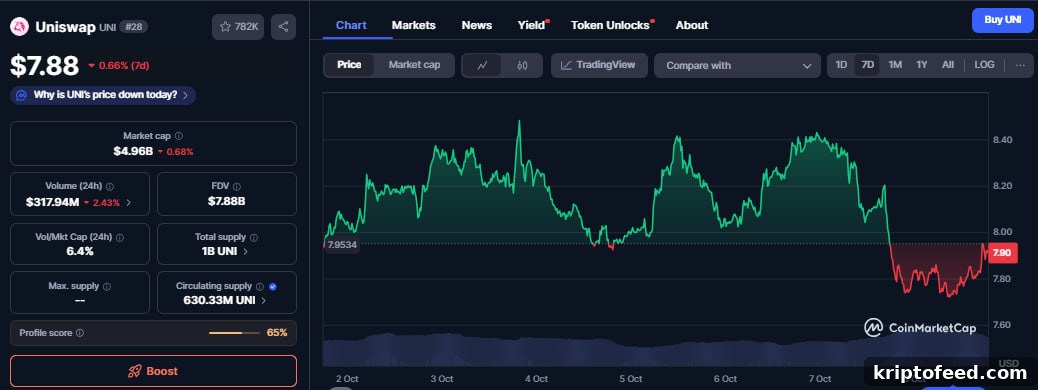
Clearing resistance near $8.40 could support a recovery toward $12 and then $18 if broader bullish conditions persist.