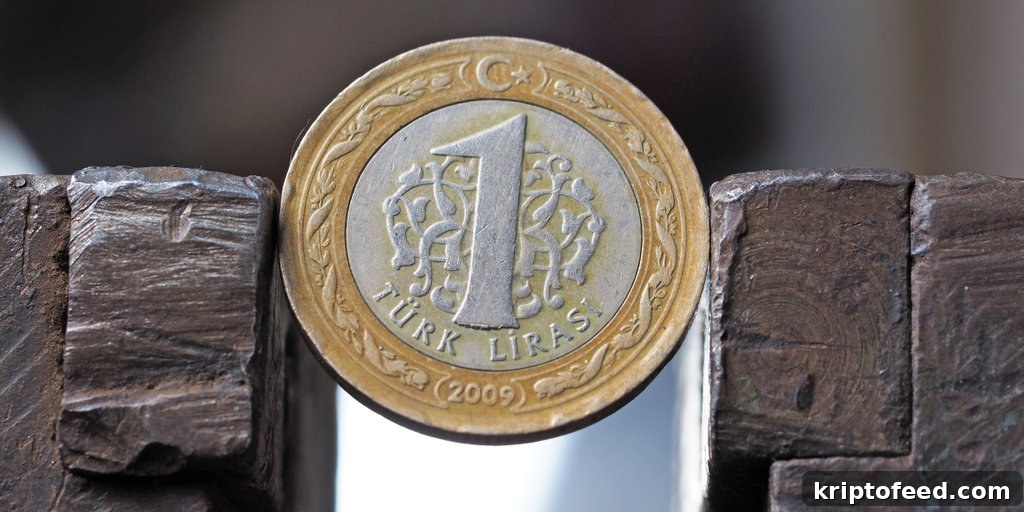
After the Turkish lira lost up to 60% of its value against the US dollar last year, many people in Turkey are turning to cryptocurrency to exchange their lira and protect their savings.
Turkish lira becomes more volatile
The Turkish lira recovered about 20% against the dollar in December after inflation reached roughly 36%. Shortly afterward, President Recep Tayyip Erdoğan announced plans to strengthen the national currency and to shield domestic reserves from market exposure.
Despite that recovery, the lira is still down roughly 60% against the dollar over the past year. In recent weeks the currency has declined further after controversial moves by Erdoğan to cut interest rates even more, increasing volatility and undermining confidence.
Efforts to preserve wealth despite crypto restrictions
To protect the value of their assets, many Turkish citizens are quickly converting lira into Bitcoin and USDT as a way to shelter their funds from depreciation.
The lira began to fall against the US dollar at the end of 2021, and trading volume denominated in lira rose. Chainalysis data showed an average trading volume of about $1.8 billion per day on three cryptocurrency exchanges. By contrast, 2019 saw much higher on-chain activity in lira terms—approximately $71 billion worth of lira was spent daily on cryptocurrencies at that time.
Turkish users are particularly interested in the dollar-pegged stablecoin Tether (USDT). In the autumn, CryptoCompare reported that more traders exchanged lira for USDT than for the TRY/USD or TRY/EUR pairs.
Where savers once favored the US dollar and gold, many now choose cryptocurrencies such as Bitcoin and Tether. Turkish investors have increasingly adopted digital assets even though the use of cryptocurrencies as a means of payment was banned in April 2021.
Bitcoin and inflation
Supporters often claim that Bitcoin is immune to conventional inflation. This argument rests on Bitcoin’s predetermined issuance schedule: the annual increase in the total number of bitcoins is fixed in advance and gradually declines, with issuance approaching zero around 2040. In that sense, Bitcoin’s supply growth is largely known for the coming years.
From this premise comes the assertion that Bitcoin is not subject to inflation, which proponents present as an advantage over traditional fiat systems. Many alternative digital currencies make similar claims of being inflation-free. The challenge is that equating money-supply growth with the inflation rate is an oversimplification. Inflation measures changes in purchasing power and prices, not just the expansion of the money supply. This distinction applies to traditional currencies as well as to Bitcoin.
7% CPI in the United States
Turkey is not alone in facing historic inflationary pressures. News from the United States also affected crypto markets: reports on US consumer prices pushed Bitcoin (BTC) briefly back above $44,000. US Consumer Price Index (CPI) data showed that inflation exceeded 7% in December, the highest level seen since the 1980s. Bitcoin and many other cryptocurrencies reacted positively to that report.
The figures were published by the United States Bureau of Labor Statistics and showed a CPI above 7% in December. Bitcoin’s price fluctuated between roughly $41,000 and $43,000 for a time, and then briefly surpassed the $44,000 mark following the announcement.
This time the inflation report helped Bitcoin. The market had experienced another BTC drop the previous week when the Federal Reserve signaled plans to reduce some assets from its balance sheet. On this occasion, however, prices rose. Federal Reserve Chair Jerome Powell indicated that interest rates would remain relatively low, a comment that contributed to Bitcoin’s upward movement.