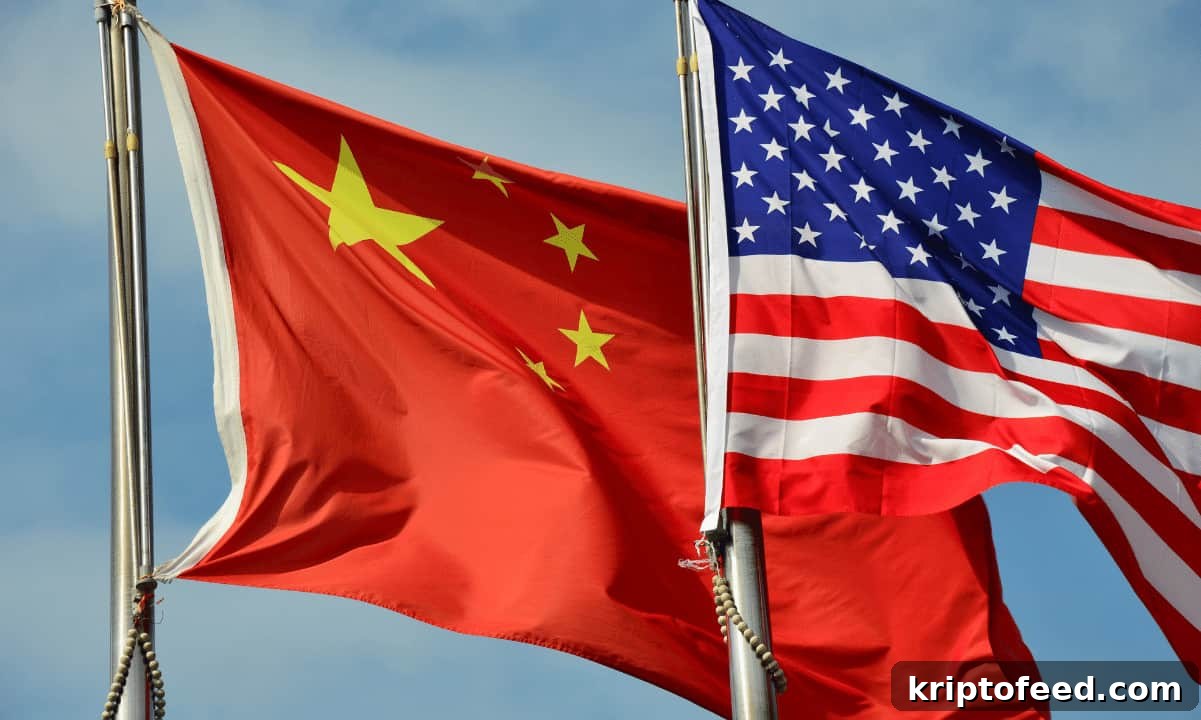
US President Donald Trump will meet Chinese President Xi Jinping in Beijing from May 13 to 15. This marks Trump’s first return to China since 2017. While agenda items reportedly include artificial intelligence, semiconductors, new trade and investment agreements, and Middle East tensions, the summit also carries meaningful implications for Bitcoin (BTC) and digital-asset markets.
The Crypto Angle
During his first term, and again after returning to the White House in 2025, Trump imposed tariffs on Chinese imports. Those measures placed pressure on Chinese mining-equipment manufacturers such as Bitmain, Canaan, and MicroBT. Trade tensions have frequently affected Bitcoin’s price: the flagship cryptocurrency has tended to react negatively to many of Trump’s tariff threats and escalations.
With global attention focused on the Trump-Xi summit, participants in the crypto industry are hoping the meeting could encourage China to soften its stance on Bitcoin and digital assets more broadly. The summit includes a number of US executives with notable digital-asset exposure. For example, BlackRock CEO Larry Fink oversees the largest spot Bitcoin exchange-traded fund, and Tesla—represented at the summit by Elon Musk—holds 11,509 BTC. Payments executives such as Visa’s Ryan McInerney and Mastercard’s Michael Miebach are working on stablecoin settlement infrastructure, and Goldman Sachs’ David Solomon joins after the bank expanded its crypto trading operations. If the summit facilitates easier US–China financial flows, these institutions could benefit quickly and markets would likely reflect that expectation.
However, optimism that China will reverse or significantly relax its crypto policies may be misplaced. Recent analysis from industry observers in Japan notes that Chinese authorities have reinforced restrictions on crypto-related activities, real-world-asset tokenization, and yuan-linked stablecoins. Given those regulatory signals, direct, rapid expansion of mainland Chinese retail or institutional Bitcoin demand appears unlikely at present.
How the Summit Could Affect Bitcoin Mining
Bitcoin mining supply chains are another area with potential exposure to the outcome of the summit. Although North America has led global hashrate growth recently, much of the mining hardware supply chain remains based in China. If the meeting reduces geopolitical and trade tensions, mining investments and hashrate expansion could accelerate, which would likely be viewed as bullish for BTC. Conversely, a breakdown in negotiations or renewed trade frictions could increase equipment costs and cause supply delays for miners worldwide, producing effects on Bitcoin that go beyond short-term sentiment shifts.
At the time of reporting, BTC was trading near $81,000 and had gained under 1% over the prior seven days, according to CoinGecko. Over the past 30 days, however, the cryptocurrency had risen roughly 13%.
Broader macroeconomic conditions entering the summit also matter. Oil prices rose as much as 4% to $105.50 a barrel on Monday after US–Iran peace talks stalled. Higher oil prices can raise inflation expectations, which in turn reduce the odds of Federal Reserve rate cuts and tighten financial conditions for risk assets, including Bitcoin. Those dynamics mean that even if diplomacy eases trade frictions, broader market drivers could moderate the immediate impact on crypto prices.