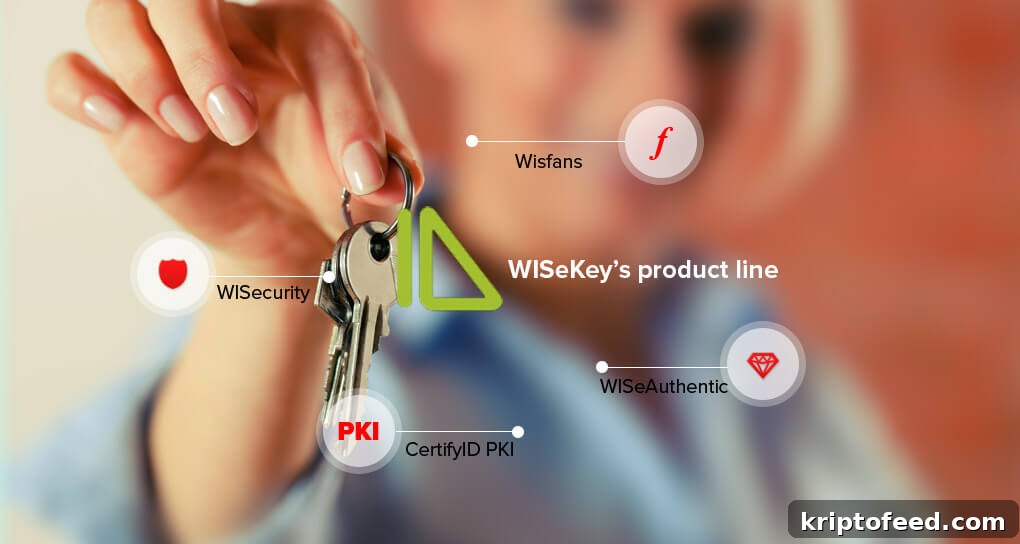
WISeKey has announced the release of the WISeID 6 app, an upgraded version of its personal data and identity protection application.

Built on blockchain technology, WISeID enables users to manage their digital identities without sacrificing privacy, security or confidentiality. The app offers a secure, easy-to-use encryption service for storing usernames, passwords, PINs, credit card details, loyalty cards and other sensitive information.
WISeID secures, stores and verifies user identities using WISeKey’s military-grade Root of Trust and public/private key encryption with multiple keys. The platform also supports biometric verification methods such as facial recognition and fingerprint authentication, along with two-factor authentication for added protection.
The solution leverages blockchain as a public, immutable ledger that allows third parties to confirm that certified identity attributes issued by trusted authorities remain unchanged and unaltered.
Every WISeID node maintains a copy of the WISeID blockchain, which is downloaded automatically when joining the network. Through the WISeID app, users retain full control over their digital identities. Identity data can be stored on mobile phones, IoT sensors or computers, and users decide which attributes to share with social networks, payment providers, merchants and other services.
The WISeID blockchain functions alongside the WISeID Kaspersky Lab Security cyber-resilience suite, using digital identification to lock personal data—such as account credentials, credit card numbers and access PINs—into a secure personal data organizer.
WISeKey, a Swiss cybersecurity company, is deploying large-scale Internet-of-Things (IoT) digital identity ecosystems using its Cryptographic Root of Trust and NFCTrusted technologies.
The Root of Trust integrates wearable technology with secure authentication and identification in both physical and virtual environments, enabling IoT and wearable devices to operate as secure transactional endpoints.
In cooperation with OISTE and through involvement with initiatives like the Clinton Global Initiative, WISeKey began this effort in 2006 with the goal of issuing one billion digital identities and enabling people to perform payments and transactions via mobile devices to support community development and communication.
Today, an estimated one-fifth of the world’s population—around 1.5 billion people—lack legal identification, and roughly 50 million children are born each year without a birth certificate or legal identity. Without recognized identities, these individuals are often excluded from essential services such as education and healthcare and are at greater risk of exploitation and trafficking.
 WISeKey’s technology aligns with the United Nations’ Sustainable Development Goals, aiming to provide every person with a tamper-resistant digital identity based on interoperable standards by 2030. The UN has encouraged the development of scalable identity systems to advance inclusion and access to services.
The non-profit ID2020, founded in 2015, seeks to apply emerging technologies to establish a unique digital identity for every individual as a basic human right. The organization collaborates with industry leaders, NGOs, governments and technology pioneers to develop the necessary systems and standards.