
- Stellar ranks third in the RWA token market by value
- Exchange balances on Binance rose to 1 billion XLM
- Active wallets reached 9.5 million, growing by 5,000 per day
Stellar (XLM) is navigating a complex landscape in 2025
As the blockchain continues to gain traction as a hub for real-world assets (RWA), concerns about centralization and potential market manipulation have intensified.
Stellar’s RWA-linked value has increased 84% this year, surpassing $500 million.
However, with nearly 80% of XLM supply controlled by just 10 wallets, analysts warn of heightened volatility risk if major holders move to sell.
At the same time, rising daily wallet growth and larger exchange balances point to expanding adoption, while also signaling potential selling pressure.
As institutional products integrate with Stellar and retail participation rises, investors remain divided over whether the current distribution can support long-term price stability without triggering major market corrections.
XLM supply concentrated in top wallets
The top 10 wallets hold roughly 25 billion XLM of the 30.9 billion circulating supply—about 80% of the available token supply.
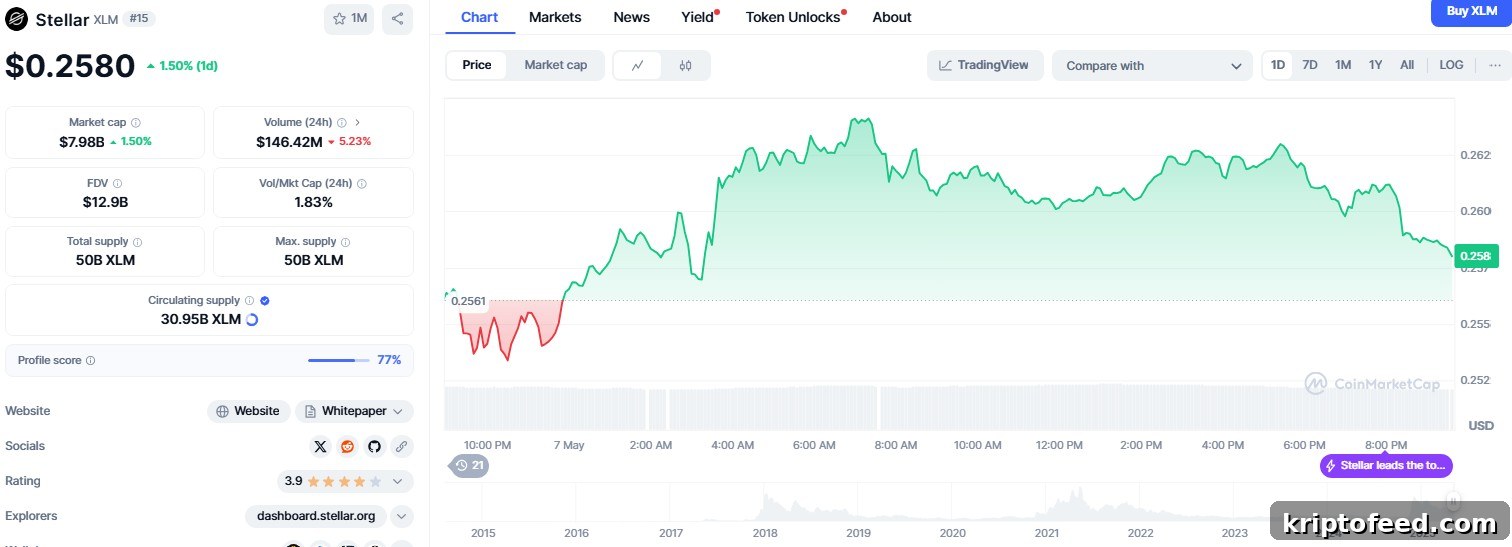
Source: CoinMarketCap
This marked imbalance raises questions about decentralization and the network’s resilience.
Conversely, 90% of holders reportedly own fewer than 100 XLM, giving them limited influence over market trends.
Such concentration can have severe implications for XLM price stability.
If a small number of large holders begin to liquidate significant amounts, the market could face rapid corrections.
The risk is further heightened by rising exchange balances: XLM held on Binance increased from 180 million at the end of 2023 to 1 billion by May 2025, according to Stellar.expert.
This inflow suggests elevated trading interest but also raises the possibility of increased selling pressure.
RWA tokens driving XLM adoption
Despite supply concerns, Stellar has made clear inroads into tokenizing real-world assets, a sector that attracted institutional capital and crypto investment in 2025.
Stellar is currently ranked the third-largest protocol by market value of RWA, trailing only Ethereum and ZKsync Era.
Institutional products such as Franklin Templeton’s OnChain US Government Money Fund, valued at $497 million, and Circle’s USDC stablecoin holding $345 million on the Stellar chain helped push Stellar’s total RWA value past $500 million.
That represents an 84% increase from $275 million in January—growth achieved in five months.
This expansion signals that traditional financial institutions are considering Stellar as an alternative to Ethereum for tokenized assets, drawn by faster transaction times and lower costs.
On-chain growth supports adoption trends
The XLM network is also showing strong user-base growth. Active Stellar accounts rose from 7.2 million in 2023 to 9.5 million by May 2025.
This increase corresponds to about 5,000 new wallet addresses per day on average. That growth helps counterbalance the effects of supply concentration, as demand expands from a broader user base.
Daily activity now reflects more than speculative trading.
It points to growing confidence in Stellar’s long-term utility, especially within the RWA sector.
Although rising circulating supply often raises concerns about dilution or market dumping, in Stellar’s case it appears aligned with a deliberate expansion strategy aimed at onboarding both institutional users and retail participants.
Market remains split on centralization risk
While Stellar’s RWA integrations and active user growth emphasize continued demand, the risks tied to token concentration cannot be ignored.
If top holders or “whales” decide to exit positions, price shocks are likely.
However, if network development continues alongside strategic RWA partnerships, the Stellar blockchain could maintain and expand its role within the broader crypto asset ecosystem.
Although Stellar’s fundamentals look strong, investors are likely to remain cautious until the network addresses centralization risks.
Efforts to diversify token distribution, improve governance, or introduce staking mechanisms could help mitigate future volatility.