- Starknet uses zero-knowledge rollups to batch transactions off-chain and settle them on Ethereum.
- The project is also pursuing Bitcoin DeFi integration through its BTCFi initiative.
- The STRK token price remained steady despite the disruption.
Starknet, an Ethereum layer-2 network built on zero-knowledge rollups, began 2026 with an unexpected mainnet disruption that temporarily interrupted network activity.
The incident surfaced at a time when layer-2 infrastructure is increasingly critical to Ethereum’s scaling strategy, with developers and users relying on these networks for faster execution and lower fees.
As decentralized applications expand across finance, gaming and experimental Bitcoin-focused use cases, even brief outages draw attention to operational resilience.
The recent disruption put Starknet under that spotlight, testing the team’s incident response while the wider ecosystem monitored network stability.
The Starknet team acknowledged the issue via an X post, confirming the outage and saying engineers were actively investigating the cause.
The update emphasized work to restore full functionality as quickly as possible, though it did not provide a technical explanation at the time.
When the message was posted, the mainnet had already been unavailable for just over two hours, representing a notable interruption for developers and users relying on live applications.
Network disruption
The outage did not immediately clarify whether transaction ordering, proof production, or another component was affected.
Starknet’s architecture relies on batching large volumes of transactions off-chain before submitting cryptographic proofs to Ethereum.
Any failure in that pipeline can pause activity temporarily, even if user funds remain safe at the base layer.
During the downtime window, on-chain data indicated halted execution rather than a loss of state, consistent with the safety mechanisms commonly used by ZK-rollup networks.
How Starknet works
Starknet operates as a ZK-rollup-based layer-2: it processes transactions off the Ethereum main chain and periodically posts validity proofs.
This design targets higher throughput and lower costs while inheriting Ethereum’s security guarantees.
The network has positioned itself as infrastructure for complex smart contracts, decentralized finance protocols and gaming applications that require fast settlement.
The reliance on cryptographic proofs means performance gains are closely tied to the reliability of off-chain components.
Bitcoin DeFi focus
Beyond Ethereum-native use cases, Starknet promotes a Bitcoin DeFi, or BTCFi, approach.
The initiative frames the network as a bridge for Bitcoin-related financial applications seeking exposure to Ethereum-style programmability.
By enabling Bitcoin-linked assets or logic to interact with decentralized applications, Starknet has aimed to broaden its relevance beyond a single ecosystem.
However, the timing of the disruption underscores how operational stability remains central as those cross-ecosystem ambitions grow.
Market reaction
Despite the mainnet downtime, the STRK token price remained steady at $0.08898 at the time of reporting, indicating a limited immediate market reaction.
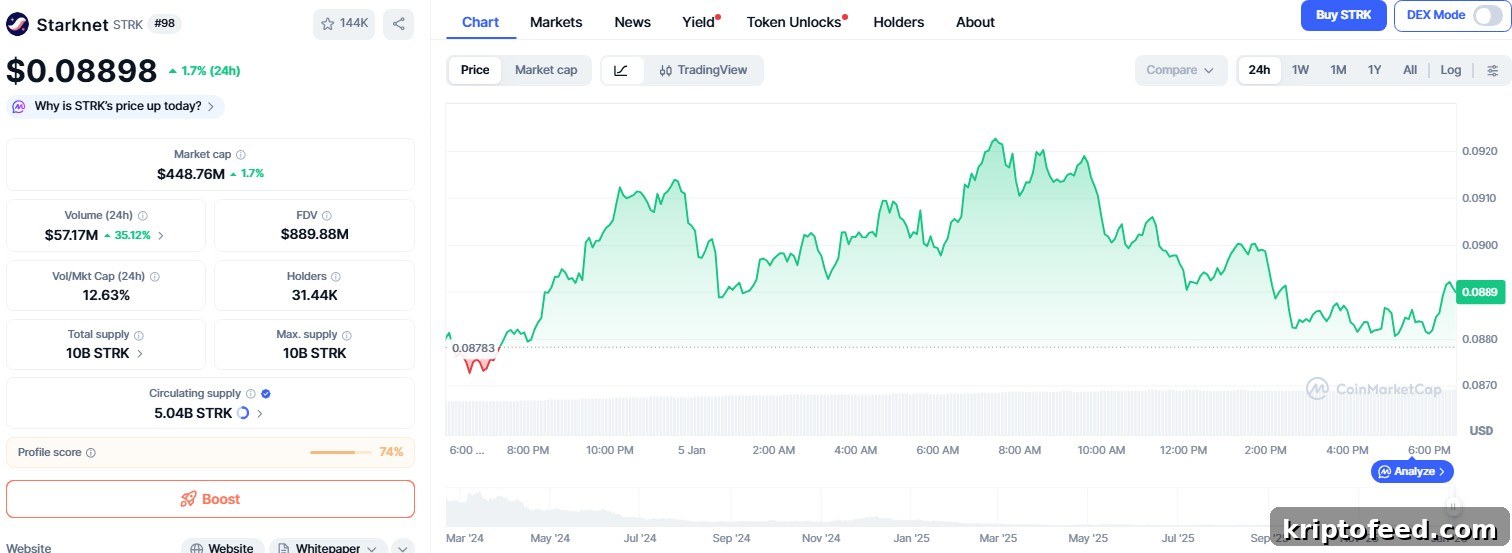
The token’s short-term resilience contrasted with the technical interruption, suggesting traders may have viewed the problem as operational rather than structural.
As engineers continued work to restore full functionality, attention remained focused on official updates and the duration of the disruption rather than on price volatility.