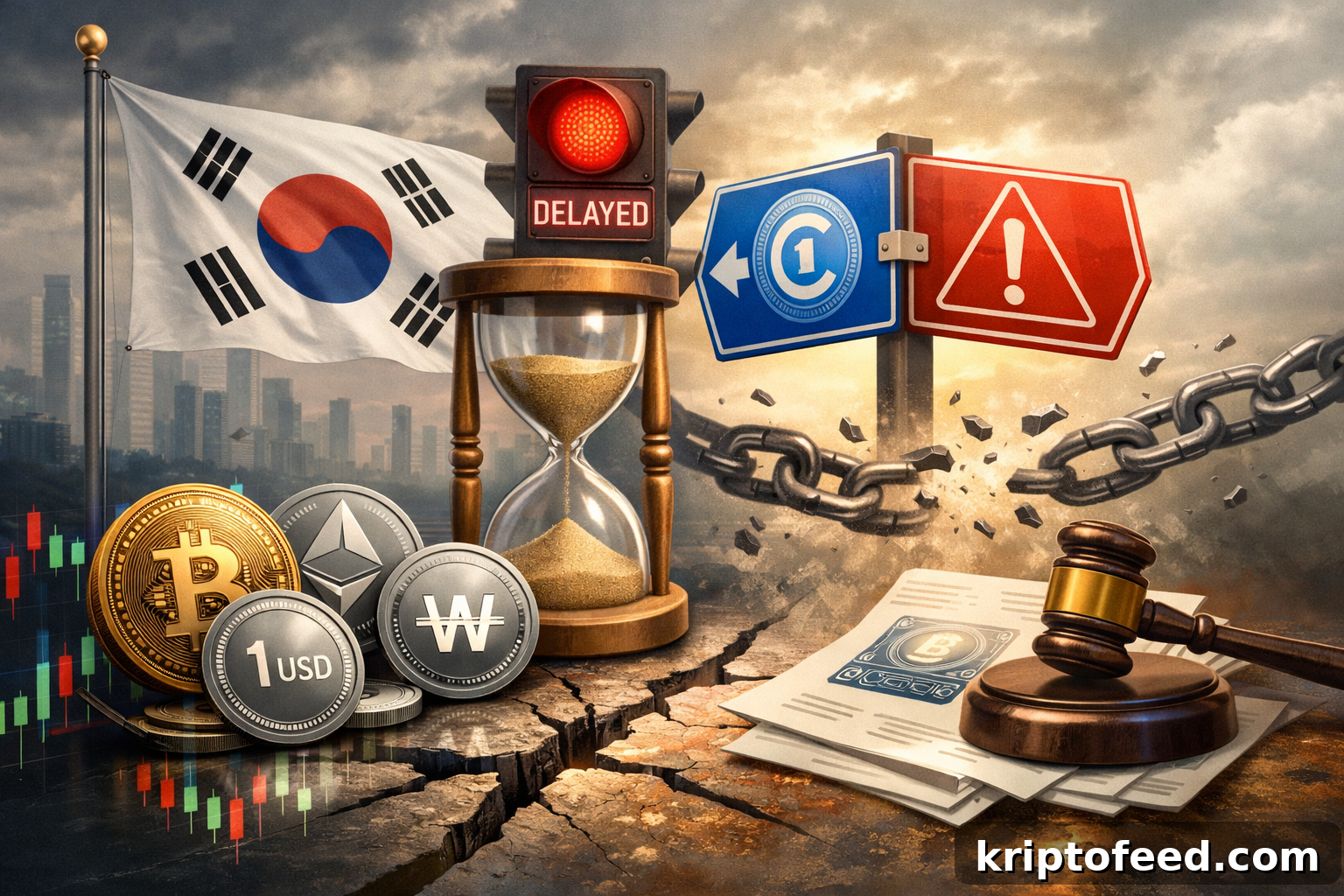
- South Korea has postponed its digital assets law until 2026 amid disputes over supervisory authority for stablecoins.
- Lawmakers have suspended crypto legislation as regulators clash over who should oversee stablecoin reserves and enforcement.
- Regulatory uncertainty is growing as Korea seeks to balance investor protection, monetary control, and innovation.
South Korea’s effort to formalize crypto regulation has stalled again, with authorities confirming that the Basic Digital Assets Act will not be introduced before 2026.
The delay highlights deep disagreement over how stablecoins should be supervised in one of Asia’s most active digital-asset markets, even as crypto products become increasingly connected to the conventional financial system.
This setback does not reflect a lack of interest in regulation.
Rather, it underscores how complex stablecoin oversight has become for policymakers trying to reconcile innovation, financial stability, and monetary sovereignty.
Because no consensus has been reached on who should hold ultimate authority, lawmakers chose to suspend the bill until the structural gaps are resolved.
Purpose of the proposed law
The Basic Digital Assets Act is intended to serve as the backbone of South Korea’s crypto regulatory framework.
Its primary aim is to protect investors by imposing stricter legal standards on digital-asset operators than those that previously existed.
One of the most notable proposals is the introduction of strict liability, which would make operators responsible for user losses even when negligence cannot be proven.
Another key pillar of the bill is the reduction of systemic risk posed by stablecoins. The proposal requires issuers to maintain reserves exceeding 100% of the circulating supply.
Those reserves would need to be held in banks or approved institutions and kept clearly segregated from the issuer’s own balance sheet.
The framework is designed to limit contagion risk if a stablecoin issuer were to fail.
Stablecoins and regulatory control
Stablecoins have emerged as the central fault line in the debate. While regulators broadly agree that tighter oversight is needed, they remain divided over who should enforce rules and supervise reserve assets.
The Financial Services Commission and the Bank of Korea have so far failed to agree on how responsibilities should be allocated.
These disagreements have complicated decisions on licensing, enforcement powers, and the treatment of reserve assets.
Rather than adopt a compromised framework, authorities chose to delay the bill to allow for further coordination between financial regulators and monetary authorities.
Market uncertainty grows
The postponement has not produced an immediate market reaction, but it adds another layer of uncertainty for crypto businesses operating in South Korea.
Exchanges, payment providers, and stablecoin issuers continue to expand while facing unclear long-term regulatory expectations.
The uncertainty can have practical consequences.
Companies may slow product launches, delay investment decisions, or consider moving some operations to jurisdictions with clearer rules.
For investors, the absence of a completed framework complicates risk assessment and compliance planning.
Politics and monetary strategy
Political dynamics are also shaping the timeline. The ruling Democratic Party is working to consolidate multiple lawmakers’ proposals into a revised digital assets bill.
At the same time, strategic concerns about monetary sovereignty are becoming more pronounced.
President Lee Jae-myung has identified a won-backed Korean stablecoin as a national priority, arguing it could counter the growing dominance of dollar-pegged stablecoins in global crypto markets.
Those ambitions increase pressure on regulators to ensure any framework aligns with broader monetary policy objectives.
The postponed Basic Digital Assets Act was intended to represent a second phase of crypto regulation in South Korea.
The first phase, already in force, focused on curbing unfair trading practices.