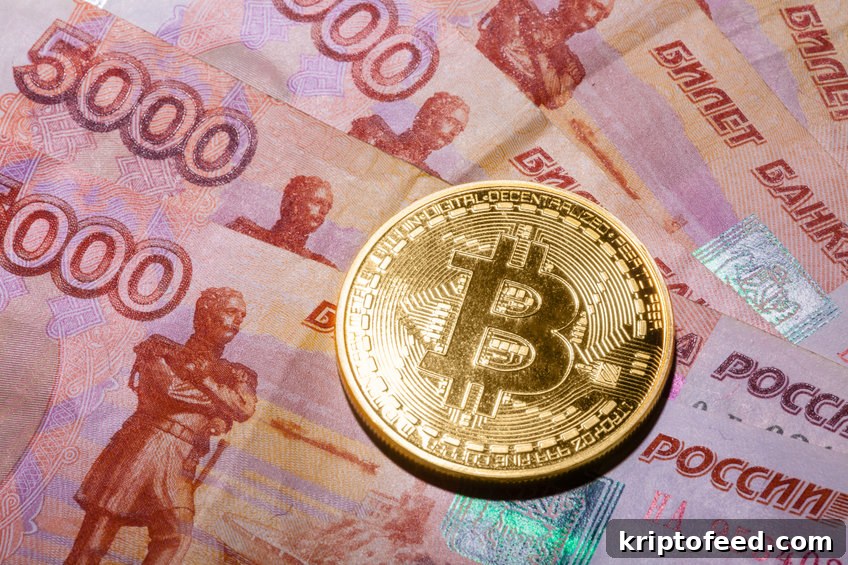
The Russian Federal Tax Service (RFS) has proposed a notable change in the debate over cryptocurrency legislation in Russia. According to reports, the RFS suggested allowing companies to make international payments using cryptocurrencies. Izvestia, a local newspaper, stated that the RFS submitted these recommendations as official comments on the draft crypto law on Wednesday.
“[…] to allow companies to pay foreign counterparties for goods and services and to receive payments in digital currencies,” the RFS wrote in response to the first draft of the cryptocurrency bill in Russia. The proposal could become a method for mitigating the impact of Western sanctions. If adopted, it would represent a significant shift in how cryptocurrencies are treated and could influence their market dynamics in Russia.
Cryptocurrencies as an escape route
The RFS proposal would effectively alter the current spirit of the bill, which now treats cryptocurrencies primarily as investment vehicles. The preliminary draft reportedly contains a clause that prohibits payments with cryptocurrencies except where the law explicitly provides otherwise. Under that framework, everyday commercial use and cross-border business payments are excluded unless an exception is written in.
By proposing explicit permission for companies to carry out international payments with digital currencies, the RFS aims to create an exception for business transactions. Izvestia reports the tax authority framed the proposal as a means to diversify payment options and support Russian businesses amid severe sanctions. Allowing controlled access to crypto payments could help companies maintain trade and financial operations with foreign partners.
The RFS also recommends that companies be able to buy and sell cryptocurrencies through regulated crypto custodians and exchange platforms. How this would be implemented remains unclear, particularly given that many international exchanges may be unable or unwilling to participate. The debate highlights how Bitcoin and the wider cryptocurrency market are increasingly relevant to geopolitical and economic policy discussions.
Bitcoin’s geopolitical moment
Bitcoin began in 2009 as a niche project embraced by cypherpunks and computer enthusiasts. Whether its anonymous creator, Satoshi Nakamoto, anticipated bitcoin’s current geopolitical significance is debatable. Nonetheless, bitcoin quickly developed monetary value and rose onto the global financial stage. Today, senior policymakers frequently discuss the role and risks of cryptocurrencies.
Different countries have reached divergent conclusions. China has imposed a comprehensive ban on bitcoin and bitcoin mining. The United States appears more receptive in some regions, with states such as Texas becoming hubs for mining activity. Russia is exploring bitcoin and crypto mining as potential tools to help circumvent Western sanctions and preserve economic channels.
Beyond major powers, other states have taken unique approaches: El Salvador, for example, became the first country to adopt bitcoin as legal tender. These varied paths show that bitcoin is a versatile monetary instrument that can be used in multiple ways. Some actors value bitcoin’s absolute scarcity, while others see its decentralized nature as a hedge against centralized control or geopolitical pressure.