The XRP token from Ripple continues to cement its position as the second-largest cryptocurrency by market capitalization. Trailed only by Bitcoin, Ripple’s corporate structure has allowed its digital currency to grow within a more controlled environment that encourages institutional adoption. However, that relatively centralized model has drawn criticism from segments of the crypto community that prioritize decentralization and resist centralized authorities. What has driven the rise of this bank-friendly cryptocurrency? This article examines the factors behind XRP’s recent momentum.
Slight global recovery, but XRP stands out—why?
After a rocky start to the week, Bitcoin and several altcoins caught a breather this Wednesday. Yet Ripple’s token drew special attention: the price of XRP surged roughly 10% within a few hours. Traders point to an announcement by SWIFT, the global interbank messaging network, as a likely catalyst. SWIFT is one of the largest banking communications systems in the world and its moves can influence expectations for cross-border payment solutions.
SWIFT and R3 — is Ripple joining the competition?
According to reports, SWIFT is preparing an integration with Corda, the enterprise blockchain platform developed by R3. R3 is a blockchain-focused firm that supplies distributed ledger solutions to financial institutions. That collaboration produced a proof of concept (PoC) to test a new payments gateway connecting e-commerce platforms with SWIFT’s GPI—the modern standard for cross-border payments.
How does this relate to Ripple? SWIFT is a key competitor to Ripple’s cross-border payment tools such as xCurrent and xRapid, the latter of which integrates XRP. Although the announcement did not directly mention Ripple, bullish traders highlighted two factors that helped justify the XRP rally:
- R3 publicly recognized XRP as “the first cryptocurrency globally acknowledged to work with its Corda Settler” and added support for the token in December 2018, highlighting interoperability with enterprise settlement tools.
- SWIFT’s former CEO Gottfried Leibbrandt acknowledged that part of Ripple’s value proposition involves the XRP token. Ripple CEO Brad Garlinghouse has also not ruled out cooperation with SWIFT, noting that Ripple has explored ways to interoperate with existing banking systems.
XRP: the fight to break out of the $0.30 range
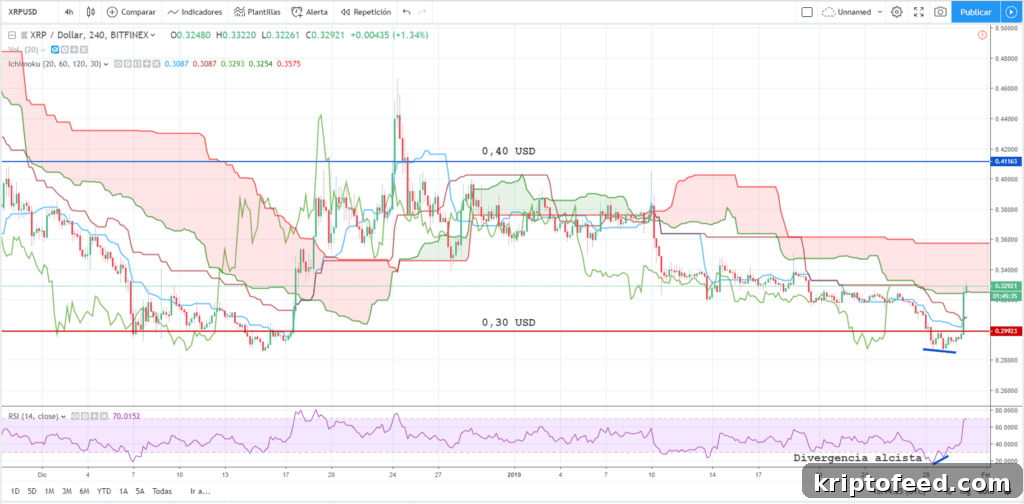
For the past two months, XRP’s price has been confined to a narrow band around $0.30. The altcoin repeatedly failed to sustain a breakout from this corridor. That bottleneck has prevented Ripple from holding levels above $0.40 for more than a month, despite brief spikes in December. Conversely, dips below $0.30 have tended to be short-lived.
A technical review of XRP over recent eight-week periods (using 4-hour candles) reveals several notable signs. First, there appears to be a double bottom near a key support level around $0.28. Second, the area near $0.40 has acted as a strong resistance that price has struggled to pierce. Looking at momentum, the relative strength index (RSI) showed a bullish divergence hours before the latest upswing. In addition, the Ichimoku cloud indicators seem to be forming a bullish TK cross, where the Tenkan-Sen may cross above the Kijun-Sen. If that signal completes, today’s rise could extend through the rest of the week.
If this technical language is unfamiliar, consult a basic guide to technical indicators to better understand signals like RSI, support and resistance, and Ichimoku patterns.
Do you think this XRP surge can sustain itself? Share your views in the comments section.