RCRDSHP is an emerging digital collectibles platform built on the Flow blockchain with a distinctive twist. Focused on bringing artists and fans closer through blockchain technology, the platform is firmly rooted in the metaverse and the new digital landscape. It offers a playful experience and a number of interesting features for both fans and artists, which I explore below.
Like other Flow-based projects such as NBA Top Shot, RCRDSHP currently emphasizes pack drops over auctions to keep collectibles accessible. Accessibility is a recurring priority for the platform: the team has openly stated they are not interested in the high-price NFT sales that have appeared in the music industry—examples like The Weeknd’s recent $490,000 sale are seen as out of reach for the typical fan. They also discourage speculation on their token—an unusual stance coming from crypto founders—and most of the founding team come from music rather than crypto.
Yesterday, in a press release, RCRDSHP introduced new NFT staking mechanics that allow fans to stake artist NFTs, earning yield for themselves while increasing exposure for artists. Naturally, I wanted to learn more about this and other aspects of the business.
I interviewed RCRDSHP’s founder and CEO, Obie Fernandez, to get his perspective.
CoinText: Do you plan to expand beyond the EDM genre?
Obie Fernandez: Yes, absolutely. We are actively recruiting key hires who can help us connect with artists and fans in other genres such as hip hop, Latin, and indie rock.
CT: Would you consider offering auctions or fixed-price items like some competitors?
OF: Creators will certainly sell fixed-price collectibles directly to fans on RCRDSHP, and as that activity grows, major pack drops will become special events rather than a weekly routine. Auctions are not a priority at this time.
CT: Why did you choose Flow?
OF: The developer experience with Cadence is excellent, but more importantly, we liked Roham, Mickey and the Dapper team and their focus on bringing NFT technology to millions of people without requiring prior crypto or wallet experience. Early RCRDSHP releases were also heavily inspired by NBA Top Shot.
CT: Your press release criticizes high-priced music NFT sales—like The Weeknd example—as inaccessible to typical fans. You promise “a steady supply of affordable collectibles.” How will you ensure affordability? And what if a highly popular artist wants to sell a more expensive NFT?
OF: Right now some big-name artists sell expensive NFTs simply because they can. That’s not sustainable and doesn’t meaningfully address the music industry’s structural problems. That said, if an artist on RCRDSHP wanted to try selling something for a million dollars, we wouldn’t stop them—it would have to be truly remarkable. Our player base is discerning and not easy to impress.
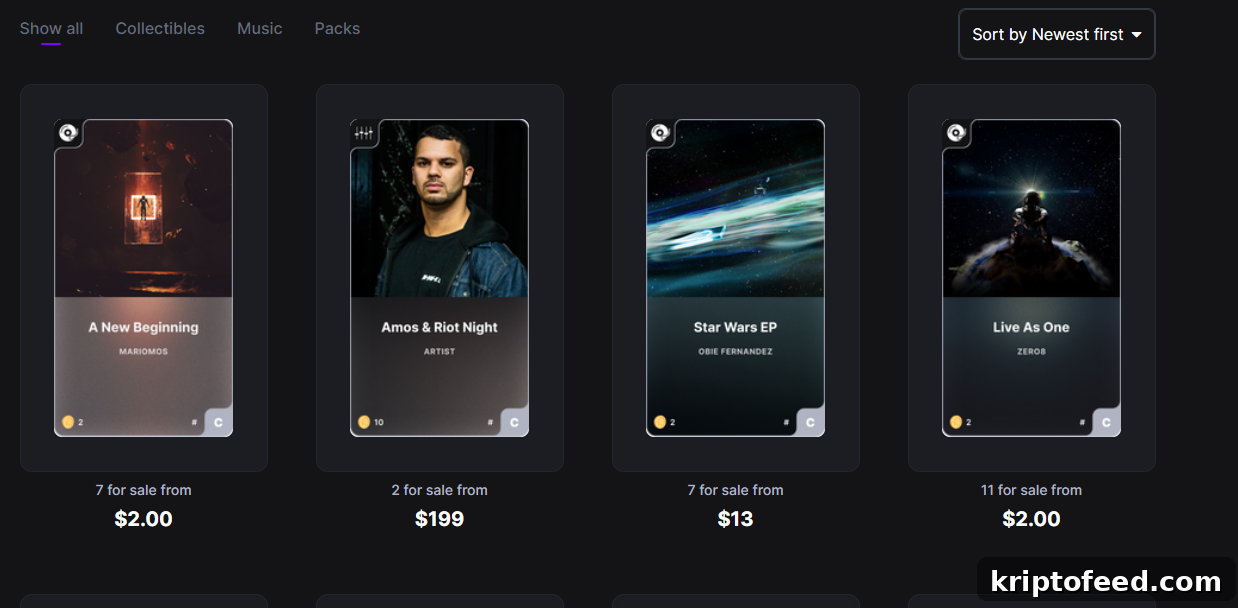 A screenshot of the marketplace on RCRDSHP
CT: Can you explain how the staking system allows fans to earn yield on behalf of their favorite artists?
OF: If you want to support an artist, you present that artist’s card—highlighting it in your public collection—and then “play” it by locking it (and its linked SOUND token) for a month in support of the artist. Daily staking rewards are calculated and distributed proportionally based on the number of SOUND tokens staked for each artist. There are a limited number of slots in a showcase, so if a player wants to increase the amount staked for a particular artist, they must “mash” that artist’s artist card by folding other collectibles from the same artist into it to create cards with progressively higher token values. We track how much each fan has generated for each artist and rank them on leaderboards to encourage competition and bragging rights for top patrons.
CT: What do you think is RCRDSHP’s greatest attraction for luring artists from competing platforms?
OF: Several factors. Most of our team, including me, come from music—not crypto or Wall Street—so we speak the artist’s language and build RCRDSHP with creators in mind. Distributing unexpectedly large revenue sums to early cohorts of artists has generated significant inbound interest because word spreads quickly. Newcomers often look at our roster and see established, respected artists, which makes conversations easier. Many competing platforms are filled with new or obscure artists, and established acts don’t want to dilute their brand by associating with creators they consider below their level. It’s not the most democratic dynamic, but it’s a reality.
CT: Can you explain how NFT burning works and how it creates scarcity and value for holders?
OF: If a RCRDSHP player no longer wants a particular collectible, they can convert it into tokens by burning it. Burning requires a “fire source,” such as a lighter or matchbook—also NFT-backed collectibles with a limited number of charges. Some fire sources, like our Genesis Set “Zippo Lighter,” are rechargeable; others, like “Late Night Pizza,” are only good for a few burns. Once you burn a collectible, it is removed from your collection (and its URL shows a small tombstone).
Burning is an important economic dynamic. When a player burns a collectible, the tokens tied to it are released and credited to their account. That can be seen as a penalty for the creator, since those tokens are no longer available for staking. On the other hand, market price is largely driven by rarity, so even a high burn rate can ultimately benefit creators by making the remaining mints harder to obtain, potentially increasing value.
CT: Do you plan to list the SOUND token on exchanges, and if so, on what timeline?
OF: Yes—on major centralized and decentralized exchanges, including ones that serve U.S. customers. We will make ongoing announcements about listings in the coming months.
CT: Your website says SOUND is not intended for speculation by players or the public. Do you have a plan to enforce that, or do you hope speculators won’t trade it? If you list the token, do you expect speculation to be inevitable?
OF: We don’t plan to build an enforcement app. The economy is designed so the platform itself exerts steady buy pressure on SOUND at around one dollar, so we expect the token to drift toward that level and remain near it. There are better assets for pure speculation.
CT: Looking at SOUND tokenomics, I notice a significant share—30%—allocated to the Treasury. What is the purpose of that allocation?
OF: The Treasury holds a large amount of tokens sold to private investors via SAFTs, and over time we’ll likely sell more to raise funds for additional projects similar to RCRDSHP—think RCRDSHP for Broadway, stand-up comedy, etc. We will also use some of that allocation to provide market liquidity.
CT: Can you elaborate on the 25% allocation for staking rewards? How will that portion be used?
OF: Staking rewards will be distributed daily and will vary with player activity. These rewards are central to our economic system because they replenish our content partners with tokens they can use to create new NFT-backed collectibles. The higher fan engagement and support for an artist, the larger that artist’s share of the rewards pool, enabling them to mint and sell more collectibles and generate revenue.