
Key takeaways
- Pi Network (PI) is consolidating inside a descending wedge pattern on the 4-hour chart.
- Deployment of cross-chain contracts on BSC and Optimism testnets is part of mainnet upgrade efforts that expand Pi Network’s functionality.
PI extends consolidation within descending wedge pattern
Pi Network (PI) is trading lower today, down roughly 1%, as it continues to consolidate within a descending wedge on the 4-hour chart.
Although recent price action has been bearish, the technical setup still shows modest bullish potential. PiChain Global, an important contributor to the Pi Network ecosystem, has deployed cross-chain smart contracts on the Binance Smart Chain (BSC) and the Optimism (OP) testnet, indicating that ongoing upgrades are bringing new cross-chain capabilities.
In a post on X, PiChain Global confirmed successful deployment of these contracts on both BSC and the OP testnet, which is built on Ethereum. The deployments point to increasing cross-chain interoperability for Pi Network.
PiChain plans to integrate the new cross-chain features into its PCM wallet. At the same time, it has temporarily paused the Meeta social app to reallocate resources toward core development tasks.
These developments are part of the Pi Core Team’s broader mainnet upgrade push. The upgrade process on testnet has reached Stellar Protocol v23, and mainnet nodes must complete the upgrade by Friday to remain connected. If the upgrade is successful on mainnet, similar cross-chain functionality should become available there, potentially increasing PI token utility.
PI price forecast: potential bullish breakout from descending wedge
On the PI/USD 4-hour chart, the bias has been bearish but shows signs of stabilizing. At the time of writing, PI is consolidating between the $0.1700 support zone and the recent high near $0.1766 recorded on May 9.
This consolidation sits between two trendlines: a descending resistance connecting the April 29 and May 6 highs, and a descending support that traces the April 30 and May 8 lows.
Short-term momentum indicators are improving. The Moving Average Convergence Divergence (MACD) remains above its signal line, while positive histogram bars are contracting toward the zero line, suggesting momentum is slowing but still tilted toward buyers.
The Relative Strength Index (RSI) is rising in the mid-range, currently around 46, and the price holding above the key $0.1700 level points to a constructive divergence in the short term.
If buyers regain control, immediate resistance lies at the short-term descending trendline near $0.1766. A sustained break above that level could remove the present cap and open a path toward the May 6 high around $0.1881.
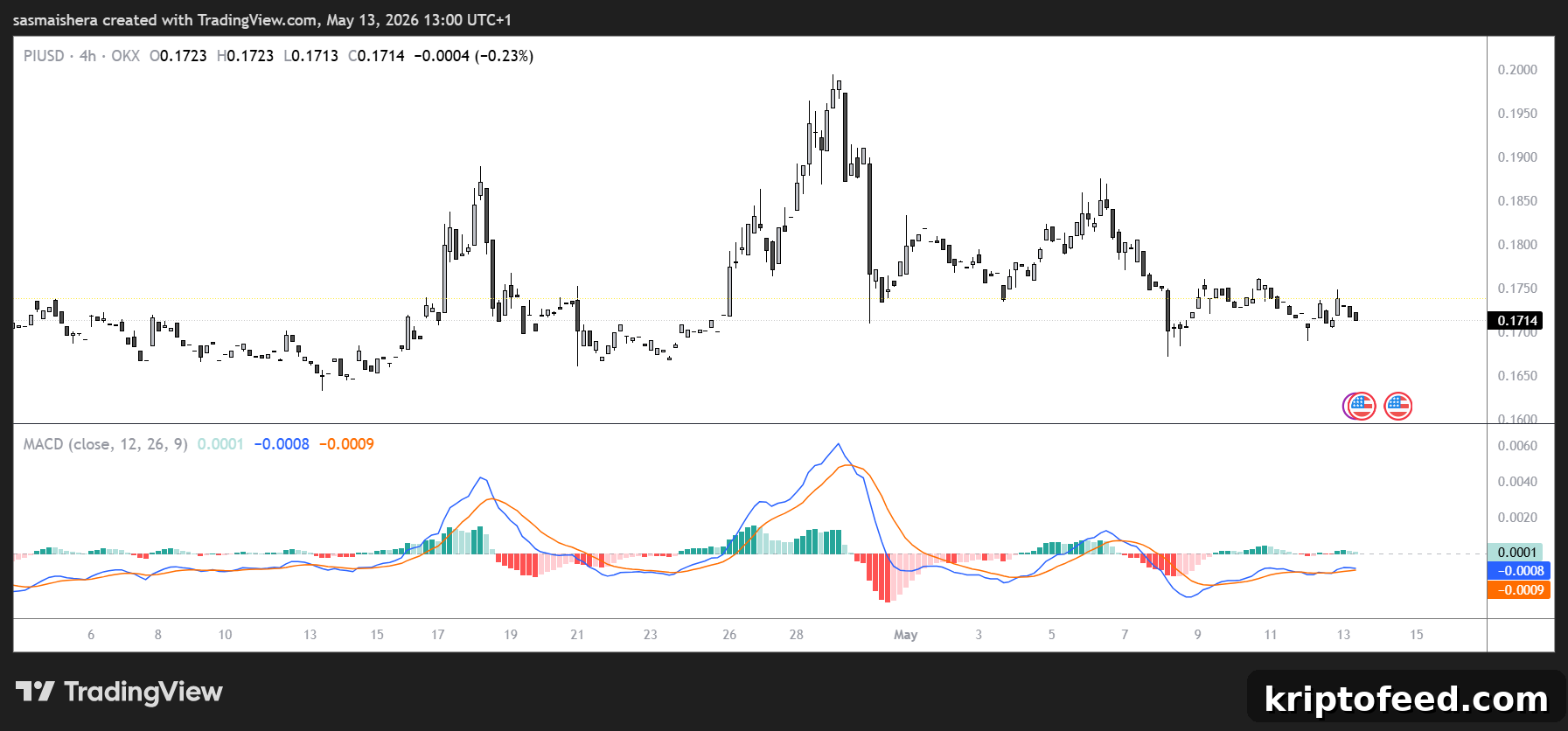
On the downside, initial support is the psychological $0.1700 mark, followed by the active descending support trendline near $0.1670. A decisive break below that support could trigger a deeper pullback and weaken the broader consolidation structure.