
Pi Network, a cryptocurrency once notable for its mobile-mining model, is facing mounting pressure from a wave of negative technical signals and growing investor caution.
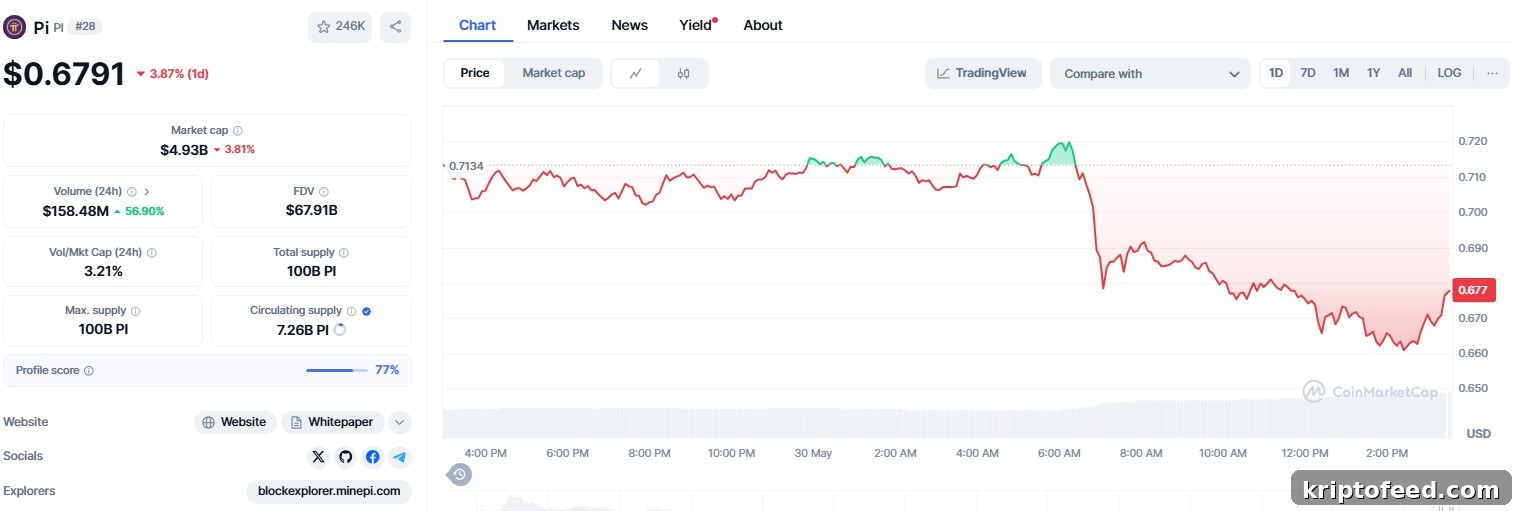
Pi has lost a key support level and is now trading at $0.67, down from $0.71 just a day earlier.
This recent breakdown suggests increasing downward momentum in the coming sessions, with sentiment among holders appearing to weaken.
 Source: CoinMarketCap
The price trajectory for Pi has shifted notably over the past few days, and several key indicators now point to persistent bearish momentum.
These signals arrive as broader altcoin markets contend with lower liquidity and reduced risk appetite, amplifying the impact on mid-tier tokens like Pi Network.
CMF points to sustained selling pressure
One of the most notable indicators highlighting the current outlook is the Chaikin Money Flow (CMF), which has dipped just below the zero line.
This move indicates that selling volume has begun to outpace buying volume.
Although the CMF shift remains close to neutral territory, it signals a reversal in market confidence.
This subtle but meaningful change mirrors broader investor behavior.
Market participants are increasingly cautious, with many opting to lock in gains or reduce exposure in anticipation of further price declines.
Outflow dominance over inflow is often viewed as a key sign of sustained sell-offs, and for Pi, that risk is growing.
The outflow trend may also reflect concerns about Pi Network’s longer-term adoption, especially as newer utility-focused tokens and large-cap coins dominate market narratives.
Squeeze indicator signals breakout risk
Another significant technical signal is the squeeze momentum indicator, which shows Pi Network currently in a low-volatility “squeeze.”
This phase is marked by black dots on the chart, indicating compression in price movement that typically precedes a strong directional breakout.
In Pi’s case, the build-up appears bearish, suggesting that once volatility returns, the coin could experience a sharp downward move.
The present squeeze follows a string of lower highs and a failure to hold above previous support zones.
Blue dots on the indicator, which would signal a release phase, have not yet appeared—meaning the potential move is still forming.
Traders and short-term holders will watch closely for signs of a release. If confirmed, any resulting sell-off could be rapid, potentially driving Pi to test new lows.
Local support at $0.61; downside risk remains
With the price now at $0.67, immediate support sits around $0.61.
This level could offer temporary stability, but a break below it would likely open the door to further losses, potentially toward $0.57.
Such a decline would represent nearly a 15% drop from the current level and would deepen the token’s downtrend, further eroding confidence among existing holders.
On the upside, reclaiming $0.71 would be the first step toward invalidating the bearish thesis for Pi Network.
A move above $0.78 would mark a higher high and could shift momentum, attracting buyers back into the market.
However, given current indicators, such a reversal remains uncertain.
Pi Network’s long-term prospects will depend on the utility it can deliver as well as broader market conditions.
For now, price action and volume flows suggest that caution is likely to prevail.