
- PancakeSwap (CAKE) bounced 1.8% on higher volume and improving short-term momentum.
- A governance proposal to cut CAKE’s max supply by 11.1% could help support price stability.
- January catalysts include a BNB Chain upgrade and a PancakeSwap AMA.
PancakeSwap (CAKE) has returned to the spotlight as traders and long-term holders reassess its price outlook amid supply changes driven by governance, improving technical indicators, and several ecosystem events scheduled for January.
After several weeks of downward pressure, CAKE is showing early signs of stabilization, drawing renewed attention from both active traders and longer-term participants.
At the time of writing, PancakeSwap (CAKE) was trading near $2.00, up roughly 1.8% over the past 24 hours.
This bounce follows a significant 10.29% decline over the past 30 days, highlighting the token’s continued price volatility.
Below we examine how supply dynamics, technical indicators, and upcoming ecosystem events could influence PancakeSwap’s price trajectory.
Governance proposal to cut PancakeSwap’s CAKE supply
One of the most closely watched developments is the PancakeSwap governance proposal to reduce CAKE’s max supply.
The proposal seeks to lower the maximum supply from 450 million to 400 million tokens, a reduction of approximately 11.1%.
This measure builds on Tokenomics 3.0, which has already burned around 8.19% of the total supply in 2025.
If approved, roughly 50 million CAKE would remain unminted, substantially reducing the risk of future dilution.
A clearer scarcity narrative often bolsters long-term confidence, especially for mature DeFi protocols.
Market participants are watching the governance vote—expected by mid-January—as a potential trigger for increased demand.
Discussion around supply discipline also reinforces PancakeSwap’s broader narrative of sustainable token economics.
January catalysts: BNB Chain upgrade and AMA exposure
January brings several ecosystem-level catalysts that could affect sentiment around PancakeSwap (CAKE).
The BNB Chain Fermi hard fork, scheduled for January 14, aims to reduce block times to roughly 0.45 seconds.
Faster blocks could improve the efficiency of decentralized exchanges and indirectly benefit PancakeSwap’s user experience.
PancakeSwap already accounts for about 40% of BNB Chain traffic, amplifying the potential impact of network upgrades.
On the same day, Stellar (XLM) is hosting an AMA with PancakeSwap, which will raise the protocol’s visibility across communities.
While primarily informational, the AMA underscores PancakeSwap’s role in broader DeFi discussions and can increase community engagement.
Together, infrastructure upgrades and ecosystem outreach create near-term relevance for PancakeSwap price discussions.
Technical rebound and short-term momentum
From a technical perspective, CAKE has begun recovering from oversold conditions.
The Relative Strength Index (RSI) moved up from below 30 to roughly 48.5, exiting deeply oversold territory.
On the daily chart, the MACD has produced a bullish crossover, with the histogram turning positive for the first time in over a week.
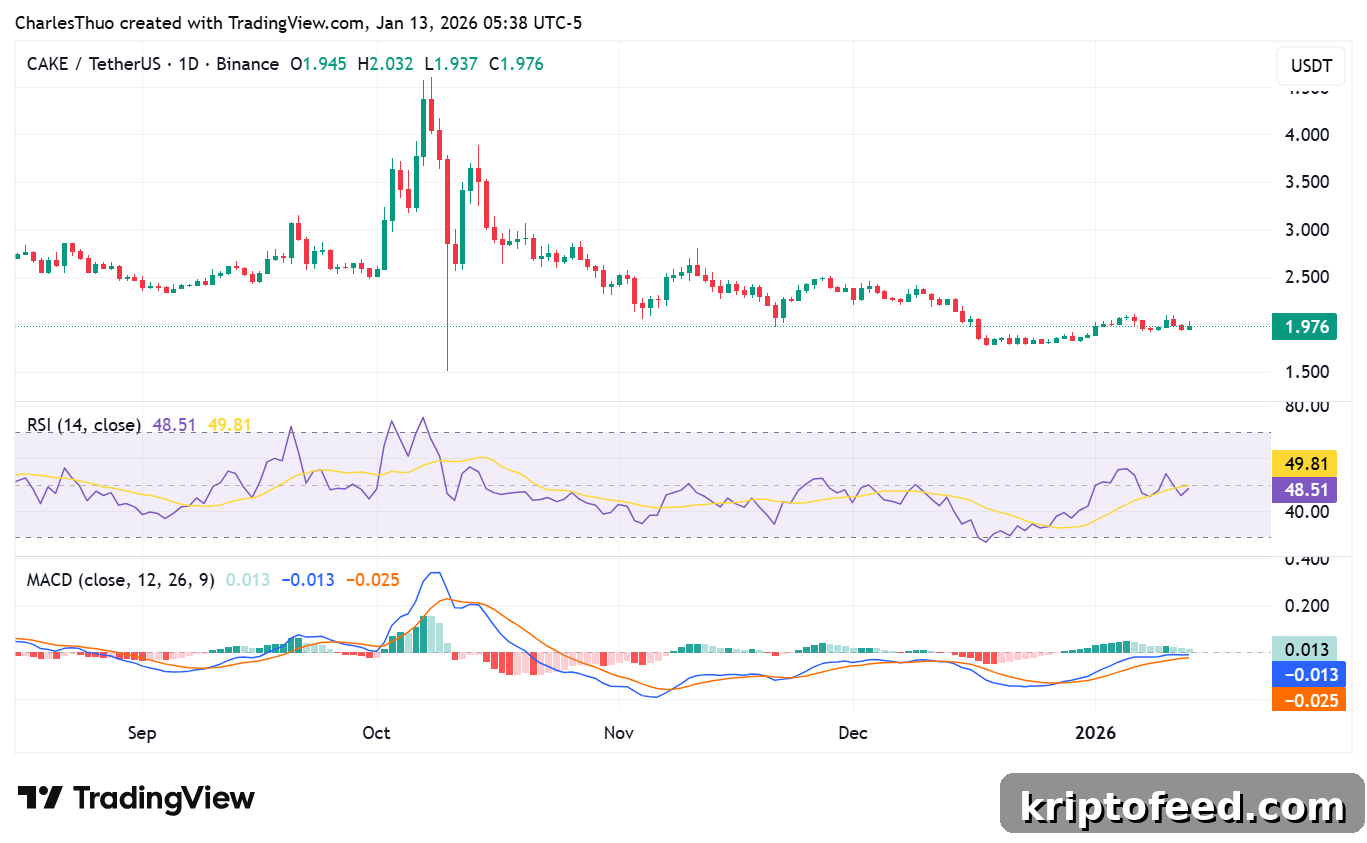
These indicators point to improving short-term momentum for CAKE’s price, suggesting that sellers may be losing grip and buyers are stepping in at current levels.
Price outlook for PancakeSwap (CAKE)
PancakeSwap’s price outlook will depend on the outcome of supply reduction measures, continued technical recovery, and the impact of January catalysts.
Approval of the supply cut would likely reinforce bullish sentiment by highlighting scarcity and lowering future dilution risks.
Sustained trading volume and maintaining support around $2.02 are important for short-term stability.
A decisive breakout above $2.15 could shift momentum toward a further short-term rally, while failure to hold current levels might expose CAKE to renewed downside pressure.
As always, traders should weigh on-chain developments, governance outcomes, and macro market conditions when assessing risk and potential reward.