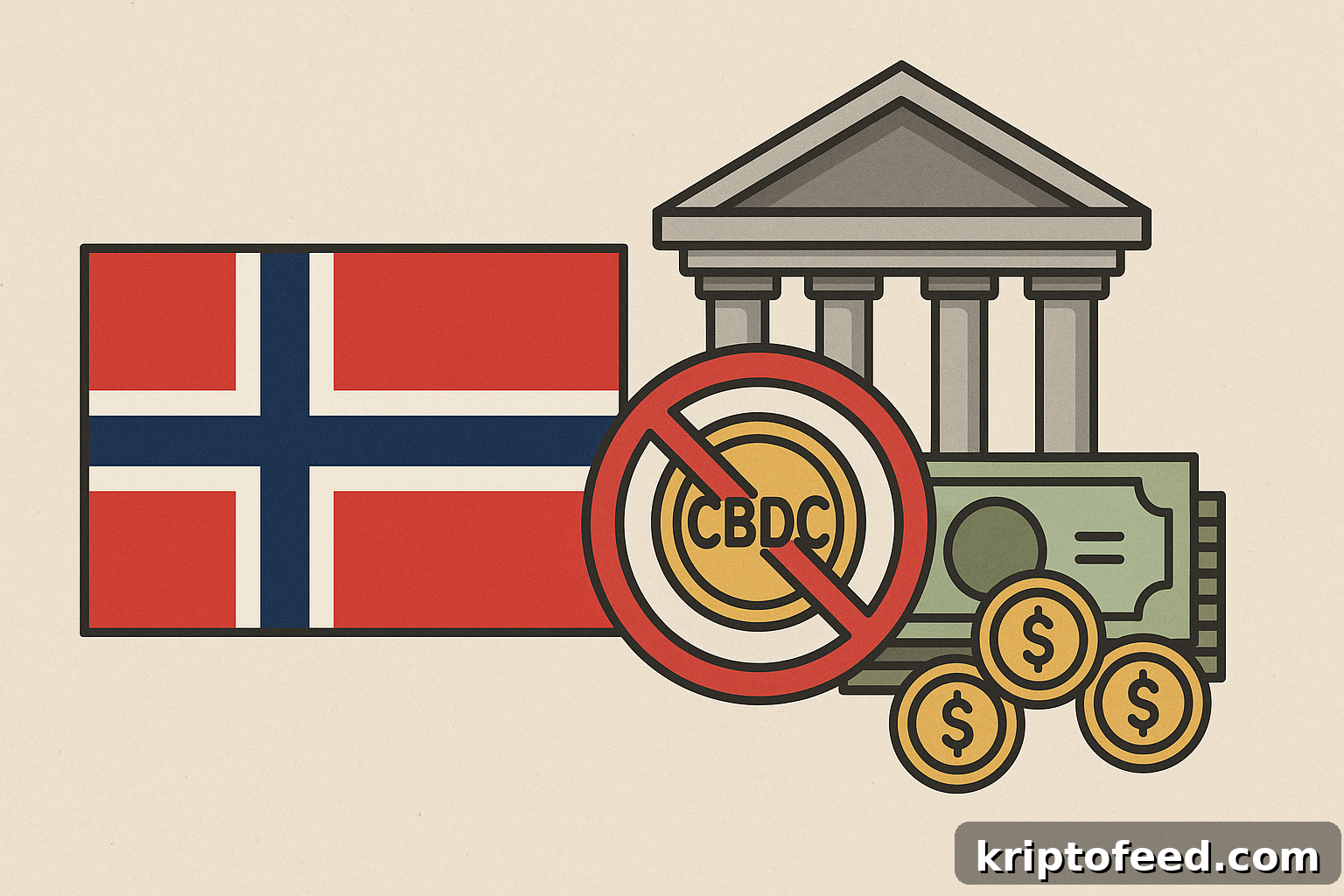
- Norway pauses CBDC plans and says the current payment system remains secure and efficient.
- The central bank will continue studying retail and wholesale CBDCs as payment habits evolve.
- Norges Bank shifts focus to tokenization trials while monitoring global movements in digital currencies.
Norway has determined that its payments system works well enough without introducing a central bank digital currency (CBDC) at this time, despite several years of research into the idea.
The decision reflects how stable and effective the country’s existing infrastructure has remained, even though Norway is one of the world’s most cash-averse economies.
It also indicates that the central bank’s priority is ensuring that payments continue to function securely, rather than rushing to launch a digital krone before it is needed.
Norges Bank announced Wednesday that a CBDC is not necessary at this stage after a broad assessment of how a digital version of the krone might support payment security and efficiency.
Cash use in Norway has continued to fall to some of the lowest levels globally, prompting debate about whether the country needed a digital alternative to keep the national currency attractive to consumers, banks and merchants.
The central bank said the current system provides stable operations, rapid settlement, low economic costs and robust contingency arrangements.
It also noted that several projects are already underway to further strengthen these backup systems.
Timing of the decision
The central bank made clear that the decision is not permanent and that the question may resurface as payment habits evolve.
Norges Bank said it wants to remain ready to introduce a digital krone if that becomes necessary to maintain a secure and efficient system.
The bank continues to distinguish between two main CBDC models.
A retail CBDC would function as an easily accessible payment method, similar to physical cash or bank deposits.
A wholesale CBDC would be designed only for financial institutions and would enable interbank transactions through tokenized units recorded on a digital ledger based on distributed ledger technology.
Types of CBDC
This distinction has shaped much of Norway’s work so far.
A retail model would give ordinary users direct access to central bank money in digital form, while a wholesale model would mirror existing central bank deposits by using tokenized units.
Both approaches remain under review as part of Norway’s broader assessment of future payment needs.
The country’s low reliance on cash had previously accelerated these evaluations.
Nevertheless, Norges Bank concluded that maintaining a strong and reliable existing system is the immediate priority, with a CBDC considered only if payment risks or gaps emerge later.
Tokenization trials
Although Norway is pausing work on a digital krone, it is increasing its focus on tokenization.
The bank said token-based systems could improve efficiency, enable innovation and reduce settlement risk.
It also warned that uncertainty remains about how widely tokenization will be adopted and what types of risks could arise as the technology matures.
Norges Bank plans to continue practical experiments in collaboration with industry participants to understand how tokenized solutions perform in real transactions.
These trials are part of a broader strategy to prepare for future developments in digital finance, without committing to a CBDC at this stage.
The central bank will publish a detailed report on its CBDC research in the first quarter of next year.
The report will outline the work completed to date, the next steps, and how Norges Bank plans to monitor progress in other regions.
Norway is closely following international projects, including the Eurosystem’s work on a potential digital euro and emerging global standards that could support cross-border CBDC arrangements in the future.