A new research paper by a pseudonymous author values a single bitcoin at $5.8 million. The paper argues that bitcoin is the best form of money available today and should be valued as the dominant global currency.
Throughout the paper the author examines bitcoin’s intrinsic value, its practical use cases, projected levels of adoption, and the possibility of bitcoin becoming the world’s most widely used form of money.
The research paper is titled Bitcoin: A $5.8 Million Valuation. The author lists their name as Mr. Game & Watch, the name of a character from the Super Smash Bros. series. When asked about his identity, Mr. Game & Watch told CoinJournal that he prefers to remain anonymous, citing concerns about offending powerful figures and noting that the work should stand on its own. He did mention that he is American with an academic background.
Bitcoin’s Intrinsic Value
Before proposing a $5.8 million bitcoin price, the paper addresses bitcoin’s “intrinsic value.” The abstract argues the collectible bitcoin is required to access the Bitcoin payment network—even for transactions denominated in USD—and claims that the network has enormous utility worldwide, particularly for criminals and victims of political oppression.
The abstract further notes that bitcoin can retain its useful properties even under pressure from wealthy or violent adversaries, such as hostile governments. The author dismisses most altcoins as serious threats to bitcoin’s dominance, in part because sidechains can enable bitcoins to be transferred to alternative blockchains that offer different features and value propositions.
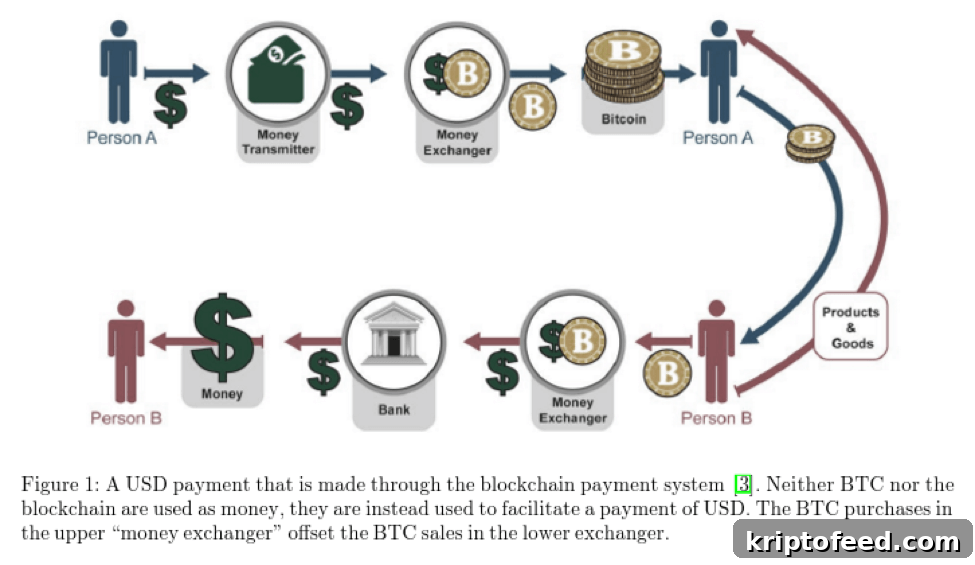 The paper explains bitcoin’s intrinsic value more directly: BTC uniquely grants access to the network’s block space. That block space, together with BTC, enables a class of transactions the author calls “Peer-to-Peer Digital USD Payments” (PDUPs).
Bitcoin Use Cases and Adoption
After outlining intrinsic value, the author explores Bitcoin as a payment system and identifies who needs PDUPs. The paper lists disadvantages—learning new technology, dealing with wallet providers and exchanges, and bitcoin’s price volatility. Advantages include potential privacy (which can be improved) and the network’s resistance to censorship or shutdown.
The paper emphasizes: “These PDUPs cannot be made without BTC.” In the author’s view, while many people speculate on bitcoin’s price, users adopt bitcoin because it enables PDUP services.
The paper is candid about the kinds of transactions PDUPs make possible. Because PDUPs restore a high degree of financial sovereignty to the user, they are “for better or worse, optimal for illegal transactions,” the author writes, listing gambling, capital flight, tax avoidance, and ransomware payments as common uses. Later the paper expands on this, saying that bitcoin’s intrinsic value includes enabling people to get paid, hide assets, gamble, or otherwise transact outside typical legal or social constraints.
The author argues this intrinsic value is durable wherever local governments are uncompetitive or unable to provide secure, private financial alternatives.
The $5.8 Million Bitcoin Price
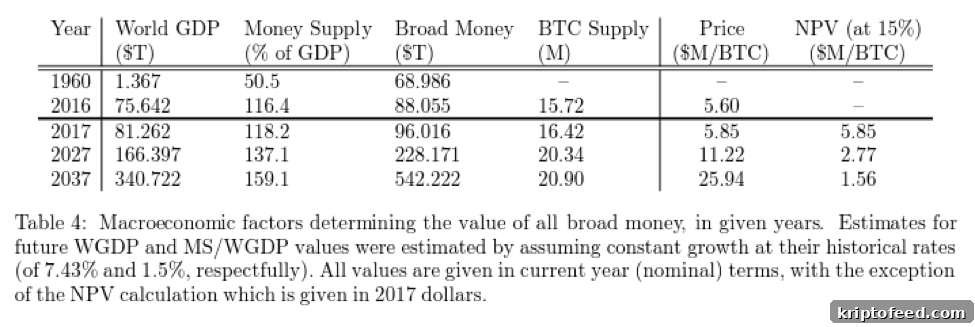
The paper ultimately asks readers to entertain the possibility of bitcoin becoming the dominant global currency. If bitcoin were to fulfill that role, the author contends, valuing it becomes a matter of estimating the total global stock of money and allocating that value across bitcoin’s limited supply, which yields the $5.8 million per bitcoin figure.
To estimate the world’s money supply, the paper cites World Bank figures for “broad money” as a proxy for total money in circulation.
For an analogy supporting the network effect that could lead to bitcoin’s dominance, the author references Nassim Taleb’s observation that most beverages in U.S. stores are certified kosher even though a tiny fraction of the population keeps kosher—because it’s simpler for retailers to stock a single product that meets all customer needs. The paper argues a similar dynamic can favor the adoption of a single global currency.
Two forces are highlighted: sellers strongly prefer using a single currency rather than multiple; and some users who are willing to use bitcoin cannot easily switch back to relying solely on USD. The paper concludes these asymmetries make a transition toward bitcoin plausible.
Other drivers of adoption discussed include the eventual capacity of Bitcoin’s network through technical improvements or sidechains, cultural shifts toward digital money, and self-reinforcing expectations that encourage more people to adopt bitcoin because others already have.
Overall, the paper presents a provocative and controversial case: bitcoin’s unique access to block space creates lasting intrinsic value by enabling PDUPs, and if bitcoin becomes the dominant global currency, a valuation in the millions per coin follows from current estimates of the global money supply.