
Aave has over $1 billion in total value locked and is currently the fourth largest by this metric among DeFi protocols
New data indicates that Aave, the decentralized lending protocol ranked fourth by total value locked (TVL), is considered low risk for depositors. DeFi Pulse’s recently introduced Economic Safety Grade tool assigns Aave a score of 95%, categorizing the protocol as “very safe” for its user community.
The same assessment tool evaluated Compound as well, giving it a score of 91%, which likewise places it above the “safe” threshold.
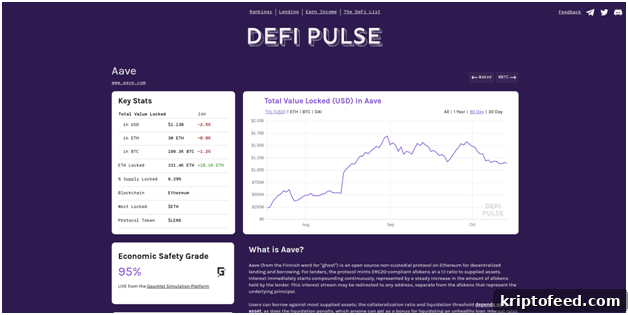
Risks within the DeFi space
The Economic Safety Grade tool, developed by DeFi Pulse in collaboration with digital-asset risk firm Gauntlet, quantifies the likely risks a protocol may present and expresses that assessment as a percentage.
This tool arrives after a rapid expansion of DeFi projects and capital inflows, a period when many users focused on potential returns without fully scrutinizing associated risks. A number of security incidents and exploits in the ecosystem highlighted the need for better risk assessment.
Gauntlet has emphasized these risks and positioned the Economic Safety Grade tool as a way to help users and stakeholders better understand protocol vulnerabilities.
The tool evaluates protocols on a scale from 1 to 100, accounting for factors such as collateral volatility, liquidity conditions, smart-contract security, protocol parameter settings, and observed user behavior.
According to DeFi Pulse, the grade is based on simulations that combine on-chain user data with market information from centralized and decentralized exchanges to estimate market and systemic risks.
At the time of reporting, Aave and Compound hold approximately $1.10 billion and $865 million in TVL, respectively, locked in their smart contracts.
Below is a snapshot of Aave’s market performance and technical posture.
AAVE/USD
Aave completed a token migration from LEND to AAVE at a ratio of 100:1. After the migration, AAVE traded as high as $53.40 on October 10.
Over the past week the AAVE/USD pair has faced difficulty building upward momentum. Following a sharp move down from highs near $56.00, selling pressure has pushed prices below the 20-day simple moving average (SMA).
Support near $47 prevented more severe losses and helped slow the decline, but the overall bias remains bearish until buyers can push prices back above the 20-day SMA, located near $51.40.
Shorter-term technicals on the 4-hour chart indicate that bulls may struggle to clear this resistance level.
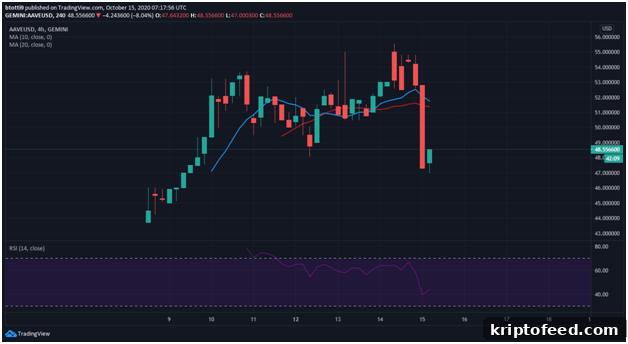
At the time of writing, the Relative Strength Index (RSI) reads around 44.45, suggesting bears still exert influence. If selling resumes, a lack of nearby support could send price toward the $46.00–$45.00 area, which may act as the next support zone.