
NEM (XEM) rose about 20% during the last session after bouncing from the base of its long-term triangle formation, then began a pullback. What can we expect from NEM in the short term?
Although NEM (XEM) remains consolidating near the lower boundary of its long-term triangle pattern, a notable bullish impulse pushed the coin up roughly 20% at one point. That move has since softened, but XEM has retained a portion of the gains.
The broader outlook for NEM is highly optimistic thanks to strengthening fundamentals. NEM announced on Twitter that Nikkei Sangyo Kokokusha, part of the Nikkei Group, will collaborate with NEM in Japan to build the NEM brand and support the launch of Symbol.
Over the past week NEM gained only 0.16%. Still, its performance outperformed Bitcoin’s 11.25% decline and Ethereum’s 5.83% loss over the same period. At the time of writing, XEM trades at $0.2386, reflecting a 7.12% decrease in price over the last month.
XEM/USD
XEM is currently trading inside the long-term triangle pattern that began forming in late December 2020. Its price has been following the triangle’s lower trendline, repeatedly bouncing and moving toward the roughly $0.26 area.
While XEM is still well within the triangle, the lower trendline serves as its nearest and strongest support. On the upside there are several key levels to watch, with immediate resistance near $0.2595.
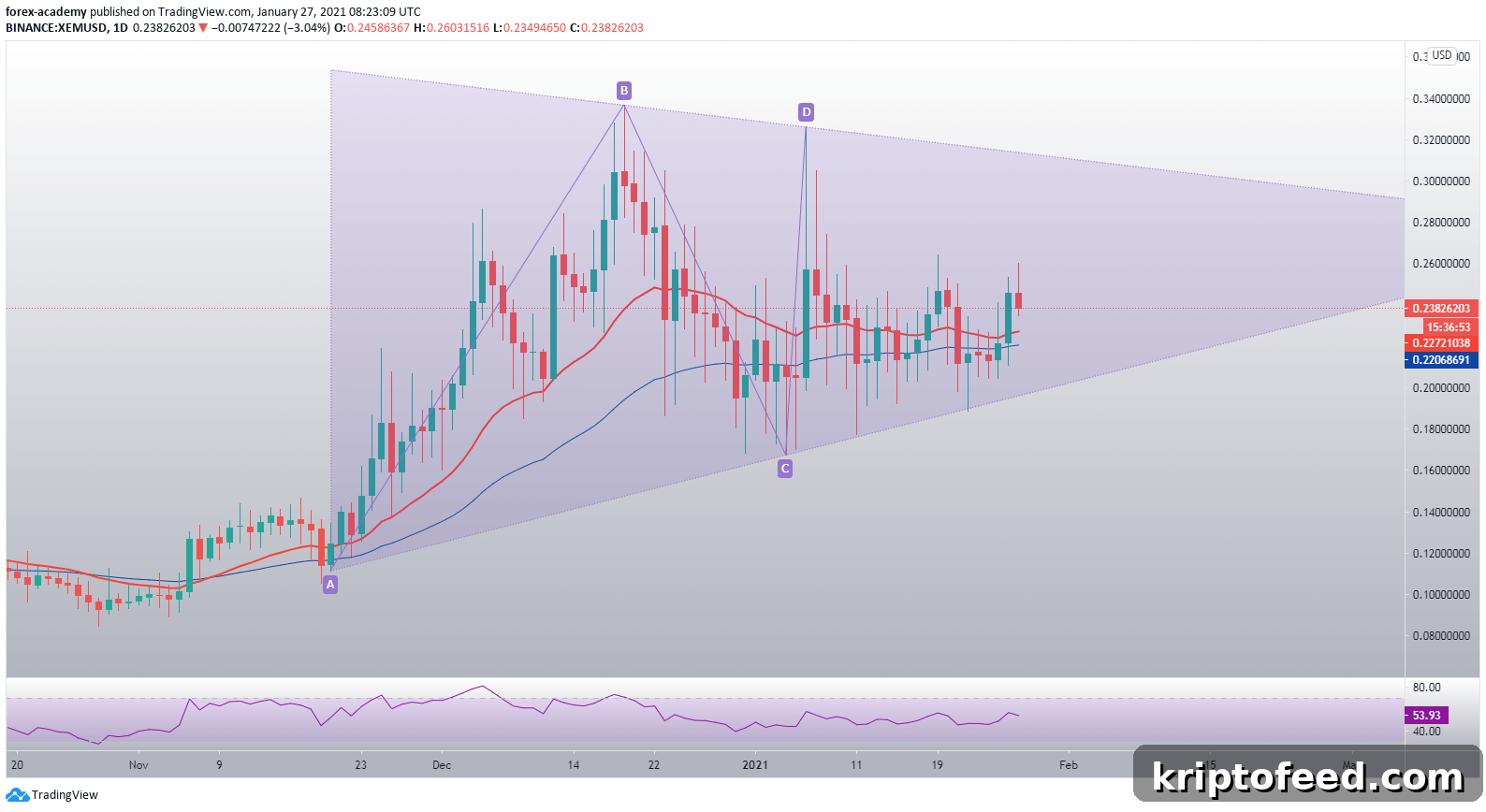
Daily XEM/USD chart. Source: TradingView
The 1-day RSI for XEM is currently rising, with the indicator near 50.73, indicating neutral-to-slightly-bullish momentum.
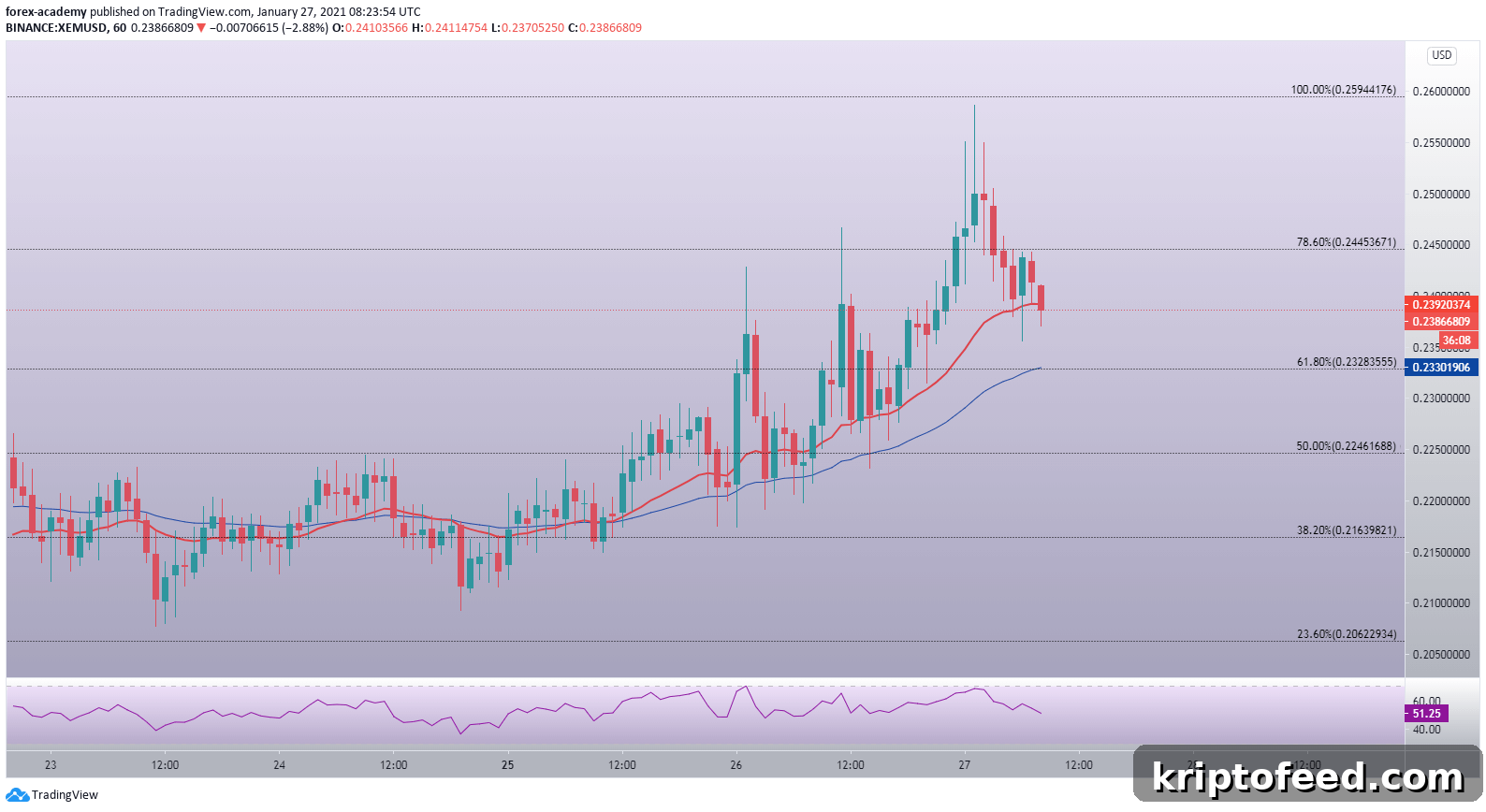
1-hour XEM/USD chart. Source: TradingView
The 1-hour chart shows XEM moving sharply higher in a fast, explosive advance, which extended and then retraced multiple times. The most recent high sits at $0.2577. After failing to break above the $0.2595 Fibonacci retracement, XEM dropped below the 78.6% Fibonacci level and the 21-hour EMA.
Short-term support levels include the 50-hour EMA and the 61.8% Fibonacci retracement at $0.2328. Traders should watch price behavior around these levels; a sustained hold above the 21-hour EMA and the immediate resistance zone could signal another attempt to retest $0.26, while a break below the 61.8% retracement would increase downside risk inside the triangle.