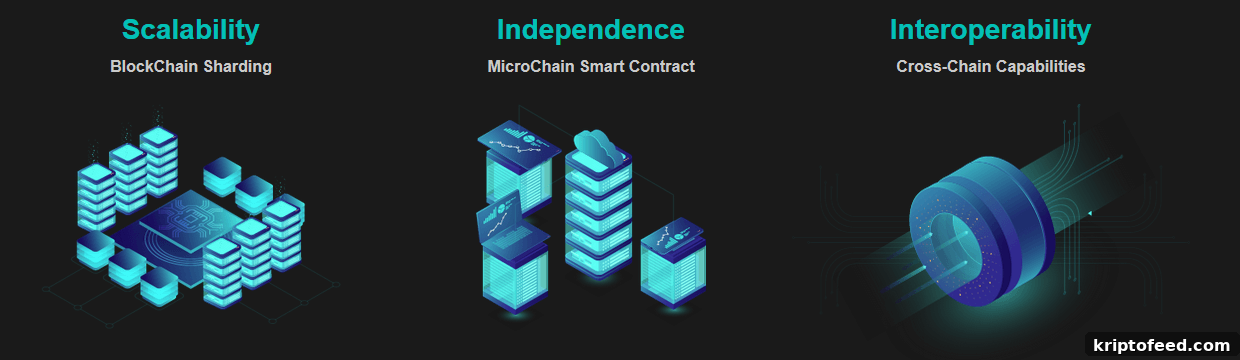
In their announcements, the creators promised investors and users a very fast, functional and highly efficient system. Another important aspect is excellent scalability. The network relies on a so-called “multi-layer architecture,” which also enables the creation of MicroChains.
Furthermore, transactions within the “multi-layer” blockchain can occur across different chain segments, not only within individual blocks. On its website the operator refers to this capability as cross-chain functionality. The developers aim to enable applications that go beyond the typical infrastructural network features offered by many competitors.
Differentiation between transaction types
One feature deserves special attention. Developers who carry out transactions such as payments, account overviews or create smart contracts can set priorities within the network and clearly distinguish between different transaction types. The blockchain’s development addresses a common shortcoming in many coin-based networks, where all transactions are often treated the same. MOAC’s innovations allow significantly faster transaction execution and a much higher number of transactions per second.
Ambitious goals for a successful 2018
The distinction between payment transactions and smart contracts is important, according to the developers, because contracts consume much more system resources while payments and similar ledger entries require far less. The ICO concluded in summer 2017, raising roughly seven million US dollars for the project. Early interest came particularly from Asia, where social media platforms and messaging services such as WeChat served as access channels. According to the whitepaper, the MOAC team targeted around 100 dApps in the network by the end of 2018.
Even lower-powered devices can participate
Given the system’s flexibility and its capacity to handle many transactions without high computational power, this goal appeared realistic to observers. That also allows network participants who use lower-performance devices — including smartphones — to take part in value creation. This approach to scalability lays the foundation for rapid and substantial growth. MOAC aims not to impose technical limits on users, as many other blockchain models and cryptocurrencies still do. The operator highlights its “unique sharding” implementation in the form of MicroChains. Development focuses on delivering tailored solutions, since there is no single best approach to building dApps.
The user is at the center of the MOAC network
The orientation is toward creating suitable blockchains for each user requirement within the overall system. Configurability here refers not only to block sizes in a chain but also to generation frequency, node counts and protocol design, all tuned to user needs. Each MicroChain is developed as a separate module. The foundation for this is MOAC’s SAAM — “Smart Contract as MicroChain.” In the Mother of All Chains system, every independent application receives a dedicated blockchain optimized for its specific conditions.
Transactions involving multiple currencies are supported
This also includes the ability for communication between different chains, aptly described by the term cross-chain technology. MOAC represents a shift away from viewing a blockchain as an isolated whole toward a multi-layer perspective that handles diverse transactions without rigid separation between currencies and chains. As a result, MOAC’s design enables users to combine transactions in various currencies such as Bitcoin, Ether and others. According to the developers, as of summer 2018 the system was one of the first of its kind to address these compatibility issues and provide practical solutions.