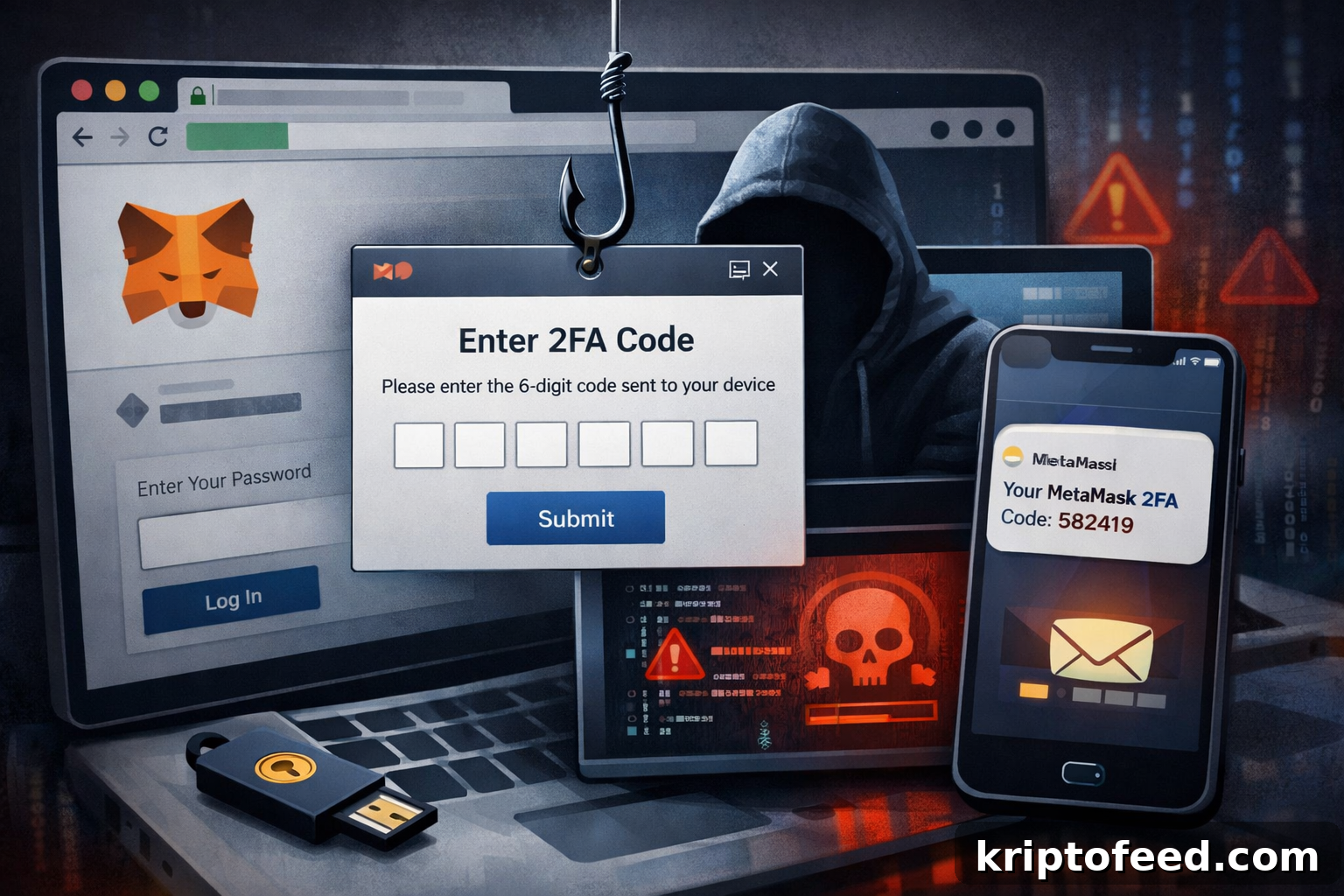
- A fake phishing campaign posing as two-factor authentication is targeting MetaMask users.
- A sophisticated MetaMask phishing scam uses counterfeit 2FA checks to trick victims.
- The MetaMask phishing scheme highlights the growing role of social engineering in crypto security.
A new phishing campaign aimed at MetaMask users underscores how quickly crypto scams are evolving.
The scheme uses a convincing two-factor authentication flow to deceive users into handing over their wallet recovery phrases.
Although overall crypto phishing losses dropped significantly in 2025, the tactics behind these attacks are becoming more refined and harder to spot.
Security researchers say the campaign marks a shift from crude spam messages to carefully crafted impersonations that combine familiar branding, technical precision, and psychological pressure.
The result is a threat that looks routine on the surface yet can lead to full wallet takeover in minutes.
How the scam works
The campaign was reported by SlowMist’s head of security, who shared details publicly.
Phishing emails are designed to resemble official MetaMask support messages and claim that users must enable mandatory two-factor authentication.
They closely mirror the wallet provider’s branding, using the logo, color palette, and layout many users recognize.
A key element of the deception is the web domains used by the attackers. In documented cases, the fake domain differed from the real one by a single letter.
That small change makes the URL easy to miss, especially on mobile screens or when users are acting quickly.
After clicking the link, victims are taken to a website that closely imitates the MetaMask interface.
The fake 2FA process
On the phishing site, users are guided through what appears to be a standard security procedure.
Each step reinforces the idea that the process is legitimate and intended to protect the account.
At the final stage, the site asks users to enter their wallet seed phrase, presenting it as a required step to complete the two-factor setup.
This is the scam’s decisive moment. A seed phrase, also called a recovery or mnemonic phrase, functions as a wallet’s master key.
With it, an attacker can recreate the wallet on another device, move funds without approval, and sign transactions independently.
Passwords, two-factor codes, and device confirmations become irrelevant once the seed phrase is exposed.
For this reason, wallet providers repeatedly warn users never to share recovery phrases under any circumstances.
Using two-factor authentication as bait is deliberate.
2FA is widely associated with stronger security, which lowers suspicion.
When paired with urgency and professional presentation, it creates a false sense of safety.
Even experienced users can be caught off guard when a familiar security feature is turned into a tool of deception.
The start of 2026 has already shown signs of renewed market activity, including meme coin rallies and growing retail participation.
As activity increases, attackers appear to be returning with more refined methods rather than larger volumes of low-quality scams.
The MetaMask phishing campaign suggests future threats may rely less on scale and more on credibility.
For MetaMask users and crypto wallet owners in general, the episode emphasizes the need for constant vigilance.
Security tools remain essential, but understanding how those tools can be misused is as important as using them correctly.