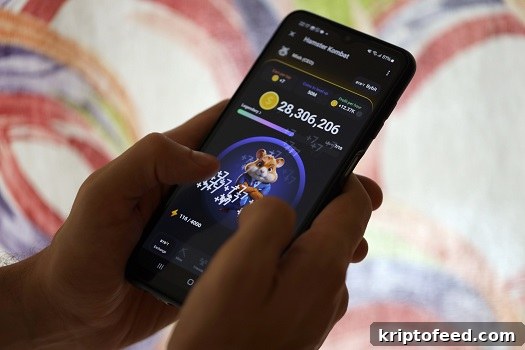
- Hamster Kombat lost 259 million players, representing an 86% decline in its user base over three months.
- The HMSTR token price plunged 76%, eroding confidence among early users and players.
- Government scrutiny and controversies intensified worries about the game’s future.
Once hailed as a breakthrough tap-to-earn game on Telegram, Hamster Kombat has recently suffered a dramatic collapse, losing roughly 259 million players in just three months.
That sharp decline has raised serious questions about the game’s sustainability and the future of its associated cryptocurrency, the HMSTR token.
Hamster Kombat lost 86% of its user base
At launch, Hamster Kombat attracted an impressive 300 million users, drawing attention with its blend of simple gameplay and the potential to earn crypto rewards.
The title initially grew quickly thanks to its “tap-to-earn” mechanic, which allowed users to participate in straightforward gameplay while earning tokens. High-profile endorsements, including mention by the Telegram CEO as one of the fastest-growing digital services worldwide, boosted its appeal.
However, that early momentum proved short-lived: over the last three months the platform has shed some 259 million players.
What caused the drop in user engagement?
Several key factors contributed to the decline in engagement. Foremost among them were gameplay issues. Players grew tired of the repetitive nature of the tap-to-earn model, which offered little variety or depth. Criticism of the AI-generated graphics used in the game added to the perception of low production values and further discouraged users.
These problems were compounded by the collapsing value of the HMSTR token. After debuting around $0.009993, the token has tumbled to roughly $0.00237 — a staggering 76% decline. That collapse undermined trust among early adopters who had invested time and resources into the platform, producing widespread disappointment and accelerating the exodus of players.
The game’s operational history has also been marked by controversial decisions. A contentious token airdrop, plagued by delays and user frustration, left many players dissatisfied. Sudden anti-cheat measures led to the disqualification of 2.3 million players, further hurting the game’s reputation. Reports indicate many users felt betrayed after spending time earning tokens that could be sold only for minimal returns.
On top of internal issues, external pressures mounted. Regulators in countries such as Iran and Russia raised concerns about the game’s impact and legality, adding to the uncertainty. Links to Gotbit, a firm facing regulatory scrutiny, fueled additional speculation about the project’s stability, even though Hamster Kombat publicly stated it never engaged Gotbit as a market maker.
With these combined challenges — repetitive gameplay, disappointing visuals, a plunging token price, controversial operational choices, and regulatory scrutiny — Hamster Kombat faces an uphill battle to recover player trust and relevance.
Whether the team behind Hamster Kombat can address these problems and rebuild its community remains unclear. If they fail to course-correct, the platform may continue to decline and eventually fade from the spotlight.