
Key takeaways
- Hedera has risen 6.5% in the past 24 hours and is trading above $0.12.
- Growing ETF inflows could push the coin toward $0.145.
ETF inflows improve HBAR sentiment
HBAR, the native token of the Hedera network, gained 6.5% over the last 24 hours and is trading around $0.123. This uptick positions HBAR among the stronger performers within the top 30 cryptocurrencies by market capitalization.
The recent strength appears driven by rising institutional interest. Data from SoSoValue shows that Hedera spot ETFs posted an inflow of $817,770 on Tuesday, marking the third consecutive day of positive flows. Continued ETF demand could provide sustained support for HBAR’s price.
On-chain and exchange metrics also point to growing conviction. CryptoQuant data highlights sizable whale orders in both spot and futures markets, which can precede notable upward moves. CoinGlass reports a long-to-short ratio of 1.06 for HBAR, the highest in over a month, indicating more traders are taking long positions than shorts—an overall bullish signal.
HBAR could test $0.145 resistance
Technical indicators on the HBAR/USD 4-hour chart remain constructive after the token climbed above $0.12 earlier this year. At the time of writing, HBAR is approaching the 50-period Exponential Moving Average (EMA) near $0.127, a key short-term resistance level.
A daily close above the 50-day EMA would bolster bullish momentum and could open the path toward the $0.145 resistance. If buying pressure continues, HBAR might extend its advance to retest the upper trendline of the wedge pattern, around $0.152.
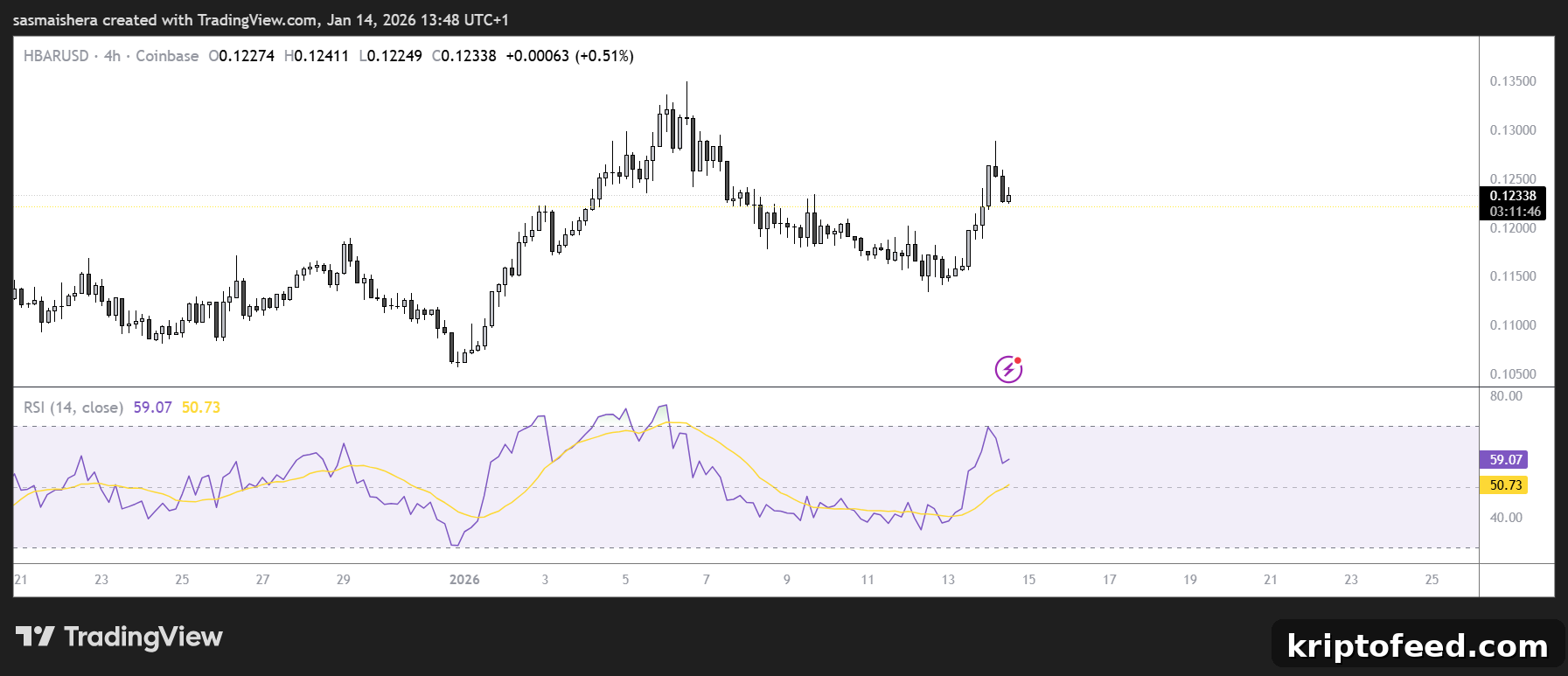
Momentum indicators support the positive outlook. The 4-hour Relative Strength Index (RSI) sits at 58, above the neutral 50 level, which signals growing bullish momentum. The Moving Average Convergence Divergence (MACD) also displays a bullish crossover that remains intact.
Nevertheless, traders should remain cautious. If HBAR fails to hold current levels and experiences a correction, the token could move back toward weekly support below $0.10, which would represent a more significant pullback.