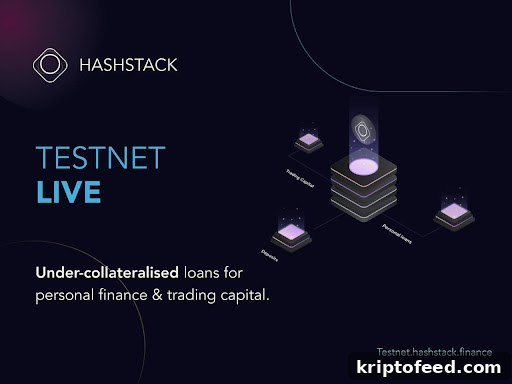
Hashstack Finance has launched its Open Protocol, the first DeFi lending protocol to offer non-custodial undercollateralized loans, the company announced in a press release.
This marks a significant milestone in Hashstack’s roadmap as the team prepares to roll out the Open Protocol mainnet in the coming weeks.
The only independent lending solution in DeFi
The Open Protocol is the only independent lending solution in the DeFi space that enables undercollateralized lending with collateral-to-loan ratios up to 1:3. In practical terms, this means you could post just $100 in collateral and borrow up to $300.
Of that $300, $230 is allocated as trading capital on the platform, while the borrower can withdraw $70 (equivalent to up to 70% liquidity available from the collateral).
Hashstack Finance founder Vinay commented:
“Today, if you want to borrow $100 on Compound, Aave, or even MakerDAO, you generally need to post at least $142 in collateral. That undermines the primary purpose of borrowing and limits borrower utility. By contrast, through Hashstack’s Open Protocol you can borrow the same $100 with as little as $33.33 in collateral. This 4.25x increase in capital efficiency compared with established market players is a notable achievement for the wider DeFi ecosystem and will help accelerate adoption.”
Hashstack’s Open Protocol removes inefficiencies from the DeFi ecosystem through a three-layer approach:
- Efficient asset utilization by diversifying available assets across lending and provision of trading capital
- Clear separation of APY and APR for deposits and loans with a minimum commitment period (MCP)
- Underserved and undercollateralized lending options
Hashstack is integrating with PancakeSwap and other DeFi platforms to enhance borrowing tools and simplify token swaps inside the app. That means borrowers won’t need to leave the dApp to exchange borrowed tokens for other primary or secondary assets.
Initially, the Open Protocol will support major stablecoins and liquid assets such as BTC, USDT, USDC, BNB, and Hashstack’s native governance token HASH. The protocol will also bridge assets from Avalanche, Ethereum, and other chains as it expands beyond its primary markets.