- GIP-140 renews GnosisDAO voting with on-chain and beacon data.
- GNO price retreats amid profit-taking and technical resistance.
- Liquidity constraints and stablecoin regulations may shape short-term sentiment.
The price of Gnosis showed modest volatility following the adoption of GnosisDAO’s GIP-140, a major governance update designed to overhaul the platform’s voting mechanisms.
GIP-140 replaces the current subgraph-based GNO strategy with a suite of strategies that read blockchain state directly from both the execution layer and the beacon chain.
Approval of the proposal marks a significant step toward improving the accuracy and reliability of Snapshot voting, while adding support for StakeWise tokens and reducing dependence on external data providers.
GIP-140: refreshing voting for accuracy and inclusion
The adoption of GIP-140 reflects broad consensus among GnosisDAO participants, with 82 votes cast and overwhelming support for the measure.
The primary aim is to eliminate reliance on subgraphs, which previously introduced delays and inaccuracies in voting power calculations.
The new system attributes voting power to GNO balances on both the Gnosis Chain and Ethereum, locked GNO holdings, validator balances, and StakeWise’s sGNO and osGNO tokens.
By extracting data directly from on-chain sources and the beacon chain, the proposal seeks to create a more robust and transparent voting environment that better reflects stakeholders’ actual influence.
The technical implementation requires updating Snapshot’s configuration via a SafeSnap transaction, pointing to aggregator contracts deployed on both Gnosis Chain and Ethereum, along with a new beacon-chain strategy for staked GNO.
Delegation mechanisms were also updated to integrate these new sources, ensuring a smooth transition for DAO members accustomed to existing workflows.
These changes position GnosisDAO to handle more complex governance requirements while reducing dependence on third-party indexers like The Graph, which previously introduced inconsistencies.
GNO price consolidates amid profit-taking
Surprisingly, following GIP-140’s approval the Gnosis price dipped slightly, falling 0.89% over the past 24 hours and underperforming the broader crypto market, which gained 0.06%.
The price action aligns with profit-taking behavior after GNO posted a weekly gain of 7.98% and an 8.3% increase in October.
Technical indicators suggest the market is testing resistance around the 30-day simple moving average at $137.93 and the 61.8% Fibonacci retracement level at $138.47.
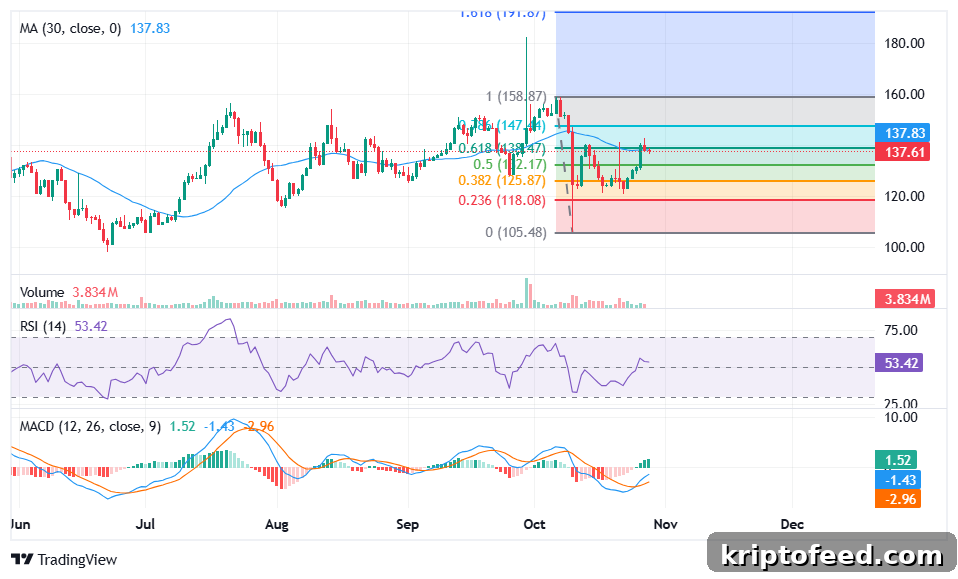
While the RSI remains neutral at 53.42, a bearish divergence in the MACD points to possible short-term consolidation.
Liquidity pressures stemming from CoinDCX’s delisting in June 2025 continue to weigh on GNO trading activity.
Although the delisting occurred months ago, it reduced retail access to the token, and the 24-hour turnover rate of 1.08% remains relatively low compared with broader DeFi sector averages.
Regulatory uncertainty around stablecoins—particularly the reintroduction of USDS under the proposed US GENIUS Act—could also indirectly affect sentiment toward assets on the Gnosis Chain.
Still, ecosystem milestones such as Gnosis Pay’s $100 million transaction volume suggest that adoption could offset some of these headwinds.
Looking ahead
The mix of technical consolidation, ongoing liquidity constraints, and regulatory considerations creates a cautious but watchful environment for GNO price movements.
Holding the $135–$137 range could provide the stability needed for renewed momentum, especially as GnosisDAO’s updated Snapshot strategies begin to reflect more accurate voting power across multiple token types.
In the coming weeks, GNO’s price may respond both to market dynamics and to the tangible effects of GIP-140’s implementation, particularly if the changes improve vote accuracy and encourage wider DAO participation.
For now, the community appears aligned, and successful adoption of GIP-140 represents a meaningful milestone that could shape GNO’s trajectory in governance and market performance.