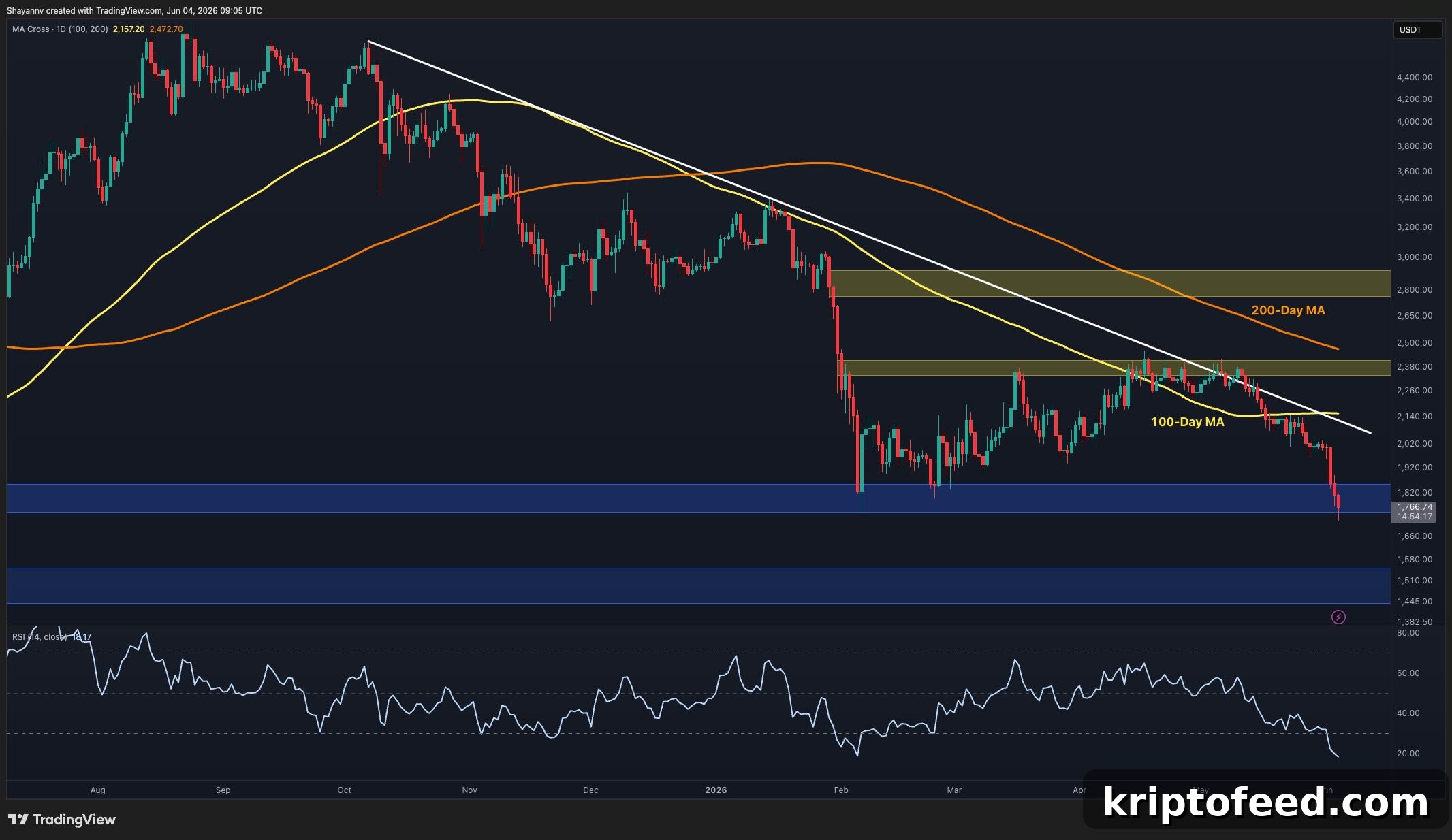
Ethereum has faced heavy selling pressure after losing the 100-day moving average earlier in the year and only briefly reclaiming it in April. A recent breakdown below a key demand zone pushed ETH to fresh local lows near $1,750, and both technical and on-chain indicators currently favor the bears. Unless buyers quickly regain the lost levels, the prevailing structure makes further downside a viable risk.
Ethereum Price Analysis: The Daily Chart
On the daily timeframe, Ethereum remains under a clear long-term bearish trendline that began following the reversal from cycle highs near $4,800. That trendline has consistently capped rally attempts and rejected price action, most recently in May, which triggered the current accelerated decline.
ETH is trading below both the 100-day and 200-day moving averages, roughly near $2,150 and $2,400 respectively. The inability to reclaim these moving averages reinforces a broader bearish market structure.
Price has now broken below the $1,800 support zone, a notable technical development. This zone had acted as a market floor since February; with ETH now trading around $1,760, that former support is turning into immediate resistance.
If sellers remain in control, the next significant daily demand area sits around $1,500, which could be tested in a deeper correction over the coming weeks. To shift the outlook, bulls would first need to retake the $1,800 area and then push toward the resistance cluster above $2,000. Until those levels are reclaimed and sustained, the daily picture remains strongly bearish.
ETH/USDT 4-Hour Chart
The 4-hour chart shows a similarly weak outlook. ETH broke down from a descending channel that contained price action throughout May, signaling an acceleration of the bearish trend rather than a bullish breakout. Alongside this channel breakdown, Ethereum slid through the $2,000 support area and is currently losing the critical $1,800 zone.
Price is now testing the lower boundary of the $1,750–$1,800 demand area. While that region could spark a short-term bounce given its historical significance, the overall structure remains bearish unless ETH reclaims and consolidates above $1,800.
The 4-hour RSI sits deep in oversold territory near 20, reflecting strong downside momentum. Although oversold conditions can precede a relief bounce, there is currently no confirmed bullish divergence on the chart, meaning there’s no reliable signal yet for a stabilizing bounce.
Sentiment Analysis
On-chain sentiment also points to seller dominance. The Ethereum taker buy/sell ratio, which compares aggressive buy orders to aggressive sell orders across exchanges, is a useful gauge of market aggression. Readings above 1 indicate stronger buying pressure; readings below 1 indicate seller dominance.
The ratio has dropped to roughly 0.96, one of its lower readings, extending a decline that began after the April–May recovery attempt. Persistently sub-1 readings suggest takers are favoring sell orders, reinforcing the bearish bias observed on the daily and 4-hour charts.
For the outlook to materially improve, the taker buy/sell ratio would need to climb and sustain levels above 1.0, signaling a return of aggressive buyers. Until that shift occurs, futures positioning and on-chain flows continue to support the broader bearish narrative, leaving downside risks elevated despite increasingly oversold technical conditions.