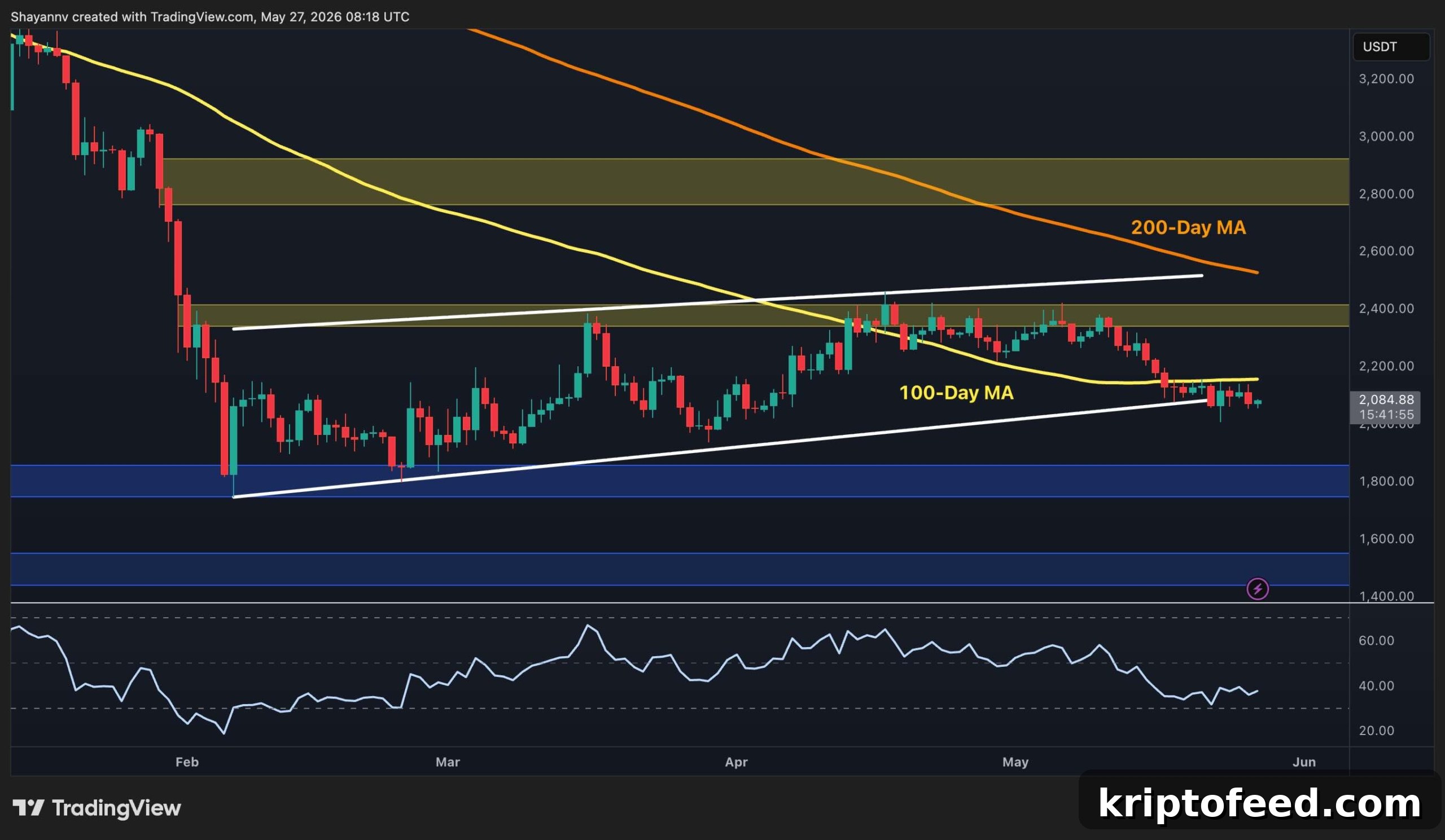
Ethereum is trading around $2,080 and drifting lower into a zone that looks weak on the surface but may be quietly setting up a more interesting technical story underneath.
The 100-day moving average sits just above current prices and remains a lost reference point. The ascending channel’s lower boundary is teetering on the brink of a breakdown, yet the 4-hour chart hints at a possible bullish reversal forming out of sight of the daily timeframe.
Whether that pattern develops into a legitimate recovery or simply unwinds into another leg down is the key question as June progresses.
Ethereum Price Analysis: The Daily Chart
On the daily chart, Ethereum has steadily drifted lower since the mid-May rejection near $2,400. With ETH trading close to $2,080, the 100-day moving average—around $2,200—remains an active resistance level. The ascending white channel is barely holding at its lower boundary, and the RSI has slipped into the mid-30s to 40 area, signaling selling pressure without yet reaching deeply oversold territory.
The primary downside reference is the $1,800 demand zone, roughly $280 beneath the current price. If the channel floor gives way, that distance could close quickly. Conversely, a recovery that pushes back above the 100-day moving average is the minimum requirement to stabilize the daily structure. Reclaiming $2,400 would represent a meaningful shift in the mid-term narrative for Ethereum.
Until one of these scenarios plays out, the daily chart depicts tightening support and shrinking room for error for bulls.
ETH/USDT 4-Hour Chart
The 4-hour chart contains the most compelling short-term development: a possible inverse head-and-shoulders pattern forming over the past week. The left shoulder printed near $2,100, the head formed around $2,000, and price is currently carving what may become the right shoulder.
The neckline sits near $2,150. If the neckline is decisively broken, the measured move from this pattern projects an initial rebound toward $2,250, with the potential to push further back into the key $2,400 supply area. However, this pattern remains unconfirmed and should be treated with caution.
A validated breakout would require the right shoulder to hold above the $2,000 support zone followed by a 4-hour close above the $2,150 neckline. That setup would be the first meaningful reversal signal since the correction began in early May. Conversely, failure to hold the right shoulder would likely result in a drop below $2,000, invalidating the pattern and opening a path toward the $1,800 demand zone.
On-Chain Analysis
Ethereum’s exchange reserves currently sit around 14.8 million ETH, a level that places sell-side availability near multi-year lows. That reserve level has been reached even with prices near $2,000, suggesting the drawdown from higher levels has not produced the type of exchange inflows associated with mass capitulation or broad distribution by long-term holders.
There has been a modest uptick from about 14.4 million in early May to 14.8 million today, which deserves attention. If reserves continue to rise, it would indicate that holders are moving more supply back onto exchanges at these prices, adding potential selling pressure to an already fragile structure. For now, however, reserves remain historically thin, implying that when buyers do step in they will encounter an order book with less available supply than in much of recent history—an environment that could help facilitate a stronger rebound if demand returns.