
- Ethereum’s price is struggling to fall below $3,000, with buyers defending the $2,750–$2,800 support zone.
- Open interest is rising as leveraged long positions increase, raising the risk of heightened volatility.
- The upcoming Fusako upgrade is drawing attention, but the market remains cautious amid ongoing outflows.
Ethereum’s price remains under pressure after a week of steep losses, institutional outflows, and renewed macroeconomic uncertainty.
The cryptocurrency has attempted several intraday rebounds, but none have been strong enough to reverse the broader downtrend.
As investors assess shifting liquidity conditions and await the Fusako upgrade, the central question is whether Ethereum (ETH) is setting up for a relief rally or preparing for another drop.
Sell pressure meets fragile support
Ethereum has fallen nearly 12% over the past seven days, extending a months-long decline and keeping price action confined within a pronounced descending channel that has guided moves since early autumn.
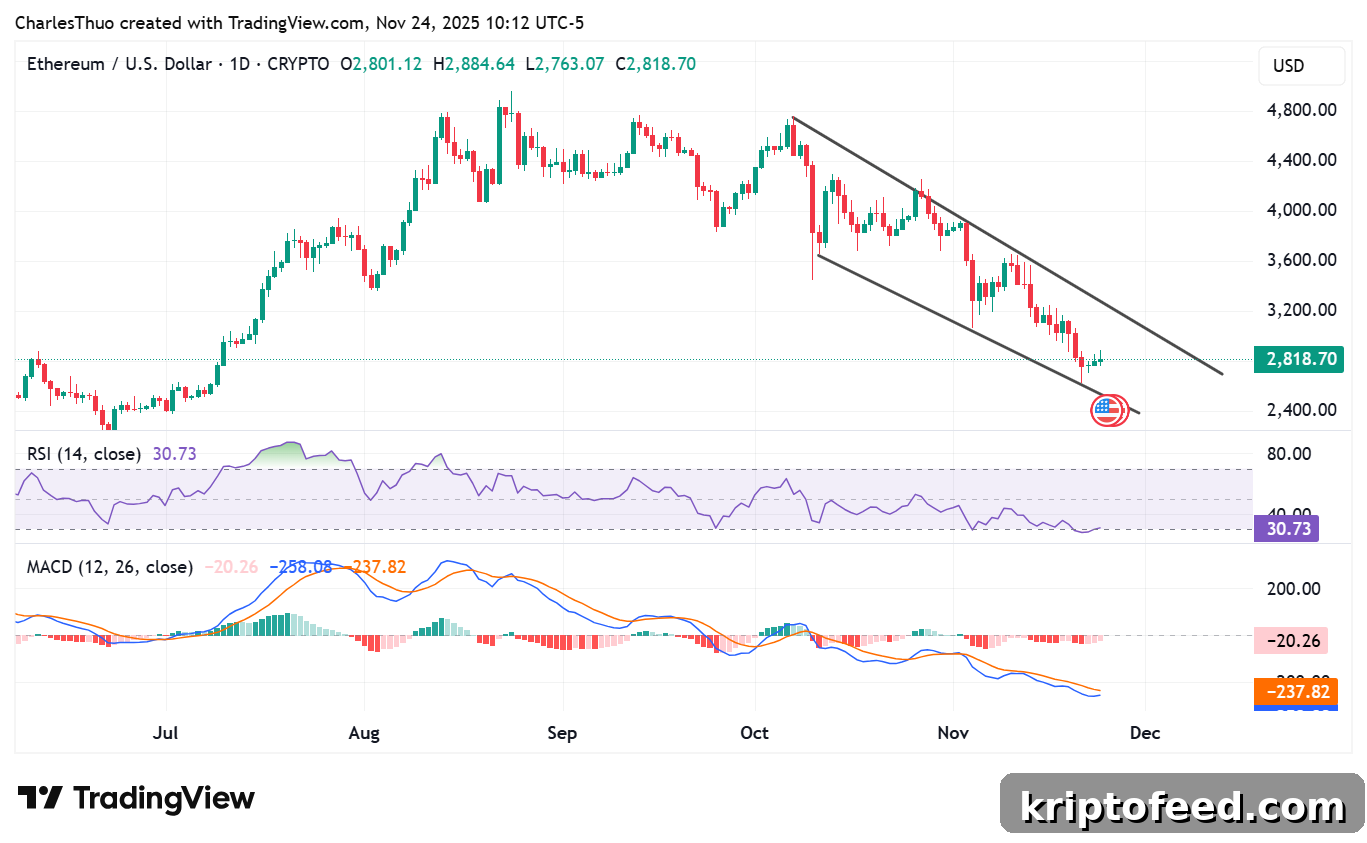
A recent bounce from the $2,525 liquidity pocket briefly lifted sentiment, but the overall structure remains heavy as sellers continue to defend every approach toward the channel’s upper boundary around $3,050–$3,120.
Momentum indicators underscore this tension: the daily RSI remains near oversold levels, signaling exhaustion but not a confirmed reversal.
Previous rebounds at similar RSI readings failed to gain traction, giving sellers multiple opportunities to push Ethereum lower.
ETH is trading below its 20-, 50- and 200-day EMAs, which have compressed above price and formed a broad resistance zone.
This general pressure has left Ethereum beneath the $2,947–$3,000 band, the first and most critical market barrier.
A decisive break above this area will be necessary to shift momentum, because without it, each recovery attempt risks fizzling out, as seen throughout November.
Ethereum price squeezed between key levels
The larger technical picture shows Ethereum caught between fragile support and heavily defended resistance levels.
The $2,750–$2,800 band has served as a demand zone throughout the year, and buyers are fighting to hold it once more.
Dropping below this area would open the path to deeper support at $2,450, $2,300 and potentially $2,150.
A clear break under $2,500 would expose thin liquidity and could push ETH into a wider accumulation range between $2,050 and $2,200.
A sustained move above $2,947 would clear the first hurdle and could trigger a rebound toward $3,132, where the 200-day EMA converges with strong volume resistance.
Clearing that level could extend recovery attempts toward $3,450 and ease downward pressure ahead of December.
Derivatives data shows traders increased exposure during the recent bounce, with Ethereum futures open interest topping $34 billion, indicating market participants are adding positions rather than reducing them.
Long-short ratios on major exchanges tilt toward longs, reflecting optimism but also raising the risk of heightened volatility if resistance levels hold and leveraged buyers become trapped.
Institutional flows continue to weigh on sentiment: ETH investment products recorded more than $500 million in outflows last week, driven primarily by U.S. spot ETFs.
That withdrawal highlights the caution of large investors, who remain sensitive to interest rate expectations and regulatory developments.
Additionally, Ethereum’s correlation with equity markets remains elevated, exposing the cryptocurrency to broader macroeconomic swings—even as interest in the upcoming Fusako upgrade grows, it has not yet altered overall market sentiment.