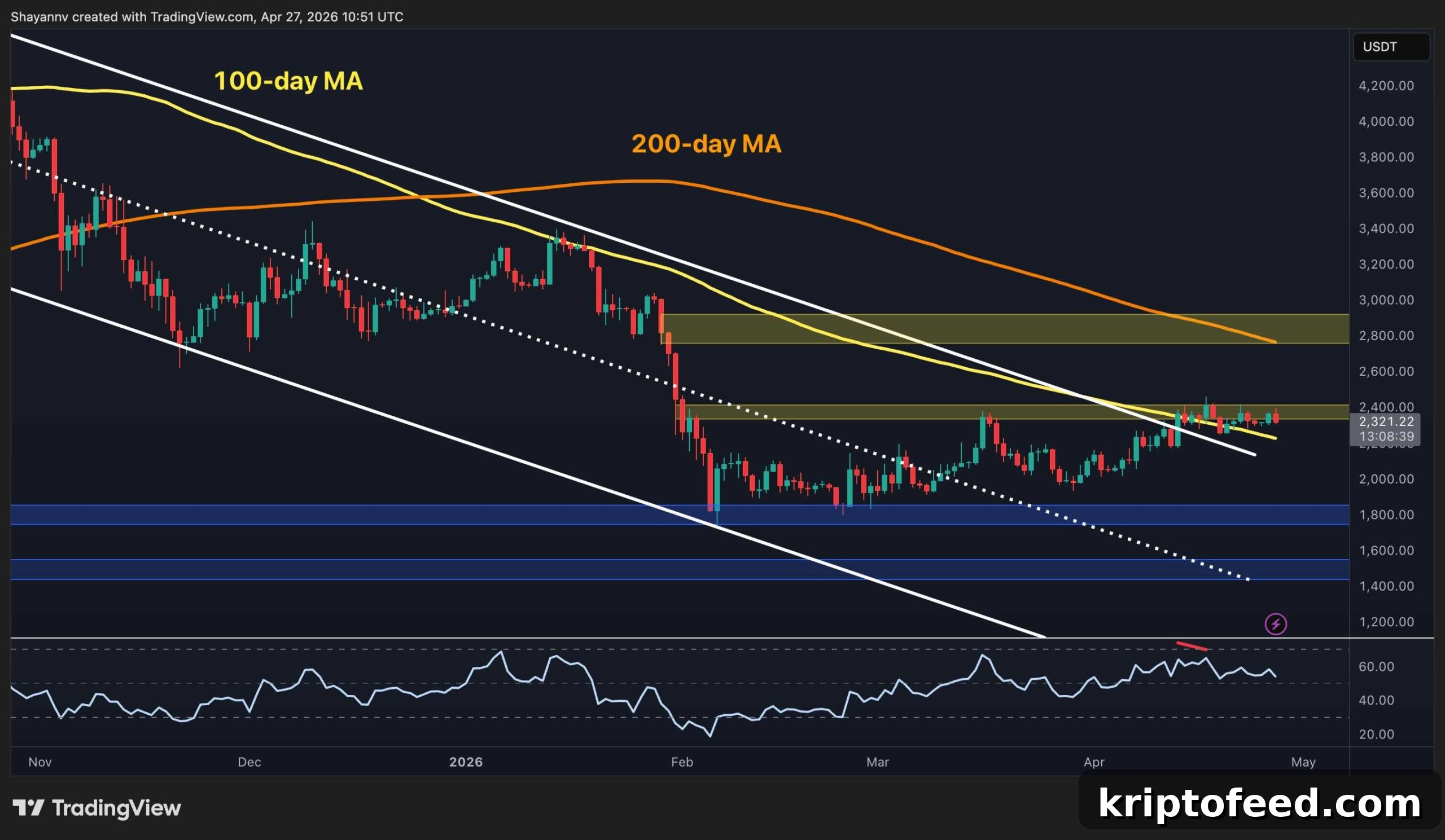
Ethereum is trading above $2,300 as April comes to a close, ending the month in a familiar, unresolved position. The coin is pressing up against the $2,400 resistance zone that has repeatedly stalled rallies since mid-March. ETH now stands at a decision point: prepare for what could be its most meaningful breakout in months or face another rejection at the same barrier.
Ethereum Price Analysis: The Daily Chart
The daily chart shows that the $2,400 resistance has remained intact over the past four weeks. What has changed, however, is the rising level of support. Recent pullbacks have found buyers at progressively higher levels — first near $2,000, then around $2,100, and now along the higher trendline of the broken channel and the 100-day moving average, both clustered near $2,200. This sequence of higher lows over several weeks points to quiet accumulation beneath a stubborn ceiling.
Relative Strength Index (RSI) readings remain in the high 50s, indicating neither a collapse of momentum nor a strong push upward. That neutral reading contrasts with previous failed breakouts driven by sharply declining momentum. If ETH cannot clear $2,400, the 100-day moving average would likely be the first downside target. A failure to hold that level could allow price to slip back below $2,000 toward the key $1,800 area that marked the start of the current recovery.
ETH/USDT 4-Hour Chart
On the 4-hour chart, a steep ascending trendline that formed from the late-March lows now provides dynamic support near $2,300, preserving a short-term pattern of higher lows. ETH is currently trading on that trendline after the most recent pullback from $2,400, and the RSI has dipped into the mid-40s.
The immediate focus is whether the ascending trendline around $2,300 holds. Maintaining it keeps the bullish structure intact and sets the stage for another attempt at $2,400. A decisive break and close below that trendline would open the $2,100–$2,000 zone as the next meaningful area of interest. If price breaks the trendline and then closes below recent significant lows near $2,250, that would be a strong signal that a deeper correction is likely.
On-Chain Analysis
Ethereum’s funding-rate picture differs notably from Bitcoin’s. While Bitcoin’s funding rates have been persistently and deeply negative in recent data, Ethereum presents a more mixed profile. The current funding reading of about -0.0044 is slightly negative, but ETH funding has oscillated between modest negative and modest positive values throughout April rather than remaining overwhelmingly negative.
This difference matters for market dynamics. A persistently negative funding rate typically signals aggressive short positioning and can set the stage for a short squeeze if prices move sharply higher. Because ETH’s funding is more balanced, the potential for a dramatic short-covering cascade is less pronounced than for Bitcoin. That reduces the likelihood of a violent upside spike driven purely by forced liquidations.
Conversely, a less short-heavy derivatives market also means ETH is less vulnerable to a rapid downside flush that can accompany an unwinding of concentrated short positions. In practical terms, the neutral-to-slightly-negative funding environment reflects a market genuinely uncertain about direction rather than one that is aggressively positioned against the trend. In that sense, the funding data aligns closely with the price action: a market poised between renewed upside attempts and the risk of another pullback.