-
- Ethereum is the second-largest cryptocurrency in the world.
- Another major Ethereum upgrade, Pectra, is scheduled to launch on May 7.
- Vitalik Buterin has proposed replacing the Ethereum Virtual Machine (EVM) bytecode with RISC-V.
Ethereum is once again in the spotlight as traders prepare for a pivotal year.
With the Pectra upgrade set for May 7—combining two long-planned improvements, Prague and Electra—the Ethereum blockchain is poised for significant change.
Increased staking activity, improved scalability through Layer 2 solutions, and proposals to overhaul Ethereum’s virtual machine are all shaping long-term expectations.
These upgrades, together with falling gas fees and growing developer activity, support renewed forecasts that put ETH’s 2025 peak near $6,000 under favorable conditions.
Ethereum’s position as the second-largest cryptocurrency by market capitalization continues to attract institutional attention despite market volatility.
Its ability to host decentralized applications and token ecosystems keeps it central to the future of crypto.
As activity shifts to cheaper sidechains, the base layer is evolving with a focus on efficiency.
Early signs suggest ETH is building momentum
Ethereum has started to show signs of recovery after months of price stagnation.
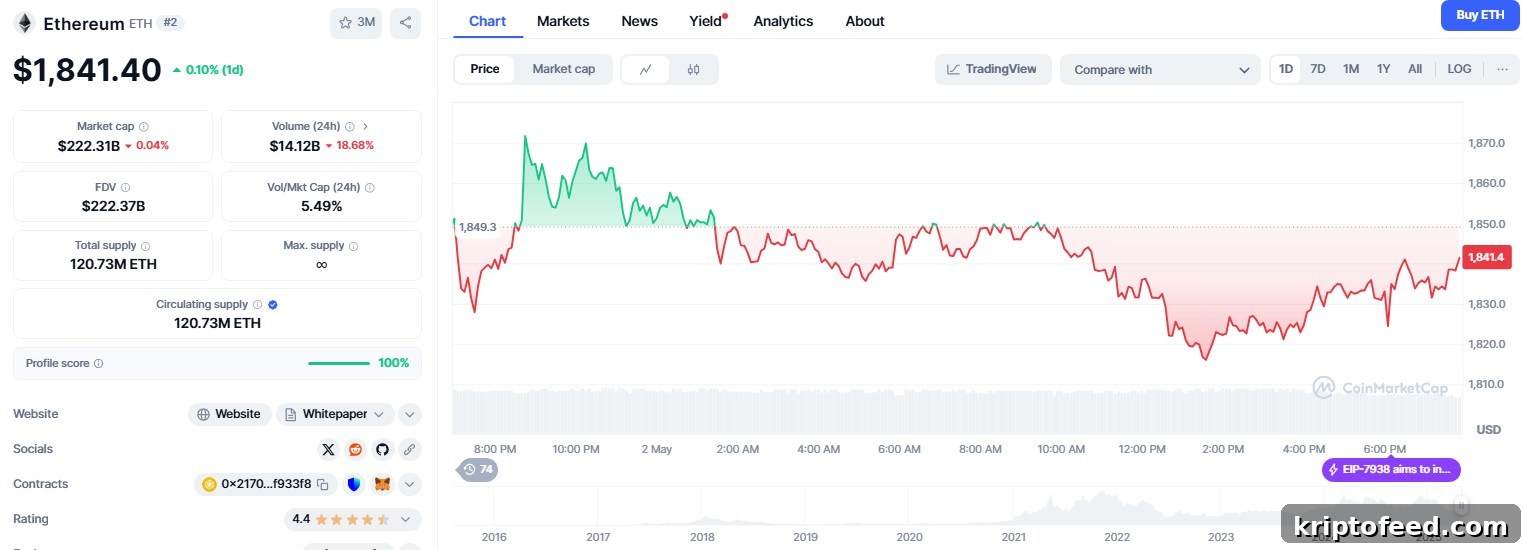
ETH is currently trading around $1,841, above its 9-day simple moving average, with a relative strength index near 58.3, indicating growing momentum.
Source: CoinMarketCap
Analysts note that the price has consolidated between $1,600 and $1,900, creating a potential rounded-bottom pattern.
If ETH breaks above $1,900, the next resistance zone could appear near $2,200.
Although gas fee revenues fell to 3.18 ETH in April and average gas prices hit a four-year low of $0.16, lower network costs are making Ethereum more accessible to users.
The sharp decline in base-layer activity has raised sustainability concerns but also signals a shift of transactions to Layer 2 networks like Arbitrum and Base.
Pectra and staking add long-term value
The next major Ethereum upgrade, Pectra, is scheduled for May 7 and is expected to introduce a range of technical improvements.
By combining Prague and Electra upgrades, Pectra aims to streamline validator operations and reduce latency.
Additionally, co-founder Vitalik Buterin has proposed replacing the EVM bytecode with RISC-V, an open-source instruction set architecture widely used in traditional computing.
If implemented, this change could bring Ethereum closer to conventional computing infrastructure and improve future compatibility.
ETH staking has also increased, with Ethereum 2.0 attracting growing interest from long-term holders.
Combined with Layer 2 scaling solutions and low transaction costs, these trends strengthen Ethereum’s fundamentals as a decentralized application platform.
ETH outlook shows a wide range
Price forecasts for Ethereum from 2025 to 2030 vary widely depending on market sentiment, adoption rates, and broader macroeconomic factors.
In the near term, ETH could test resistance near $2,400 by the end of 2025 if the broader crypto market remains bullish.
However, growth may be capped near $2,500 unless momentum accelerates significantly.
Some forecasts suggest ETH could reach a new high of $5,925 in 2025 under optimistic conditions.
Predicted 2025 ranges vary, with some models placing ETH between $2,917 and $5,925 and an average near $4,392.
By 2026, the upper bound in some forecasts rises to $6,610, and by 2030 some projections extend to $15,575.
Longer-term estimates show further upside for some models.
Certain projections suggest ETH could reach $123,678 by 2040 and $255,282 by 2050, though these are extreme scenarios and include lower and median cases as well.
Different firms offer varied predictions: some expect around $4,012 in 2025 and up to $24,196 by 2030; others estimate $6,540 for 2025; and some give more conservative figures near $3,499 for 2025.
These forecasts underline how Ethereum’s value depends on network upgrades and broader market adoption.
Its future path will hinge on continued technical innovation, staking incentives, and expanding decentralized finance use cases.