-
- Ethereum is the second-largest cryptocurrency in the world by market capitalization.
- The next major Ethereum upgrade, Pectra, will be launched on May 7.
- Vitalik Buterin has proposed replacing the Ethereum Virtual Machine (EVM) bytecode with RISC-V.
Ethereum is once again in the spotlight as traders and investors prepare for a year that could mark a decisive inflection point.
The upcoming Pectra upgrade, scheduled for May 7 and combining two long-planned improvements—Prague and Electra—brings meaningful changes to the Ethereum blockchain.
Increased staking activity, improved scalability via layer-2 solutions, and proposals to overhaul the Ethereum virtual machine are all shaping expectations for the network’s long-term prospects.
Together with falling gas fees and renewed developer activity, these upgrades have fueled optimistic projections, some forecasting an ETH peak near $6,000 by 2025 under favorable conditions.
Ethereum’s position as the second-largest cryptocurrency by market cap continues to draw institutional attention, even amid persistent volatility.
Because it supports decentralized applications and an extensive token ecosystem, Ethereum remains central to the broader crypto landscape.
As more activity shifts to lower-cost sidechains and layer-2 networks, the base layer is evolving to prioritize efficiency and lower user costs.
Early Signals Point to Building Momentum for ETH
After months of price stagnation, Ethereum is showing initial signs of renewed momentum.
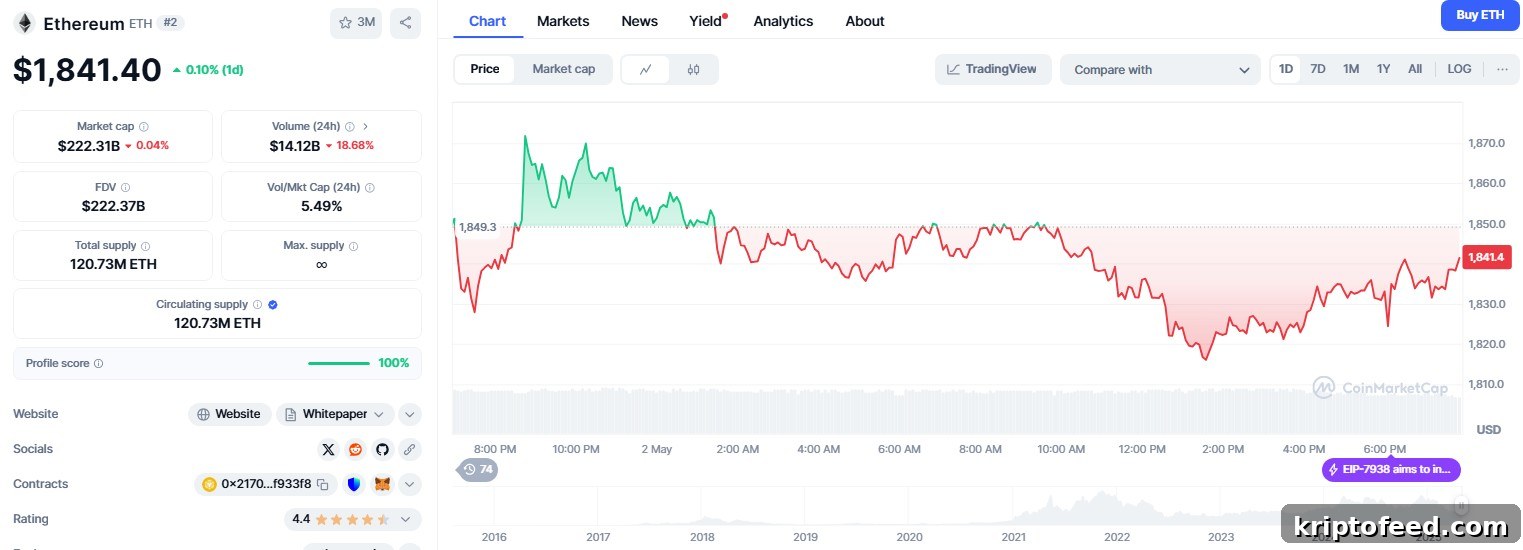
ETH currently trades around $1,841, sitting above the 9-day simple moving average, and the relative strength index stands near 58.3, indicating growing bullish momentum.
Source: CoinMarketCap
Analysts note that price consolidation between $1,600 and $1,900 could be forming a rounded bottom pattern, a structure traders often view as bullish if confirmed.
If ETH breaks above $1,900, the next significant resistance may appear around $2,200.
Although gas fee revenue dipped to 3.18 ETH in April and average gas prices reached a four-year low of $0.16, the reduced cost of network use makes Ethereum more accessible for everyday users.
The sharp decline in base-layer activity has raised questions about fee sustainability, but it also reflects a migration of transactions to layer-2 solutions such as Arbitrum and Base.
Pectra and Staking Strengthen Long-Term Value
The next major Ethereum upgrade, Pectra, will go live on May 7 and is expected to introduce several technical efficiencies.
By merging Prague and Electra, Pectra aims to streamline validator operations and reduce latency, improving overall network performance.
In addition, Vitalik Buterin has proposed adopting RISC-V as a replacement for EVM bytecode—a widely used, open-source instruction set architecture.
Should such a change be implemented, it could align Ethereum more closely with conventional computing infrastructure and enhance future compatibility.
Staking activity has also increased, with Ethereum’s proof-of-stake environment drawing more interest from long-term holders.
Combined with layer-2 scaling solutions and lower transaction costs, rising staking participation strengthens Ethereum’s fundamentals as a decentralized application platform.
ETH Forecasts Show a Wide Range of Outcomes
Price outlooks for Ethereum from 2025 through 2030 vary widely, depending on market sentiment, adoption rates, and macroeconomic conditions.
In the nearer term, ETH could test resistance around $2,400 by the end of 2025 if the broader crypto market trends upward; in more restrained scenarios, growth may be limited to roughly $2,500.
Some optimistic models suggest higher targets: under favorable conditions, certain forecasts estimate that ETH could reach new highs near $5,925 in 2025, with projected ranges spanning approximately $2,917 to $5,925 and an average close to $4,392.
By 2026, higher-end projections rise further, and long-range forecasts for 2030 envision values significantly above current levels, reflecting scenarios of broad DeFi adoption and continued technical progress.
Even more extended estimates—including theoretical scenarios stretching to 2040 or 2050—suggest far larger values, but these long-term figures carry substantial uncertainty and should be treated cautiously.
Other firms offer differing forecasts: some estimate mid-range outcomes near $4,012 for 2025 and higher numbers for 2030, while others provide more conservative projections around $3,500.
These varied predictions underscore that Ethereum’s value depends heavily on network upgrades, ongoing technical innovation, staking incentives, and the evolution of decentralized finance and application use cases.
Ultimately, Ethereum’s future trajectory will be shaped by how effectively the ecosystem scales, maintains security, and attracts long-term developer and user adoption.