
- CleanCore and House of Doge launched a $175 million Dogecoin (DOGE) treasury.
- ZONE shares plunged nearly 60% as investors questioned the Dogecoin treasury move.
- DOGE price remained stuck near $0.21 amid weak flows and muted whale activity.
Dogecoin (DOGE) drew fresh attention after CleanCore Solutions, a Nebraska-based manufacturer of water ozone treatment systems, together with House of Doge, the commercial arm of the Dogecoin Foundation, announced a $175 million treasury aimed at giving the memecoin more institutional credibility.
Despite the bold initiative, DOGE’s price barely reacted, hovering near $0.21—a level it has traded around for weeks.
The muted market response has left investors and traders wondering whether the new treasury will provide durable momentum or simply join a long list of high-profile but ultimately underwhelming corporate plays around meme-inspired tokens.
CleanCore Solutions launches $175M Dogecoin treasury
The treasury initiative was funded via a private investment in public equity (PIPE), in which CleanCore issued 175,000,420 pre-funded warrants priced at $1.00 each.
The PIPE attracted more than 80 institutional and crypto-focused investors, including Pantera, GSR, FalconX, MOZAYYX and Mythos.
Proceeds will be used to build a dedicated Dogecoin reserve, one of the most notable attempts to formalize a corporate treasury structure around this asset.
To strengthen its institutional profile, the treasury has the backing of House of Doge and will work in collaboration with 21Shares, a well-known exchange-traded product issuer.
Elon Musk’s personal attorney Alex Spiro was named chairman of the board, while Dogecoin Foundation director Timothy Stebbing and House of Doge CEO Marco Margiotta also took leadership roles.
Margiotta described the effort as the foundation’s first supported treasury strategy for Dogecoin, intended to shift discourse away from meme-driven speculation toward more structural funding and stewardship.
Tepid market reaction
Despite the strong institutional framing, the market response was muted.
CleanCore Solutions, listed on the New York Stock Exchange under the ticker ZONE, saw its shares drop nearly 60% on the announcement day—reflecting ongoing investor skepticism around companies pivoting toward crypto treasuries, particularly those focused on memecoins rather than assets like Bitcoin (BTC).
Dogecoin itself remained rangebound.
At the time of writing, DOGE traded around $0.215, representing a marginal intraday gain but a roughly 2.4% decline over the past week.
Whale wallets, according to on-chain analyst Ali Martinez, remained largely inactive, limiting buying pressure while exchange flows showed persistent caution.
On September 3rd, exchange outflows were $68.57 million against inflows of $59.07 million, according to Coinglass data.
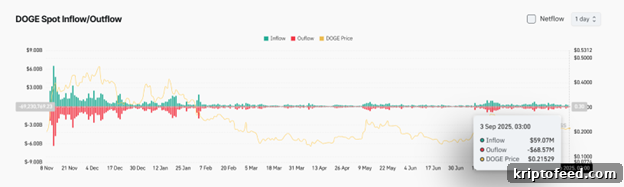
Without consistent inflows, the new treasury by itself may not be enough to change the market’s direction.
Dogecoin price technical analysis
From a technical perspective, DOGE’s price action highlights prevailing indecision.
The token is holding support around $0.19, anchored by the 200-day moving average.
On the upside, resistance has formed near $0.22, reinforced by the 20-day and 50-day moving averages.
Momentum indicators are mixed: the relative strength index (RSI) sits near 47, signaling neutral bias, while narrowing Bollinger Bands suggest volatility could rise soon.
The MACD trend remains mildly bearish, though the stochastic RSI points to the possibility of a short-term rebound.
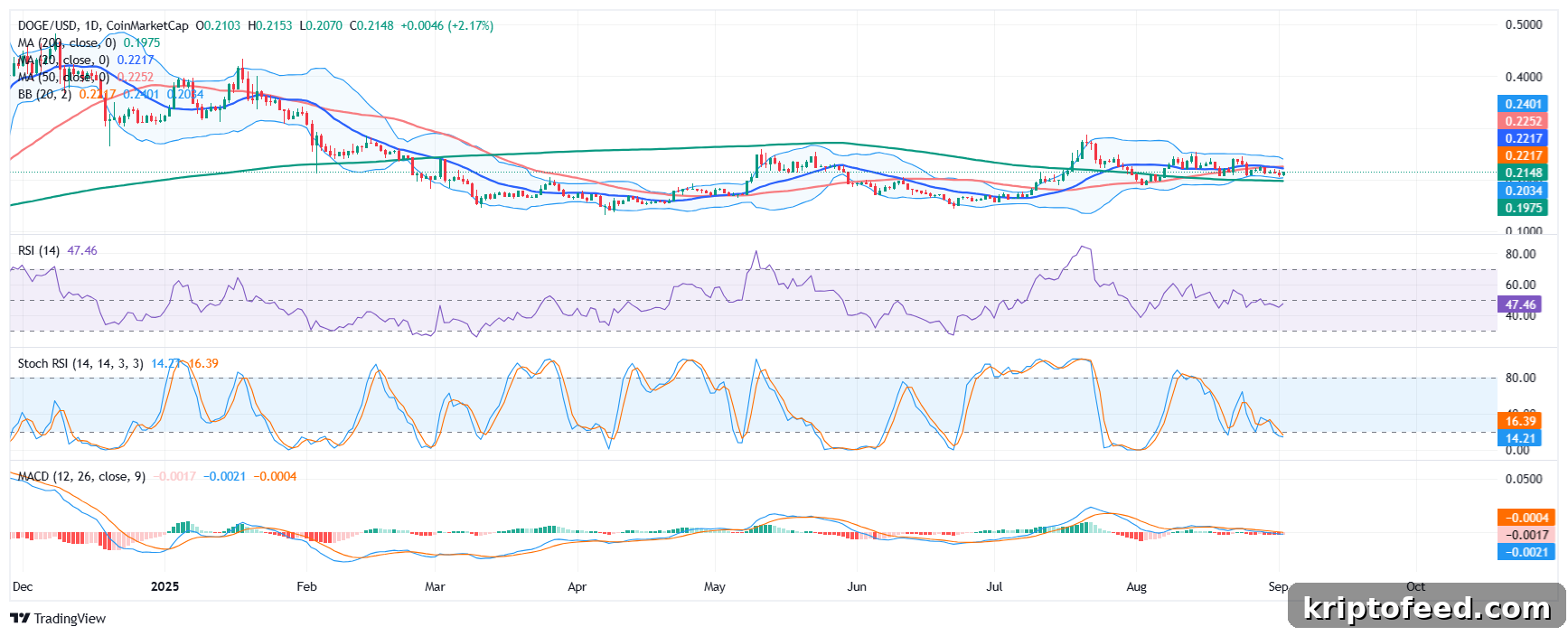
A decisive break above $0.226 would likely open the way to $0.238 and $0.249, while failure to defend the $0.211 zone risks a slide toward $0.188, the low from last summer.
In summary, the CleanCore–House of Doge treasury is a noteworthy institutional attempt to formalize Dogecoin’s financial footing, but the market’s subdued response suggests that structural credibility alone may be insufficient without renewed capital flows and active participation from large holders.