
- Short-term holders have triggered the correction by locking in gains.
- DOGE is trading at $0.234, below the key resistance at $0.245.
- If support at $0.198 fails, the price could test $0.220.
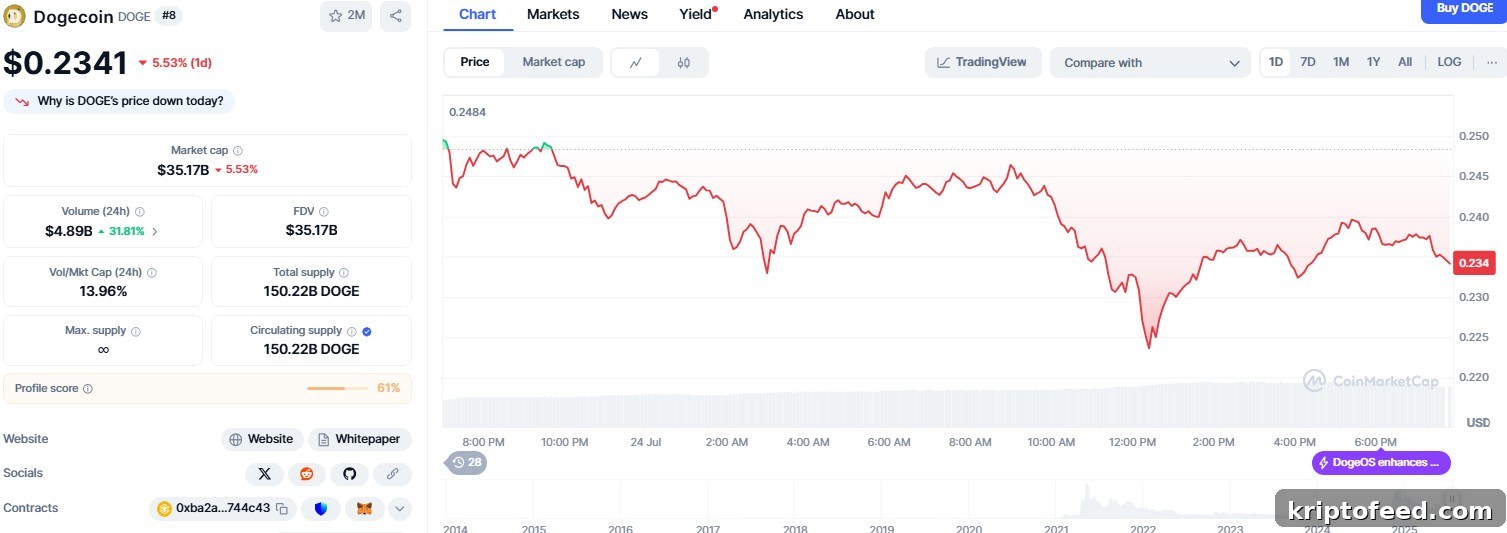
Dogecoin has slipped about 15% since reaching a six‑month high earlier this month, as a wave of profit-taking by short-term holders reversed the recent rally in the meme coin.
The pullback reflects a broader sell-off across the cryptocurrency market, with traders booking profits amid uncertain macroeconomic signals and resistance at key price levels.
At the time of writing, Dogecoin trades at $0.234, beneath the recent peak and under the critical resistance zone near $0.245.
This retracement marks a notable shift in market sentiment after a period of renewed optimism.
 Source: CoinMarketCap
Investor behavior signals short-term weakness
The realized profit and loss for Dogecoin surged this week to a six‑month high. This metric tracks the profits or losses investors record when they sell.
The sharp rise suggests a large number of holders are locking in gains, indicating waning confidence in further upside.
That wave of profit-taking has come mostly from short-term investors and has been a major contributor to DOGE’s recent decline.
The decision to secure gains at current levels has added downward pressure on the token, showing reluctance to hold through potential near-term volatility.
Traders are watching the $0.220 support level closely.
A break below that area could pave the way for a move toward the next lower support around $0.198 — a key zone seen in earlier trading cycles.
Long-term holders remain steady amid volatility
Despite short-term selling, Dogecoin’s longer-term outlook has not been entirely undermined.
One important indicator—long-term holder (LTH) activity—has continued to decline.
That trend shows LTHs are not moving their DOGE balances, implying they are not participating in the sell-off.
This reluctance to liquidate positions has historically provided stability for Dogecoin during periods of elevated market activity.
A falling liveliness metric can act as a buffer, slowing the pace of the current correction and possibly preventing a full-scale collapse in price.
Market analysts often view LTH behavior as a gauge of a token’s resilience.
Their present stance suggests that if supports hold and broader sentiment does not deteriorate further, Dogecoin may still retain upside potential.
Key resistance will likely determine the next move
DOGE’s short-term path may hinge on whether it can reclaim resistance at $0.245.
A decisive break above that level could invalidate the current bearish setup and open the door for a recovery toward $0.268.
Conversely, without fresh buying momentum and with continued profit-taking, losses could widen.
Should the $0.220 support fail, the market could quickly test the lower $0.198 support.
For now, Dogecoin’s next directional move will largely depend on whether long-term holders can provide sufficient support to offset selling pressure from short-term investors.