
- Strategy bought 1,550 BTC after a rare 32 BTC sale.
- Bitcoin is stabilising near $63K after a sharp 20% monthly drop.
- Analysts split on whether the $60K support will hold or break lower.
Bitcoin has entered a turbulent period highlighted by heavy liquidations, uneven recovery attempts and mixed signals from technical indicators and institutional activity. Recent weeks have seen abrupt price swings, periods of deleveraging and renewed interest from a major corporate holder.
The most notable development is Strategy’s reported acquisition of 1,550 BTC — roughly $101.3 million at the disclosed average price — which came shortly after a much smaller, one-off sale of 32 BTC earlier in the month.
Strategy resumes accumulation after a brief Bitcoin sale
Per a June 8 SEC filing, Strategy purchased 1,550 BTC at an average price of $65,332 per coin. The purchase follows a short-term sale of 32 BTC that generated about $2.5 million and was used to cover corporate obligations, including preferred-share dividend commitments.
That small sale stood out because it represented a rare departure from the company’s broader accumulation program. Yet the subsequent, far larger buyback indicates the company quickly returned to accumulating Bitcoin, bringing its reported holdings to roughly 845,000 BTC.
The juxtaposition of a minor sale to meet liabilities and a significant repurchase has shaped market narrative: traders view Strategy’s return to buying as an attempt to shore up confidence while the market digests the recent drawdown. As the largest corporate holder of Bitcoin, the company’s moves carry outsized influence on sentiment during periods of volatility.
Bitcoin stabilises after liquidation-driven crash, but trend uncertain
Bitcoin is trading in the low $60,000s after a volatile stretch that pushed prices briefly below $60,000. Over the past seven days the coin has dropped roughly 10.9%, and the 30-day decline is near 20.8%. However, the selling pressure was accompanied by significant deleveraging rather than clear new directional conviction from spot traders.
Open interest in Bitcoin futures has contracted materially, falling from about 901,000 BTC to approximately 716,000 BTC, a move that signals broad liquidation of leveraged positions. In one swing, over $500 million in shorts were liquidated as the market bounced, underscoring the role of forced exits in recent volatility.
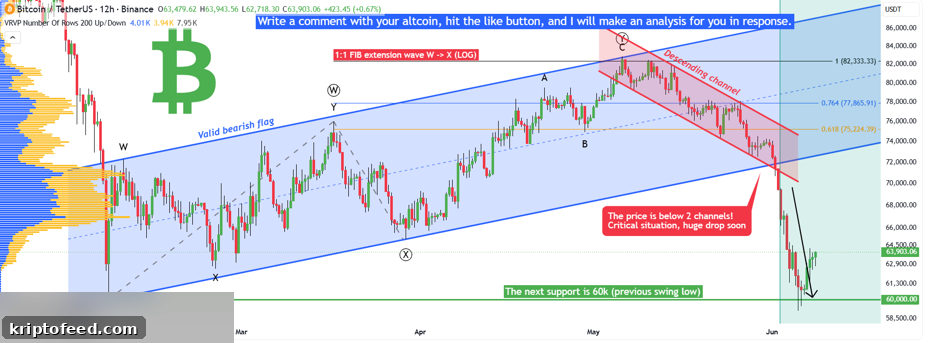
Technically, analysts remain cautious. Several commentators have pointed out that price action has broken key ascending and descending channel structures — patterns that often precede continued downside rather than an immediate, sustained recovery. Despite that, the market is hovering around the $60,000 area, which coincides with Bitcoin’s long-term 200-week moving average and has historically acted as a pivotal zone during major market resets.
Analysts split on whether the correction is over
Market views are divided between two primary narratives. One argues the recent moves amount to a late-stage capitulation: forced liquidations and a substantial drop in leverage could clear weak hands, setting the stage for a more sustainable recovery. Proponents of this view point to falling volatility and the dominant role of liquidation-driven selling rather than a collapse in spot demand.
Countering that, other analysts highlight the technical breakdowns and warn the correction may not be finished. If the $60,000 region fails to hold as support, Bitcoin could revisit lower levels. Near-term downside targets cited by cautious traders include $54,000 and $52,000, with deeper weakness toward the $48,000 area possible if macro headwinds intensify or if ETF flows turn unfavorable.
In short, Bitcoin’s immediate path remains uncertain. Institutional activity like Strategy’s large purchase adds a stabilising element, but the market’s technical structure and reduced leverage leave room for both a continued recovery and the risk of further downside. Traders and investors will be watching the $60,000 zone and related technical indicators closely as the market seeks a clearer direction.