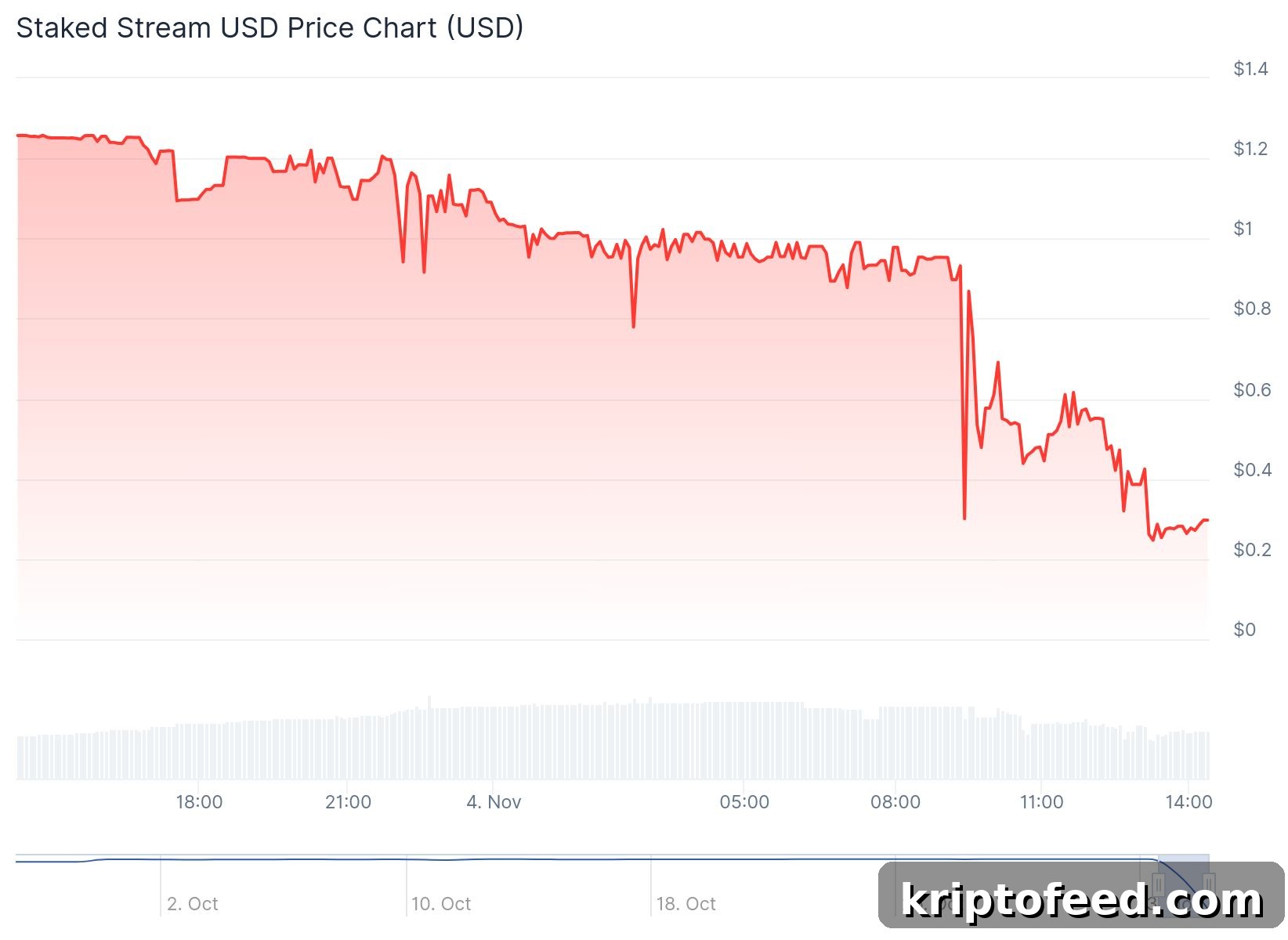
- Its stablecoin, Staked Stream USD (XUSD), fell to $0.2975, according to CoinGecko data.
- The depegging followed a $100 million exploit on Balancer, an automated market maker.
- Stream Finance also faced questions about TVL discrepancies with DefiLlama’s data.
Stream Finance, a decentralized finance (DeFi) platform focused on yield-generating strategies, paused all deposits and withdrawals after an external fund manager reported a $93 million loss in assets under management.
The incident has sparked scrutiny across the DeFi ecosystem, raising concerns about risk exposure and transparency among platforms that offer high yields through complex strategies.
The Stream Finance team confirmed the loss in a Monday post on X, saying the fund manager disclosed the loss the previous day.
Since then, the project has retained Perkins Coie to conduct an independent investigation into the matter.
Withdrawals suspended as Stream moves to recover assets
Stream Finance says it is currently liquidating all available liquid assets and expects the process to be completed shortly.
The team said periodic updates will be provided as more information becomes available.
While the investigation is ongoing, the platform suspended withdrawals and stopped processing any pending deposits, effectively freezing user funds until the situation is clarified.
In a statement on X, Stream Finance wrote: “We are actively withdrawing all liquid assets and expect this process to be completed in the near term.”
The platform said users will be kept informed through regular updates.
Stream stablecoin XUSD loses its peg
Stream Finance operates a yield-focused “recursive loop” protocol and issues a collateralized stablecoin called Staked Stream USD (XUSD).
Even before the team’s public announcement, XUSD began decoupling from its $1 target, signaling growing concern among users.
On Sunday, community members noted that deposits and withdrawals were halted without prior communication from the team.
As speculation intensified, XUSD fell below its intended range, dipping as low as $0.51, according to CoinGecko.
At the time of writing, XUSD is valued at $0.2975, down 76.4% over the past 24 hours — one of the steepest single-day drops among stablecoins this year.
 Source: CoinGecko
Omer Goldberg, founder of Labs, posted on X about 10 hours before Stream Finance’s official statement that XUSD had begun trading “well below its target range.”
Goldberg linked the move to an exploit of more than $100 million on Balancer, an automated market maker.
The timing between the Balancer exploit and the reported loss at Stream Finance led market observers to draw parallels between liquidity management gaps and the risk of asset exposure across DeFi platforms.
TVL discrepancies raise transparency concerns
On Friday, before the loss was disclosed, Stream Finance responded to community concerns about discrepancies between the total value locked (TVL) shown on its website and the figures reported by DefiLlama.
Stream Finance explained on X that DefiLlama excluded the recursive loop from its TVL calculations, stating: “DefiLlama decided that the recursive loop is not TVL according to their definitions.
We disagree with that, but to be transparent to users, the site now distinguishes between user deposits (~$160M) and total assets deployed across various strategies (~$520M).”
The clarification highlighted how differences in data methodology can create uncertainty when assessing a DeFi protocol’s exposure.
Analysts noted that inconsistent reporting standards across DeFi platforms can obscure the true level of leverage in yield-generation models.
Minal Thurkal, head of DeFi ecosystem growth at CoinDCX, commented that the case underscores “the critical importance of understanding exactly how protocols generate yield and the material risks associated with complex DeFi strategies.”
She added that projects deviating from established metrics, such as DefiLlama’s TVL calculations, can increase transparency challenges for both users and investors.
Broader DeFi implications
The Stream Finance incident arrives amid growing regulatory attention on DeFi protocols and stablecoin risk management.
Depegging events like the recent XUSD collapse often undermine market confidence and trigger liquidity withdrawals from decentralized platforms.
As DeFi matures beyond early adopters, incidents like this underscore the fragility of complex yield structures and the urgent need for standardized transparency frameworks.
With Stream Finance’s investigation ongoing, the wider ecosystem will closely watch how the project manages asset recovery and compensation for affected users.