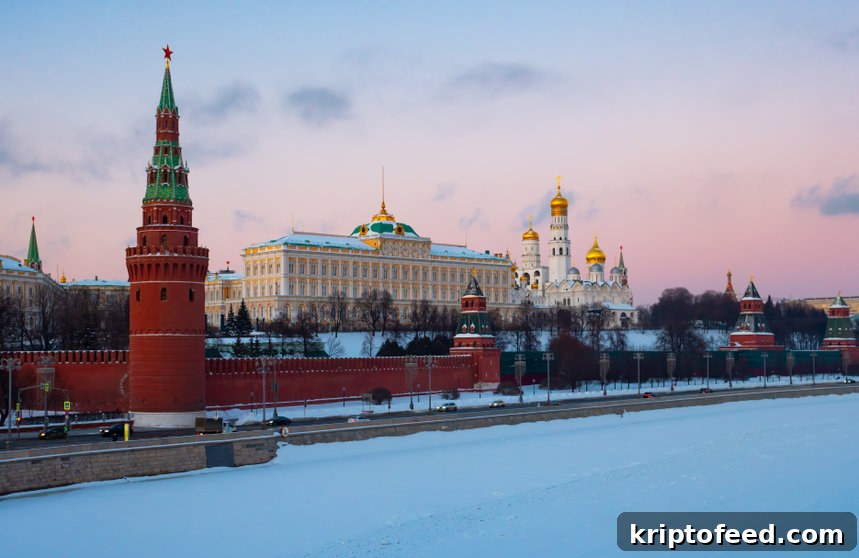
After waiting for a turning point for some time, events finally unfolded: earlier this week, Russia launched a major invasion of neighboring Ukraine following months of rising tensions. Crypto markets reacted sharply, pushing Bitcoin (BTC) prices lower as investors anticipated strong sanctions from the West. Experts warn that Russia may increasingly rely on cryptocurrencies to evade those sanctions.
Russia and Sanctions
With an unprovoked invasion of Ukraine, it is almost certain that Russia will become the target of sweeping Western sanctions. These measures aim to isolate Russia from much of the global economy, with the financial sector expected to take the heaviest toll.
The European Union, the United Kingdom and the United States have already announced initial rounds of sanctions designed to go further than the restrictions applied after Russia’s 2014 annexation of Crimea. Despite the expanding measures, President Vladimir Putin has appeared undeterred, and the Russian government so far shows only limited public concern.
“Russia has had plenty of time to consider the consequences. It would be naive to assume they did not plan for this scenario,” one observer noted.
Legalizing Crypto
On the Monday before the invasion, Russia’s Ministry of Finance submitted draft legislation regulating digital currencies—just days prior to the military action in Ukraine.
The proposed law keeps a ban on using cryptocurrencies to pay for goods and services, sets limits on how many rubles citizens may invest in crypto, and restricts cryptocurrency mining.
Russia’s crypto market was valued at over $200 billion in early February, roughly 12 percent of the global market, according to government statements. Officials stated that around five billion crypto transactions occur domestically each year, and that across a population of 144 million, Russians hold approximately $26.5 billion in crypto assets.
On January 20, the Central Bank of Russia called for an outright ban on cryptocurrencies in the country, but no such ban has yet been enacted. President Putin has also participated in the debate, acknowledging investment risks while arguing that the central bank should not block technological progress. Finance Minister Anton Siluanov said the new law could come into force by the end of 2022.
Crypto in Russia
Russia’s interest in digital assets is tied to the country’s desire to shield itself from Western sanctions. A growing body of evidence suggests that cryptocurrencies and related digital assets provide tools that could blunt the impact of financial penalties, a point highlighted by international reporting.
“When the U.S. barred Americans from dealing with Russian banks, oil and gas developers and other firms after the 2014 invasion of Crimea, the economic effects on Russia were swift and severe,” one analysis noted. “Economists estimated that those sanctions cost Russia about $50 billion per year. Since then, global markets for Bitcoin and other digital assets have exploded, complicating sanctions enforcement and offering Russia plausible alternatives.”
Experts say it is inevitable that some sanctions pressure will be absorbed through increased use of Bitcoin and other cryptocurrencies, given their borderless nature. That accessibility could enable Russia to mitigate the full force of Western restrictions.
CryptoRuble
One option under active consideration is a national digital currency often referred to as the “CryptoRuble.” Putin advisor Sergei Glazyev has argued that introducing a state-backed digital ruble could help Russia sidestep Western sanctions.
In practice, such a currency would be a digital version of the ruble, not a truly decentralized cryptocurrency. The government would likely prefer a non-mineable digital currency that it can closely monitor and control.
Previously, Deputy Finance Minister Alexey Moisseev and Central Bank Deputy Governor Olga Skorobogatava expressed reluctance about creating a state digital currency. However, given current geopolitical pressures, official positions could change rapidly and pave the way for accelerated development of a CryptoRuble.
Plans Dating Back to 2015
Discussion of a state digital currency in Russia is not new. The idea resurfaced in 2015 when payment provider Qiwi criticized proposals for a Russian digital currency—at the time referred to as “BitRuble.”
Russia established a working group to examine potential risks and determine what regulatory framework would be necessary should a digital ruble move forward.
While past reporting sometimes framed cryptocurrencies as potentially banned, today’s approach appears to favor strict regulation rather than outright prohibition. The shift reflects a broader effort to control digital currencies domestically while exploring their potential use in a sanctions-prone environment.