Not long ago, a wave of contagion swept so violently through the cryptocurrency industry that it felt like nowhere was safe.
Just like Terra, a former top-10 coin that collapsed, many companies were caught in the fallout. Among them were the so-called crypto lenders, some of which presented themselves as banks but were in reality closer to aggressive hedge funds.
BlockFi ran into major trouble. Voyager Digital filed for bankruptcy, its stock price plunging 99.8% so far this year. Celsius became perhaps the most high-profile case, freezing withdrawals one night and later filing for bankruptcy amid allegations that the founders had cashed out first.
The takeaway is simple: if you don’t want to take on risks you can’t quantify, chasing yield through these platforms is not the solution. One constant truth in crypto is that cold storage is the safest option. As the oft-repeated (and accurate) saying goes, “not your keys, not your coins.”
CoolWallet
I tested the CoolWallet Pro, the latest hardware wallet I reviewed.
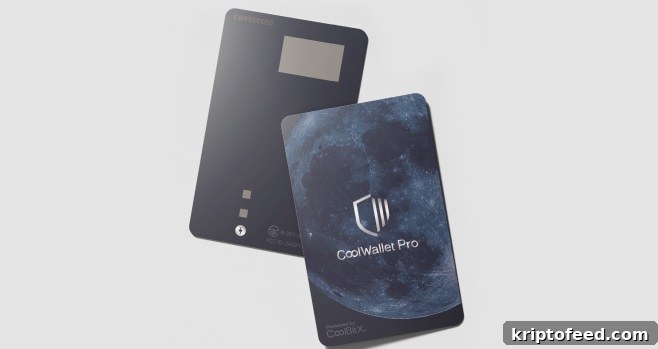
The first thing that struck me was its somewhat old-school design. It looks like a late-90s credit card. It may not win any beauty contests, but it’s portable, lightweight, and easy to hide in a secure place. Compared with many of the bulkier wallets with screens on the market today, I like it.
The card comes with a physical button, though it’s very subtle and easy to miss unless you’re looking for it — practically flush with the card. It’s the only button on the device, and once paired with your phone via Bluetooth (a surprisingly smooth process), all prompts and guidance are handled inside the app. It’s straightforward.
The card also has a tiny display, roughly 2 cm wide and 1 cm tall, which shows basic numbers to the user. It isn’t the most high-tech screen — I felt like I was typing messages on a classroom calculator in elementary school — but it gets the job done.
Setup
I paired the device and followed the app’s instructions. As expected, the first step is creating the recovery seed. This process is always a little tedious. I received 12 groups of five-digit numbers and recorded each on paper, pressing the card’s button to move to the next number every time.
The seed setup can be a bit nightmarish, though that’s more a reflection of the recovery seed process in general than a criticism of this specific wallet. We’ll likely see better UX over time, but for now, this remains the most secure option. With the CoolWallet, the process takes about two minutes, so my complaints are minor.
Overall, the setup is very simple. The small screen can be a little squinty to read, but it’s manageable. My main hardware criticism is the charger: it uses micro-USB, something I thought would be a relic by now and consigned to a drawer with old DVDs, tapes, and wired earbuds.
The wallet does include a cable, which is convenient and allows direct USB charging. Personally, I don’t like keeping an extra cable just for one device — all my other devices (laptop, phone, speaker, headphones) use USB-C, including the hardware wallets I currently use. For some, that could be a dealbreaker. If you’re the type who keeps dedicated cables for each device (Apple fans, for example), this may be less of an issue.
Connectivity and Features
Once set up, the CoolWallet impresses. The app offers a clean, intuitive interface and a smooth experience. Core functions like sending and receiving crypto are easy — and, ultimately, that’s what matters most.
Staking options are available and will appeal to many users. The wallet supports a broad range of tokens, including ERC-20 and BEP-20, among others. Bluetooth pairing is simple. After initial configuration, it’s as easy to use as any hardware wallet.
Its connectivity to external platforms stands out. I could connect to OpenSea to manage NFTs, send ETH to Lido, or integrate with MetaMask and Binance DEX. The list of supported services is extensive. The breadth of features and connectivity options here is as comprehensive as you could reasonably expect — truly impressive.
Price matters too. The CoolWallet Pro sells for $149, which aligns with most wallets on the market. That price seems fair given the emphasis on features and connectivity rather than flashy hardware — after all, there’s no large screen and the design is intentionally understated. For a device you’ll store away, those trade-offs seem reasonable.
Conclusion
People prioritize different things in a hardware wallet. Security is paramount, and most reputable wallets handle that well — CoolWallet Pro is no exception. The next considerations are token support and features, and this wallet excels in that area with a wide range of options and strong platform integrations.
Ease of use is also important, and once set up, the CoolWallet is about as simple as they come. Portability and discretion matter to me: its credit-card form factor means it fits easily in my wallet or a hidden spot at home. Other wallets I’ve used can be bulkier, with larger screens or a more technical appearance.
That inconspicuous look works in its favor. If a thief broke into my house, they’d be unlikely to spot this card unless they knew what to look for. In short, the CoolWallet strikes a strong balance between practicality and capability.
Despite the micro-USB charger being a minor drawback — and I’m admittedly biased toward devices that use a single cable standard — this is a solid option for cold storage. If you’re looking to move into offline storage, the CoolWallet Pro is an excellent hardware wallet with advanced features and broad connectivity.