-
Chainlink joins GAKS to support KRW stablecoin standards and adoption.
-
LINK price shows a modest recovery on the back of the partnership and whale accumulation.
-
Technically oversold conditions could trigger a short-term price rebound for LINK.
Chainlink Labs has officially joined the Global Alliance for KRW Stablecoins (GAKS), a key initiative led by South Korean blockchain and gaming firm WEMADE.
Chainlink Labs has joined the Global Alliance for KRW Stablecoins (GAKS) led by WEMADE, a 600M+ user platform.https://t.co/PdTxmFvSbj
The alliance is advancing stablecoin standards in Korea by leveraging Chainlink’s data, interoperability, compliance, & privacy standards. pic.twitter.com/QPTuTH4mEo
— Chainlink (@chainlink) January 27, 2026
Launched in November 2025, the alliance aims to accelerate adoption and standardization of Korean won–pegged stablecoins.
Its objective is to ensure KRW stablecoins meet both local regulatory requirements and international technical standards.
GAKS brings together a diverse membership, including security firms, fintech companies and blockchain infrastructure developers.
Adding Chainlink Labs gives the alliance access to a major oracle network, enhancing its technical capabilities and trustworthiness.
Chainlink’s role in shaping KRW stablecoin standards
Chainlink’s participation in GAKS positions the company as a central contributor to the development of global technical standards for KRW stablecoins.
By leveraging its oracle technology, Chainlink connects blockchain networks with real-world data to ensure KRW-backed digital assets are transparent, reliable and compliant.
The alliance benefits from Chainlink’s expertise in data integrity and verifiable real-time information—features that are critical for institutional adoption.
With this technology, KRW stablecoins can be used confidently in tokenized asset projects and other digital finance applications, both domestically and internationally.
Chainlink’s inclusion also brings institutional credibility to GAKS. Its oracle solutions are already trusted by large global institutions such as UBS, Mastercard and Fidelity International, indicating that KRW stablecoins developed under this framework aim to meet high regulatory and security standards.
Supported by Chainlink, GAKS is now better positioned to drive real-world adoption of KRW stablecoins while maintaining transparency, trust and technical robustness—a model that could influence other regulated stablecoin ecosystems worldwide.
LINK price outlook as Chainlink joins GAKS
The announcement of Chainlink’s partnership with GAKS gave LINK a modest price boost, moving it up just over 1% in the past 24 hours—slightly outperforming the broader crypto market.
This uptick reflects a mix of fundamental, technical and market dynamics.
The strategic partnership ties LINK’s utility directly to South Korea’s regulated stablecoin sector, reinforcing its role as critical infrastructure for institutional finance and real-world asset tokenization.
By joining GAKS, Chainlink signals to investors that its technology is central to a compliant and growing market, which could support long-term demand for LINK.
On-chain metrics also point to significant accumulation by large holders who have moved LINK off exchanges, reducing immediate sell-side pressure.
That behavior suggests informed investors view current levels as an opportunity, creating a base for price stability and potential upside.
Technically, LINK approached oversold territory, with the RSI briefly dipping to 38.95 while price tested support between $11.38 and $11.92.
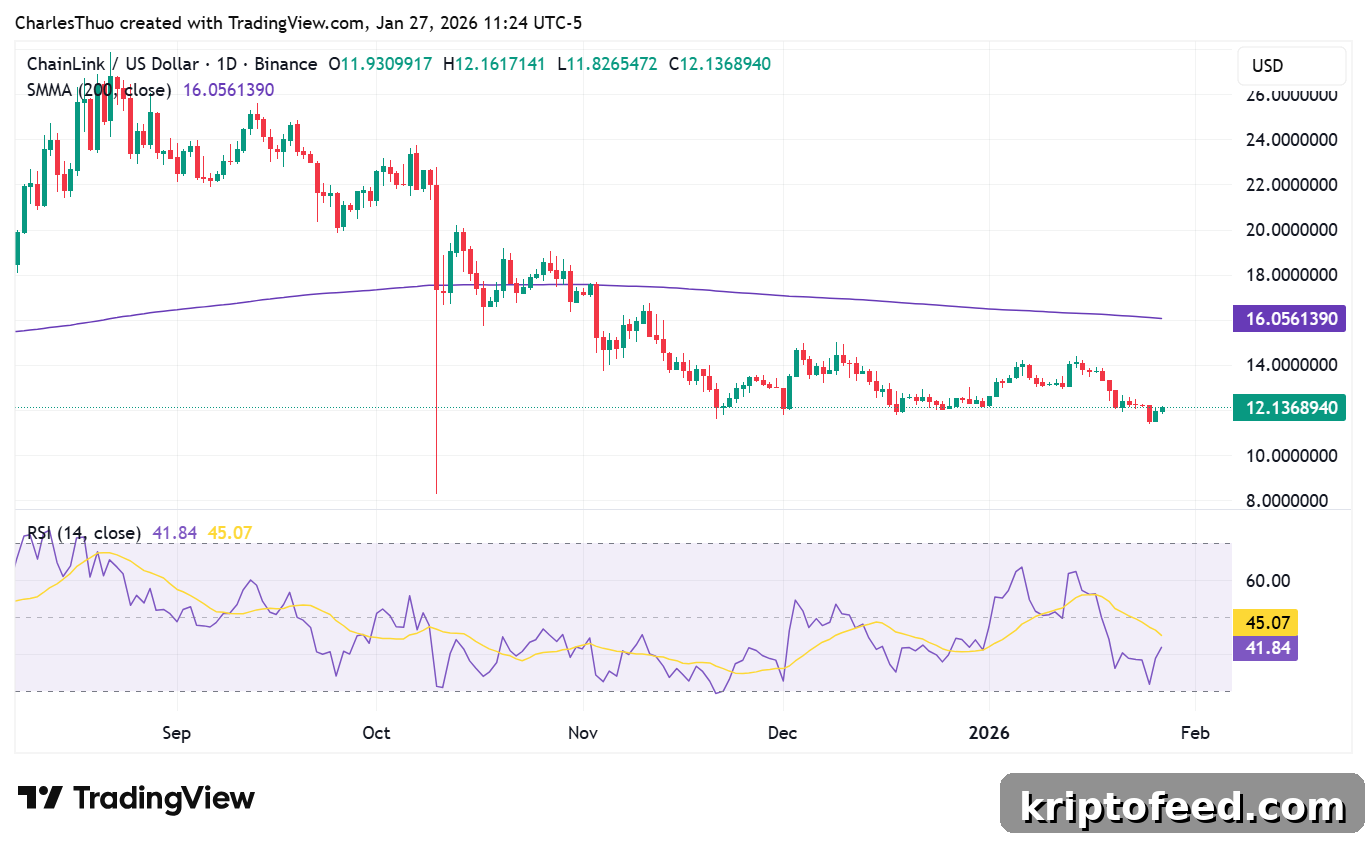
Oversold conditions often precede short-term rebounds, as seen now, but broader market indicators remain cautious with LINK trading below several major moving averages, including the 200-day SMA near $16.056.
A more meaningful reversal would likely require a break above $13.40 (the 7-day SMA).
Overall, while LINK may register short-term gains driven by the GAKS partnership and technical rebounds, the larger trend remains bearish.
Sustained upward momentum will depend on continued institutional adoption, further technical integrations or positive developments across the market.