
- Chainlink and Swift enable tokenized fund workflows through existing banking systems.
- UBS pilots a new Chainlink‑Swift integration, avoiding costly infrastructure upgrades.
- Global institutions can connect to crypto using trusted, proven rails.
Chainlink and Swift have deepened their collaboration with a new solution designed to let financial institutions manage tokenized fund workflows using their current infrastructure. By combining Swift’s global messaging network with the Chainlink Runtime Environment (CRE), the initiative enables subscription and redemption processes for tokenized assets without forcing firms to overhaul legacy systems.
The pilot involved UBS Tokenize, the tokenization arm of Swiss bank UBS, and builds on prior work such as Project Guardian with the Monetary Authority of Singapore. Together, the partners aim to demonstrate how blockchain can streamline traditional financial processes and help accelerate broader adoption of tokenized assets.
We’re excited to announce a landmark technical solution enabling financial institutions worldwide to manage digital asset workflows directly from their existing systems using Swift (@swiftcommunity) messaging and Chainlink in collaboration with @UBS.https://t.co/W1fq1guro4… pic.twitter.com/0uBUl2K4tk
— Chainlink (@chainlink) September 30, 2025
By linking Swift’s ISO 20022‑compliant message standards with Chainlink’s CRE and its Digital Transfer Agent (DTA) specification, the solution offers a plug‑and‑play approach to tokenization. Institutions can trigger smart contract events directly through Swift messages, reducing the need for separate identity or key management platforms and lowering implementation friction.
Chainlink co‑founder Sergey Nazarov commented on the milestone, highlighting the significance of combining Swift standards with UBS’s tokenized asset design. He emphasized how smart contracts and new technical standards can enable transfer agents and other entities to manage tokenized asset workflows on‑chain.
Market reaction has been optimistic as observers see a potential shift in how financial infrastructure interacts with blockchain. The UBS pilot showed that banks can integrate cryptocurrency capabilities into existing operations without steep learning curves, major platform launches, or disruptive system replacements.
These developments follow months of joint exploration. In 2024, UBS, Chainlink and Swift investigated tokenized fund mechanics through Project Guardian in Singapore. The latest experiment advances that work by demonstrating practical compatibility between blockchain technology and established financial systems.
Chainlink highlighted the practical benefit: with Swift messages and the Chainlink Runtime Environment, banks and institutions gain seamless access to blockchains through the same Swift infrastructure they have relied on for decades. This taps institutional familiarity while extending capabilities to manage digital assets.
Why this matters
Bridging blockchain and traditional finance has often felt like connecting two very different worlds. The Chainlink‑Swift model reframes that relationship by allowing banks to access crypto functionality via familiar systems instead of requiring them to adopt unfamiliar platforms.
The approach is straightforward yet impactful. If broadly adopted, it could mark the start of a new era in which blockchain becomes part of routine operations across the global financial system. For institutions seeking the security and programmability of blockchains, the integration offers more opportunities and fewer operational risks.
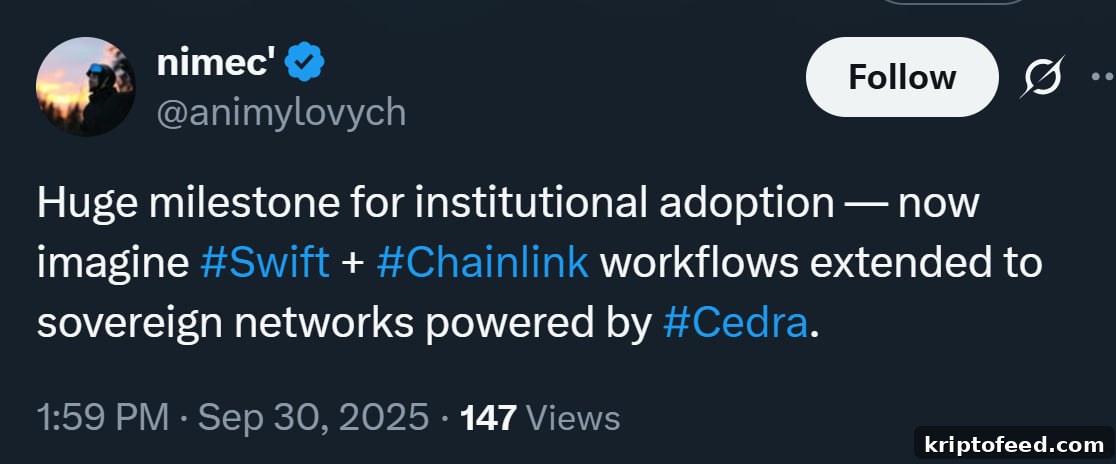
By enabling tokenized asset workflows to run on tested infrastructure, the solution lowers barriers to entry and reduces the operational complexity of adopting blockchain‑based services.
LINK price outlook
Chainlink’s native token, LINK, remained relatively steady amid the announcement, rising about 1% on the daily chart to roughly $21. A 35% increase in 24‑hour trading volume signaled renewed market activity, even as price action consolidated over the week.
Some analysts view the current consolidation as a setup for a potential breakout in October. Popular analyst commentary pointed to the $20 level as a key support for a possible rebound, with a hypothetical target near $47 if that support holds—an advance that would represent a substantial percentage gain versus current market levels.
If Chainlink $LINK defends $20 support, the next target could be $47. pic.twitter.com/GUTAuMdJyH
— Ali (@ali_charts) September 30, 2025
While price forecasts are speculative, the technical and institutional progress represented by the Chainlink‑Swift‑UBS collaboration may strengthen confidence in demand for blockchain infrastructure that integrates smoothly with existing financial operations.