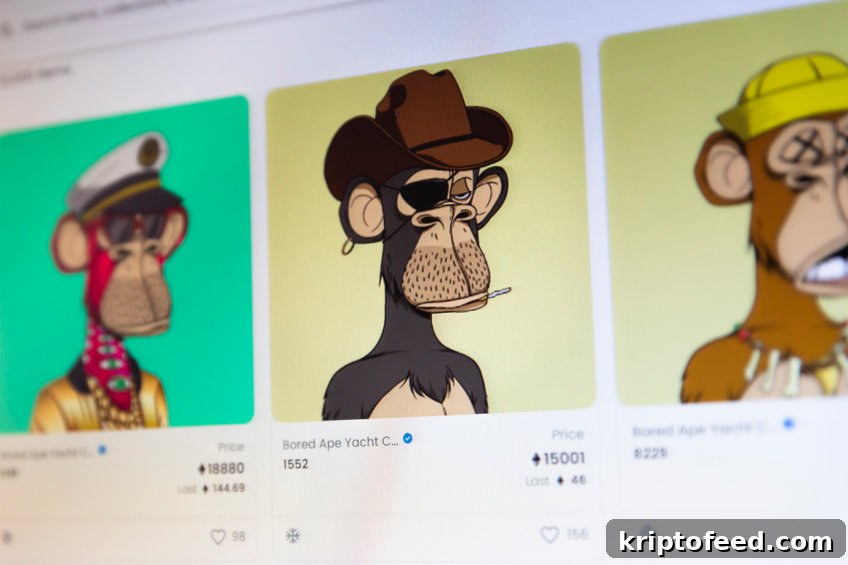
- The disastrous Otherside mint left many paying thousands of dollars in gas fees without receiving anything
- Yuga Labs refused to apologize, instead blaming Ethereum and saying they need their own blockchain to scale
- The entire episode highlights growing wealth centralization within NFTs, as average investors are increasingly priced out
- In many ways the Yuga ecosystem now feels like the opposite of what crypto was meant to be
What a circus this weekend was in the NFT world — and not the entertaining kind. Yuga Labs, the team behind Bored Ape Yacht Club, launched its long-anticipated Otherside mint on Saturday night, offering plots of land in its upcoming metaverse game. The company, valued at approximately $4 billion before the weekend, pulled in roughly $320 million from the mint.
But that headline number hides what happened for most individual investors. Due to enormous demand, Ethereum gas fees spiked into the four digits, leaving many buyers paying huge gas bills and still failing to secure the land they tried to mint.
Predictable problems
The worst part is it was all predictable. Yuga’s handling was flawed on multiple levels: they failed to optimize the smart contract, abandoned their originally planned Dutch auction with little transparency, and announced the mandatory ApeCoin requirement late. They also did not prevent mass minting by KYC’d wallets, and they allocated 15,000 deeds to certain investors in a way that lacked openness — a move that reduced supply and pushed gas prices even higher.
All of this culminated in an inevitable gas war that left many newcomers out of pocket by thousands of dollars. Yuga has said it will refund gas for failed transactions, but that does little for the thousands who were unable to purchase land and were then denied preference in any follow-up sales — a decision many in the community see as unfair.
Beyond the direct losses to retail buyers, the fallout drained liquidity from the NFT market. Traders dumped assets to amass the huge amounts of ETH required both to buy plots and to cover gas. The surge in activity even caused Etherscan outages, and Solana experienced disruption as validators struggled under bot pressure generated during the mint. Other NFT collections on both chains fell in price as holders liquidated to fund their ApeCoin purchases — purchases that, in many cases, did not result in land allocation.
Yuga fails to read the room
Yuga’s tone-deaf communications during the crisis were disappointing. After staying largely quiet as the situation unfolded, the company posted a tweet that blamed Ethereum for the outage and suggested ApeCoin will need to migrate to its own chain to scale properly — effectively proposing a centralized, BSC-style solution as the fix.
Anyone remotely familiar with crypto could have predicted the problems; the responsibility lies with Yuga for shipping an unoptimized contract and handling the sale poorly. Yet the proposed remedy — launching their own chain — would further centralize power. Consider what Yuga already controls: the largest NFT project on the planet with Bored Apes, the intellectual property to the second-biggest collection CryptoPunks, and a token with a reported market value in the billions. Now they want their own blockchain too?
Ethereum has its issues, and the community is working on scaling (including through upcoming upgrades). But Ethereum benefits from a large, diverse developer base and an active community. The question is: what has Yuga done for the broader ecosystem besides consolidating influence and resources?
Centralization of wealth
This episode underscores how exclusive the NFT space is becoming. Which average investor can afford to pay four-figure gas bills on top of the 305 ApeCoin required to mint a plot (roughly $7,000 that Saturday) just for the chance to join the Yuga club? Increasingly, this feels like playground for the extremely wealthy, where wealth consolidation accelerates by the day. That is the opposite of what many people find exciting about crypto — a more democratic, fair, and accessible financial infrastructure.
Many traders bought ApeCoin specifically to participate in the mint. ApeCoin had been airdropped to Bored Ape holders earlier, with over 10,000 tokens sent to each holder in March — worth a significant sum. Holding an Ape, whose floor price sits near hundreds of thousands of dollars, meant those holders were already well-positioned to take advantage of the mint. Tokenomics also looks concentrated: roughly 15% of ApeCoin’s supply is held by Yuga Labs, 14% to BAYC founders, 15% to early BAYC holders, and 8% to those involved with the DAO launch — together representing over half the supply.
The Otherside mint was supposed to offer a path for regular people to enter the ecosystem. Instead, most could not participate because of the gas war, many were further harmed when ApeCoin plunged roughly 40% after the mint, and the retail buyers who couldn’t convert their ApeCoin into land were left holding the losses.
Anti-crypto
Crypto was intended to be more equitable: an open, permissionless system providing new opportunities to many, not a privileged few. This weekend’s events felt like a betrayal of that promise. On social media, some Ape holders dismissed those who lost out as simply not resilient enough, while others celebrated paying massive gas fees as a point of pride. That attitude — “you should have had more money” — only reinforces the perception that NFTs are becoming a rich-persons’ club.
As an enthusiast who spends much time defending crypto to skeptics in traditional finance, watching this unfold was disheartening. It spotlights a recurring critique: crypto’s tendency toward wealth concentration. It was meant to empower underdogs and allow anyone to participate. Instead, events like the Otherside mint showcase the opposite trend.
Logging off
People may dismiss me as a disappointed outsider or a “normie” upset about missing out on a piece of the BAYC empire. To be honest, I don’t own any Yuga assets and, yes, I’m disappointed — not because I missed a speculative opportunity, but because I love crypto and its potential. What I saw from Yuga this weekend runs counter to what made me excited enough to leave my traditional finance job and pursue this space.
It would be nice to belong to the Bored Ape Yacht Club for financial reasons, but right now it feels like membership is reserved for the Bored Ape 1% Club. I may remain without those assets, but at least I’ll still enjoy being part of the space.