
- The trading platform halted contract transfers today due to a brief downtime.
- Binance has fully restored its trading services.
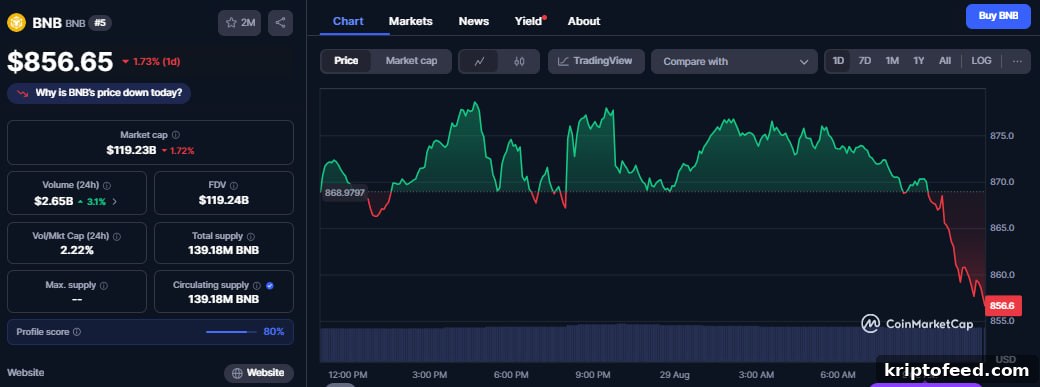
- BNB price momentum weakened following the interruption.
Binance, the world’s largest cryptocurrency exchange by trading volume, experienced a temporary disruption in its futures trading services early today. Between 14:18 and 14:36 UTC+8, users were unable to execute futures contracts while the platform’s team worked to restore service.
We’re aware of an issue affecting Futures UM trading on Binance.
All futures trading is temporarily unavailable. Our team is working to resolve this as soon as possible.
New updates will be shared here. Thank you for your patience.
— Binance (@binance) August 29, 2025
The interruption was short, but it served as a reminder of the risks associated with centralized exchanges: even brief outages can ripple through markets and affect trader positions.
Community reaction was swift. Some users criticized Binance and raised concerns over market manipulation, while others highlighted the benefits of decentralized alternatives and promoted DEX platforms in discussion threads.
Another day, another CEX outage. This is why decentralized futures markets like MuesliSwap on Cardano hit different. No single point of failure, no downtime, just market action 24/7.
During the pause, Binance’s native token, BNB, lost momentum. The token fell from intraday highs around $876 to roughly $856 within minutes after the outage was reported.
The quick restoration
Within about an hour the exchange confirmed services were back to normal and futures trading resumed. The rapid resolution likely helped alleviate some immediate concerns about platform reliability.
Despite the fast fix, users remained unhappy about potential losses incurred during the outage. Many asked how Binance planned to address trades that were impacted by the interruption and whether affected users would receive compensation.
And may I ask who covers the loss I just made because of your systems server issues???? What sort of chart is this? Absolute disgrace, there should be reimbursement for the loss occurred at the fault of such an unreliable platform! pic.twitter.com/AqN0LGLp6i
— PoWeRpLaY (@PoWeR2906) August 29, 2025
The incident demonstrated how even a 20-minute outage can mean the difference between profit and loss for traders operating at high speed in derivatives markets.
What it means for traders
Binance’s temporary suspension of futures trading had immediate consequences for traders. Many reported being unable to enter or exit positions, leading to missed opportunities and, for some, realized losses.
Events like this underscore the importance of risk management: diversifying trading across multiple platforms, using position sizing, and setting automated stop orders can all reduce exposure to a single platform outage.
Some traders may now rethink how they allocate assets across centralized exchanges (CEXs) and decentralized exchanges (DEXs), assessing tradeoffs between liquidity, speed and operational risk.
Opinion in the industry is divided: while centralized venues provide deep liquidity and fast execution, outages highlight a single point of failure that can hurt users. As a result, discussions about decentralized alternatives and backup strategies have resurfaced.
BNB price impact
BNB had been performing strongly in recent months, contributing to gains across the altcoin market. Still, the outage interrupted its intraday rally and coincided with a dip in price.
BNB fell from around $876 to roughly $856 as market participants reacted to the temporary suspension of futures trading. Although the token has enjoyed significant appreciation over the past year, its price remains closely linked to Binance’s operational health and user activity.
Incidents like this can erode user confidence and, if repeated, could prompt withdrawals or reduced platform usage—factors that would negatively affect BNB’s growth prospects. Conversely, the team’s ability to restore service quickly can help limit long-term damage if such outages remain rare.
For traders, the event is a reminder to maintain disciplined risk controls, diversify across venues, and stay informed about platform status notices that may affect active positions.