
Blockchain technology is steadily entering mainstream conversation. As you browse the web, you’re increasingly likely to encounter articles about this emerging field. Like any technical domain, blockchain brings its own vocabulary. The following definitions will help you navigate the basics.
Blockchain
Bitcoin has captured widespread attention since 2017. Launched by the pseudonymous Satoshi Nakamoto in 2009, Bitcoin is the first and most prominent cryptocurrency to date. Many people may not realize that Bitcoin runs on blockchain technology.

At its core, a blockchain is a form of distributed ledger. Think of a ledger used to record sales in a small shop, but duplicated across many computers around the world. Each participating computer keeps a copy of the ledger, and new transactions are validated by comparing those copies. A defining characteristic of blockchain is immutability: records entered into a block cannot be altered.
Because entries are appended in chronological order and cannot be changed after the fact, a blockchain functions as an append-only ledger. This makes its transaction history transparent and auditable—especially in public blockchains. While blockchain is commonly associated with digital currency, virtually any type of digital file, including images or documents, can be encoded and preserved on a blockchain. Once recorded, a transaction or file’s authenticity can be verified by the network and cannot be deleted or tampered with.
Block
A block is a data structure that contains one or more transactions. Once a block is completed, it is added to the blockchain as a permanent record and a new block is created. Each block is cryptographically linked to the previous one, forming a chain—hence the term “blockchain.”
Distributed Ledger
The phrase “distributed ledger” is often used interchangeably with blockchain. While the terms overlap, they are not identical.
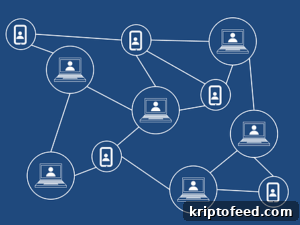
Put simply, blockchain is one type of distributed ledger. A distributed ledger is a database that is replicated across multiple locations. Traditional databases are usually centralized and controlled from a single point. In contrast, a distributed ledger is stored across many computers and is not controlled by any single authority. This decentralization has attracted attention because it enables systems that are resistant to censorship and more difficult to attack: to compromise the network, an attacker would need to take down many independent nodes simultaneously.
The foundational technology behind many distributed ledgers is blockchain, but distributed ledgers can also take other technical forms depending on design and requirements.
Mining
Long before Bitcoin, researchers experimented with digital currencies. A persistent challenge for digital money has been the double-spend problem—digital data can be copied, creating the risk that a token could be spent more than once.
Bitcoin and many other cryptocurrencies address double spending by recording every transaction in a public log. New transactions are confirmed through a process called mining. Mining refers to the work involved in validating and adding new transactions to the blockchain. This process prevents users from spending the same tokens multiple times.
Participants who perform mining are called miners. They run algorithms on computers to validate transactions and are typically rewarded with newly issued coins for their efforts. Mining can be computationally intensive: for Bitcoin, specialized hardware is commonly used, while some other cryptocurrencies can still be mined with ordinary personal computers. Because of the high energy requirements—especially for Bitcoin—mining has raised environmental and regulatory concerns.
Some countries have restricted or banned mining due to its energy consumption. Estimates have suggested that Bitcoin’s total energy use could rival that of some small nations, creating competitive advantage for miners in regions with cheap electricity. Out of the 21 million bitcoins that will ever exist, roughly 17 million have already been mined, leaving about 4 million still to be created—an incentive that continues to drive mining competition.
Node
A node is any computer that holds a copy of the ledger and participates in the network. Reliable nodes are essential for the network’s operation: they verify, validate, and broadcast transactions. The greater the number of nodes, the more resilient and secure the network becomes.

Nodes are typically selected or used in ways that preserve network integrity. Not all nodes store the entire blockchain; nodes that do are known as full nodes. Full nodes are critical because they enforce the core consensus rules and independently verify transactions and blocks.
Public and Private Blockchains
Blockchains can be public or private. Public blockchains, such as Bitcoin, allow virtually anyone to participate in validating transactions and running nodes. These permissionless networks are open and decentralized by design.
Private or permissioned blockchains restrict participation to a defined set of authorized parties. Networks like Ripple operate with more centralized control and limited validators. Some critics argue that private blockchains compromise the decentralization benefits of the technology because access is restricted and influence can be concentrated among a few entities. Nevertheless, private blockchains are being adopted by enterprises that want to leverage aspects of blockchain—such as secure audit trails and controlled access—while maintaining governance and privacy suited to business needs.