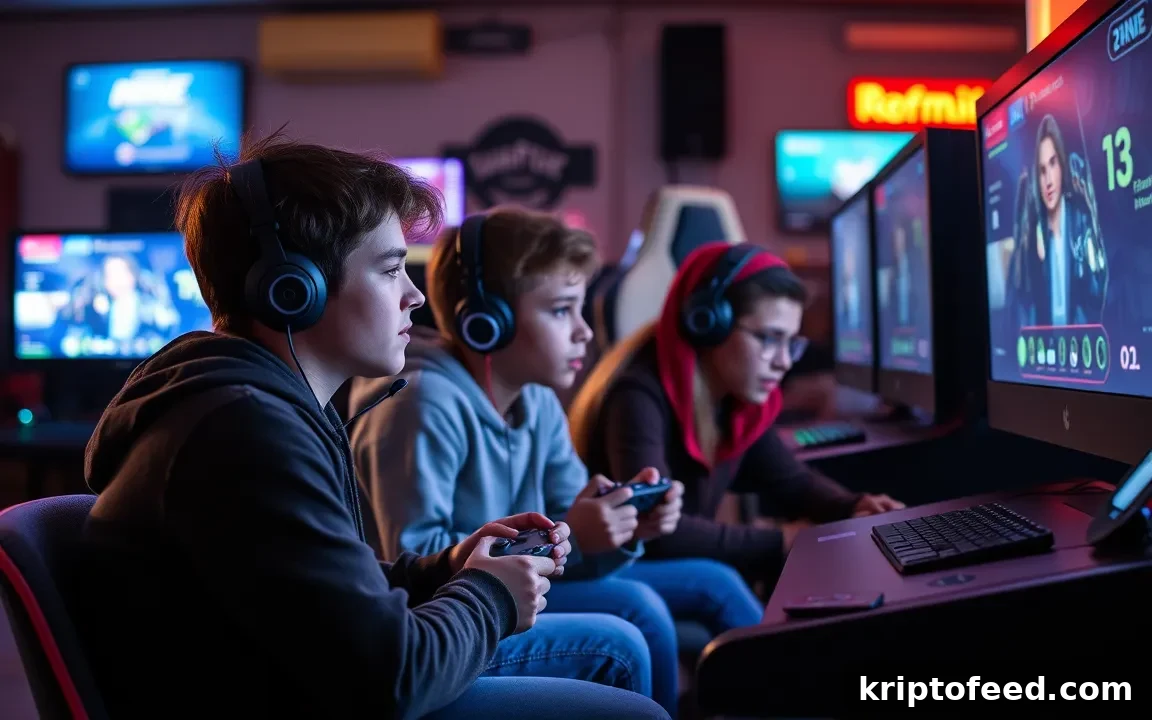
- Block3 aims to be a disruptive force in the $500 billion gaming sector.
- The presale for the project’s native token, BL3, goes live in four days.
- The token offers investors an entry point into the intersection of AI and gaming.
The gaming industry may be on the verge of a major transformation.
As traditional studios struggle with layoffs and declining revenues, newcomer Block3 positions itself as a disruptive force in a market valued at roughly $500 billion.
Where conventional studios typically work on multi-year schedules and budgets ranging from $50 million to $200 million, Block3 aims to compress development timelines and drastically reduce costs.
The platform leverages AI trained on player behavior to generate and refine game content in real time, using reinforcement learning and community prompts to iterate and improve experiences.
At the core of Block3’s technology stack is Trinity, its proprietary AI engine.
Trinity functions similarly to commercial large language models like ChatGPT or Claude—but instead of producing text or images, it generates entire game worlds.
Users provide a text prompt, and Trinity responds with a fully formed game, complete with non-player characters, narratives, combat systems, and interactive mechanics.
Described as a Large World Model (LWM), Trinity operates on principles akin to large language models but is trained on game-specific datasets rather than literature or generic web text.
Plans to change the market
Block3 presents itself as a next-generation platform that makes game creation accessible to users without technical expertise.
By integrating generative AI with blockchain infrastructure, the platform enables creation of open-world video games from simple text prompts, shrinking development time from years to seconds.
The BL3 token is central to the ecosystem, powering creation fees, in-game asset trading, and revenue sharing across the platform.
BL3 also represents a financial entry point into the convergence of artificial intelligence and gaming, a sector analysts expect to grow substantially by the end of the decade.
While legacy studios rely on large budgets and extended schedules, Block3 offers a leaner production model designed to accelerate output and lower barriers to entry.
As AI continues to reshape creative industries, Block3 positions itself as an on-ramp to the foundational layers of game development and monetization.
With a tokenized structure and an emphasis on community participation, the platform aims to redefine how gaming content is created, distributed, and experienced.
The BL3 token
The native BL3 token from Block3 is scheduled to enter presale on Tuesday, July 1.
The token is marketed as a liquid, scalable gateway into the AI-and-gaming intersection—an industry projected to reach roughly $665 billion by the end of the decade.
For retail participants, BL3 provides early access to upstream layers of game creation, monetization, and distribution through a tokenized framework.
Block3’s ecosystem is designed to generate value across multiple channels, including creation fees, licensing royalties, and marketplace activity within games.
These revenue streams are consolidated through the BL3 token, which is intended to function as a broad-based instrument tied to the growth of AI-generated gaming—similar in concept to an index exposure within the entertainment sector.
Beyond enabling rapid game creation, the Block3 platform also contributes to AI development.
Each user-created game feeds back into the system as training data, forming a continuous loop where in-game interactions improve the model and deliver increasingly refined player experiences.
This feedback loop positions Block3 not only as a tool for accessible game creation but also as a potential large-scale contributor to AI training.